
Jack Black’s vocal range spans roughly from the low baritone register up into powerful high tenor territory, covering about three octaves in performance. While he’s known for comedy, his singing shows strong breath support, controlled belting, and surprising upper extension for a rock-focused male voice.
He’s not just shouting high notes for effect. Many of his performances demonstrate legitimate pitch control, dynamic contrast, and stamina. Let’s break down what that actually means for singers.
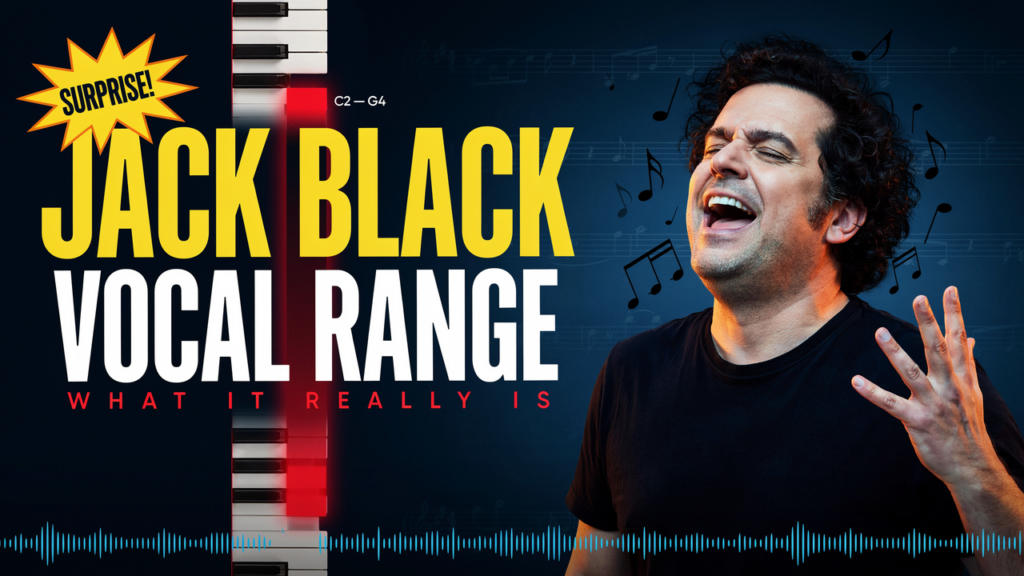
Lowest and Highest Notes
When analyzing any singer, we separate sustained, musical notes from one-off yells or sound effects. The notes that count are controlled and repeatable.
Jack Black’s lower register sits comfortably in baritone territory. His upper range extends into high rock tenor notes, often delivered with a belt-dominant mix rather than pure head voice.
What This Means Musically
Most male singers fall somewhere between two and three octaves in usable range. If you’re unsure where you sit, you can compare yourself with this male vocal range chart.
Range alone doesn’t determine quality. A singer’s tessitura — the notes they sing most comfortably — matters more than extreme highs or lows. If you’re unfamiliar with that distinction, review this guide on what is tessitura.
What Is Jack Black’s Voice Type?
He is generally considered a high baritone with strong upper extension. In rock styles, classification becomes flexible because distortion, belting, and stylistic choices blur strict classical categories.
If you want a deeper breakdown of how voices are categorized, study the vocal fach system explained article.
Baritone or Tenor?
Here’s the important distinction:
- A baritone typically has warmth and strength in mid-range.
- A tenor lives higher comfortably and sustains high notes with less effort.
Jack Black’s core comfort zone feels baritone. However, he frequently pushes into tenor-like territory for dramatic rock effect.
If you’re deciding between categories for yourself, compare your range against a detailed baritone vocal range guide and a structured tenor vocal range explanation.
Songs That Showcase His Range
In Tenacious D performances, you’ll hear:
- Strong mid-range belts with distortion
- Controlled sustained high notes
- Occasional falsetto flips for contrast
His high notes are not classical head voice lines. They are aggressive, supported rock belts with chest-dominant mix.
This is important for singers trying to copy him. If you simply yell upward, you’ll strain quickly.
Range vs Tessitura (The Critical Difference)
Many fans ask how many octaves he can sing. That’s the wrong first question.
Range measures the extreme edges.
Tessitura measures where the voice thrives.
A singer might hit a very high note once. That does not mean they can sing an entire melody comfortably in that zone.
If you’re unsure of your own numbers, start by learning how to find your vocal range. Then identify which notes feel sustainable, not just reachable.
How Jack Black Reaches His High Notes
His upper extension relies on three core techniques:
- Strong breath support from the lower ribs
- Forward resonance placement
- Controlled compression instead of throat squeezing
Step-by-Step: Safe Rock-Style High Notes
If you want to build similar power safely, follow this progression:
- Start with lip trills on a five-note scale in mid-range.
- Add light “gee” or “nay” sounds for brightness.
- Gradually move up by half steps.
- Keep volume moderate at first.
- Stop immediately if your throat tightens.
Think of your breath like steady air filling a balloon — consistent pressure, not explosive bursts.
If high notes feel tight, you likely need technique refinement before pushing range further. Work gradually on extending your vocal range safely.
Table: Practical Range Comparison
| Category | Typical Male Singer | Jack Black Style |
|---|---|---|
| Core Range | ~2–3 octaves | ~3 octaves in performance |
| Strongest Zone | Mid register | Mid to upper mid |
| High Notes | Mixed/head voice | Belt-dominant mix |
| Tone Quality | Neutral | Bright, dramatic, theatrical |
This table shows why his voice feels powerful. It’s not just range — it’s intensity and projection.
Is He a Trained Singer?
He does not perform like a classical vocalist, but that does not mean untrained. Rock technique still requires breath coordination and stamina.
He demonstrates:
- Controlled pitch in live settings
- Sustained belts
- Dynamic control
Training does not always mean conservatory education. It often means years of active use, awareness, and refinement.
Use the microphone test to verify your browser input.
Can You Sing Like Him?
Possibly — but with realism.
You cannot copy someone else’s anatomy. You can develop:
- Strong breath control
- Balanced mix
- Resonance efficiency
If you want to test whether your upper notes are truly controlled, try this structured pitch accuracy test.
Common Mistakes Singers Make When Copying Him
1. Shouting Instead of Supporting
Rock belting still requires airflow control. Shouting dries and swells the folds.
2. Forcing Chest Voice Too High
You must allow mix to develop. Dragging chest upward causes strain.
3. Ignoring Warm-Ups
Even powerful singers warm up. Skipping this step increases injury risk.
4. Confusing Volume with Range
Being loud does not mean singing higher.
5. Practicing at Full Intensity Daily
High-energy singing should be cycled. Recovery matters.
If strain appears, reduce intensity and refocus on technique before pushing higher again.
Quick Self-Check: Are You Using Healthy Power?
Ask yourself:
- Can I sustain the note for 3–5 seconds without throat tension?
- Does my jaw stay relaxed?
- Is my neck free of visible strain?
- Can I repeat the note tomorrow without soreness?
If the answer is no to any of these, you’re likely compensating.
Healthy power feels stable, not squeezed.
Realistic Expectations
A three-octave range is already above average for most male singers. Expanding beyond that takes time, smart training, and consistent recovery.
Do not chase extreme high notes at the expense of tone quality. Most professional singers rely far more on control and consistency than on maximum pitch.
Your goal should be usable range, not bragging range.
Final Perspective
Jack Black’s vocal ability is often underestimated because of his comedic image. In reality, he demonstrates legitimate rock technique, strong projection, and impressive upper extension for a baritone-leaning voice.
But the real lesson is this: power comes from coordination, not force.
If you train patiently and intelligently, you can develop strong, controlled high notes without damaging your voice.
FAQs
1. How many octaves can Jack Black sing?
He covers roughly three octaves in performance. The usable, musical portion of that range is more important than isolated extreme notes.
2. Is Jack Black a tenor?
He’s generally considered a high baritone with strong upper extension. He sings into tenor territory stylistically but likely sits lower in natural tessitura.
3. What is his highest note?
He has reached high tenor-range notes in rock performances, often using a belt-dominant mix. These are powerful but not classical head voice tones.
4. Does he use falsetto?
Yes, occasionally for stylistic or stylistic contrast. However, most of his high-impact notes are strong mix or belt rather than pure falsetto.
5. Is his range considered wide?
For a rock singer, three octaves is strong. It’s above average but not extreme compared to some outlier vocalists.
6. Can beginners train to sing that high?
Possibly, but gradually. Start with technique development before attempting aggressive rock belting.
7. What matters more: range or tessitura?
Tessitura matters more. It determines where your voice sounds strongest and can sustain phrases comfortably over time.

Cooke is a vocal training and singing education writer specializing in vocal range analysis, pitch recognition, voice development, and singing tools for vocalists, performers, musicians, and beginners. He creates practical content focused on vocal improvement, singing techniques, and voice analysis resources.