
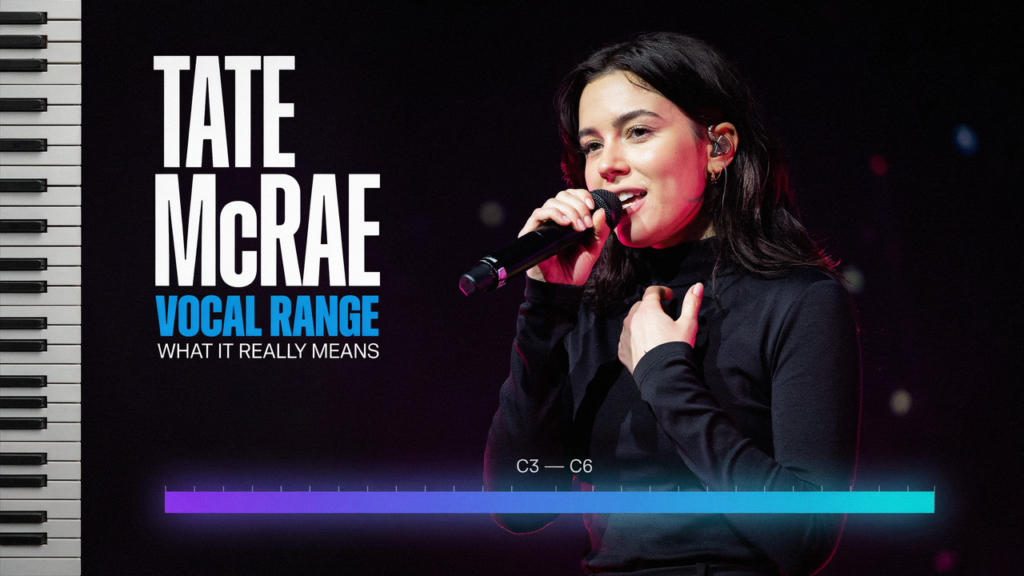
Tate McRae’s vocal range refers to the lowest and highest notes she can sing, typically estimated from around F3 to D6, covering roughly two and a half to three octaves. Her most comfortable singing area (tessitura) sits in the mid-to-upper female range, commonly associated with a mezzo-soprano.
That definition gives you numbers. Now let’s break down what those numbers actually mean in practical vocal terms.
What Is Tate McRae’s Lowest and Highest Note?
F3 sits in the lower part of the female chest register. It requires grounded breath support and stable cord closure.
In this area, her tone is softer and more speech-like. It’s not extremely low for a female singer, but it reflects a natural mid-range placement rather than a dramatic contralto depth.
If you’re unsure where that sits on the keyboard, review a visual vocal range chart to see how female ranges are typically mapped.
Highest Notes: Around D6
D6 moves well into the upper register. These notes rely on head voice coordination and lighter vocal fold contact.
Important: touching D6 does not mean that note is part of a comfortable singing range. High notes are often achieved with lighter coordination rather than full voice power.
Total Octave Span
From F3 to D6 equals roughly 2.5–3 octaves.
That’s strong for a pop vocalist. However, range alone doesn’t tell the whole story. Tone control, breath stability, and dynamic expression matter more than raw span.
For context, compare this to the typical average vocal range and you’ll see that her range sits slightly above many untrained singers.
Is Tate McRae a Soprano or Mezzo-Soprano?
Most vocal coaches would lean toward mezzo-soprano.
Here’s why:
- Her comfortable singing zone sits in the middle register.
- Her tone carries warmth rather than a piercing soprano brightness.
- She often navigates upper notes with head-dominant coordination rather than sustained high belting.
Voice type is determined more by tessitura than by highest note. If you need clarity on classification categories, understanding the fundamentals of voice types helps separate myth from reality.
Tessitura vs. Full Range
Many fans focus only on the highest note.
That’s incomplete.
Your full range is everything you can produce. Your tessitura is where your voice lives comfortably.
Think of it like shoe sizes. You might squeeze into a size smaller for a few steps, but that doesn’t mean it’s your real size.
If you want a deeper explanation of this concept, explore what tessitura means and why it matters more than extremes.
Register Breakdown
Chest Voice
Her lower notes rely on light chest coordination. They are not heavy or operatic, but they are stable and grounded.
Pop singers often use a speech-like chest quality to maintain intimacy.
Mixed Voice
This is where much of her melodic phrasing sits. Mixed voice blends chest and head resonance to avoid strain.
Good mix feels balanced—not shouted.
Head Voice
Upper notes, especially above C5, shift toward head-dominant production.
Head voice should feel lifted and buoyant, not squeezed. If the neck tightens, you’re pushing instead of coordinating.
To see how these notes compare across singers, you can test yourself using a vocal range calculator and map your own registers accurately.
Supported vs. Extreme Notes
Here’s a clearer breakdown:
| Category | What It Means |
|---|---|
| Lowest recorded note | Deepest pitch documented |
| Highest recorded note | Top pitch achieved |
| Supported range | Notes sung consistently with stable tone |
| Tessitura | Most comfortable singing zone |
As a coach, I always evaluate supported range first. A note that appears once under perfect conditions doesn’t define the voice.
What Makes Her Voice Unique?
Range is just structure. Style is personality.
Her vocal identity includes:
- Air-dominant tone
- Emotional phrasing
- Controlled dynamic softness
- Smooth register transitions
- Intimate pop delivery
Many singers try to copy the airy tone but forget that airflow must be controlled. Too much air without support leads to instability.
If you’re curious how her span compares to typical singers overall, reviewing the human vocal range gives helpful context.
Step-by-Step: How to Test If You Have a Similar Range
Do this safely. Never force your voice upward or downward.
- Warm up for at least five minutes with gentle humming.
- Start on a comfortable middle note.
- Slide downward slowly until tone becomes breathy or unstable.
- Return to center and slide upward gradually.
- Stop immediately if tension appears in the throat.
- Record your lowest and highest clean notes.
If you want more precise pitch tracking, you can try a pitch accuracy test before stretching range further.
Quick Self-Check: Are You a Mezzo Like Tate McRae?
Ask yourself:
- Does your voice feel most stable in the middle range?
- Do high notes require a shift into lighter coordination?
- Does your tone lean warm rather than piercing?
- Do lower notes feel comfortable but not extremely deep?
If most answers are yes, you may align closer to a mezzo-soprano profile.
To understand the category better, review the typical mezzo-soprano vocal range for comparison.
Common Mistakes When Analyzing Her Range
- Assuming a high note equals soprano classification
- Ignoring tessitura entirely
- Confusing breathy tone with weak technique
- Comparing studio layering to live performance
- Believing more octaves automatically mean better singing
A healthy voice is not about extremes. It’s about control and sustainability.
Try the daily warm-up generator for consistency.
Realistic Expectations for Your Own Voice
Not everyone will have a three-octave range. That’s normal.
Healthy range development should:
- Progress gradually over months
- Never cause throat pain
- Maintain tone clarity
- Improve control before expansion
If you feel strain or hoarseness the next day, you pushed too far.
If you’re unsure how your classification compares to brighter female voices, reviewing the typical soprano vocal range can clarify distinctions without forcing yourself into the wrong category.
Final Perspective
Tate McRae’s vocal range spans roughly F3 to D6, with a mezzo-soprano tessitura and strong upper register coordination. Her vocal strength lies less in extreme power and more in control, tone color, and emotional nuance.
Range is a measurement. Artistry is execution.
Build control first. Range will follow.
FAQs
1. What is Tate McRae’s highest note?
Her highest documented notes reach around D6. These are typically produced in head voice rather than sustained chest belting.
2. What is her lowest note?
Her lower range sits around F3. This falls comfortably within a mezzo-soprano profile.
3. Is Tate McRae a soprano?
She is more commonly classified as a mezzo-soprano due to her tessitura and tonal warmth. Highest note alone does not determine voice type.
4. How many octaves can she sing?
Her estimated range covers approximately 2.5 to 3 octaves. That is strong for a contemporary pop singer.
5. Does she belt high notes?
She uses controlled mix and head voice rather than heavy belting for extreme highs. This keeps the tone lighter and more sustainable.
6. Can I train to reach D6 safely?
Possibly, but only with gradual coordination work. Never force the voice upward; strain can cause vocal fatigue.
7. Is airy singing unhealthy?
Not necessarily. Controlled airflow can create stylistic softness. Problems arise only when excessive air leaks due to poor support.

Cooke is a vocal training and singing education writer specializing in vocal range analysis, pitch recognition, voice development, and singing tools for vocalists, performers, musicians, and beginners. He creates practical content focused on vocal improvement, singing techniques, and voice analysis resources.