
The Weeknd’s vocal range spans approximately three octaves, commonly estimated around the low third octave up into the sixth octave, depending on whether you include falsetto. He is generally classified as a tenor, with a light, flexible upper register and a signature use of controlled falsetto.
That headline number is helpful — but it doesn’t tell the whole story. What matters more is how he uses his registers, where his voice sounds strongest, and how safely he navigates high notes.
Let’s break it down like a coach would.
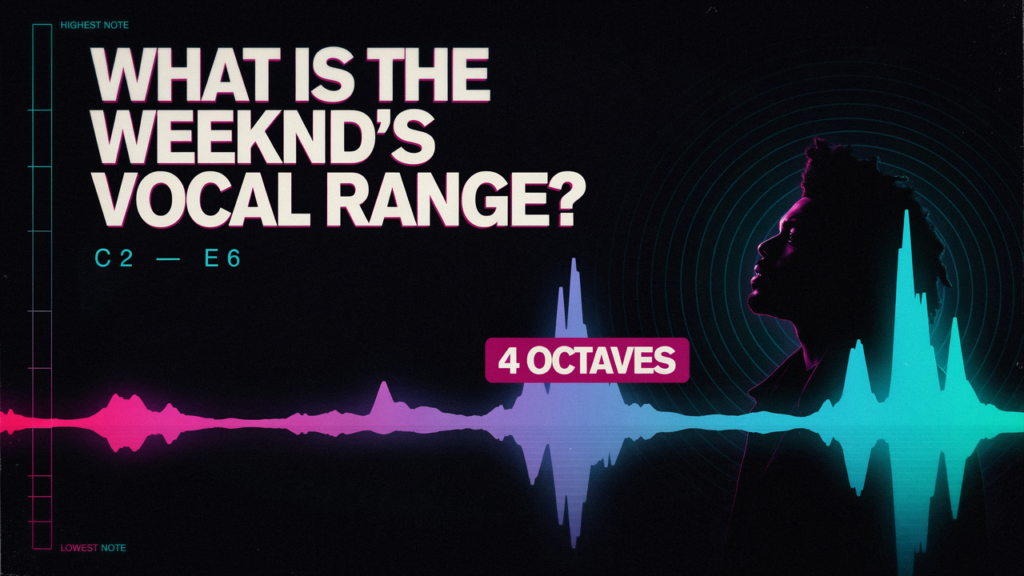
The Weeknd’s Lowest and Highest Notes
Range discussions can get exaggerated online. What we care about is usable, musical notes — not one-time studio effects.
Lowest Notes
In recorded material, his lowest notes sit around the lower third octave. These tones are usually breathy and stylistic rather than heavy, chest-dominant lows.
He’s not a bass or baritone with deep resonance. His lower register is lighter, consistent with a tenor foundation.
Highest Notes (Modal Voice)
In full voice (not falsetto), he reaches strong upper fourth and fifth octave notes. These are typically mixed or head-dominant tones, not pushed chest voice.
You’ll hear this especially in songs like “Blinding Lights,” where he sustains bright high phrases without sounding strained.
Highest Notes (Falsetto)
His signature sound lives in falsetto. Here, he extends into the sixth octave range with an airy, smooth quality. That floaty tone is a stylistic choice — not a sign of vocal weakness.
If you’re unsure what falsetto really means, read this breakdown of chest voice vs head voice. Understanding the difference clears up most confusion about his range.
How Many Octaves Can He Sing?
Depending on how you calculate it, his total span sits around three octaves.
That’s impressive — but not extreme.
A three-octave range is strong for a contemporary pop tenor. If you’re wondering how that compares to others, review the broader context of the human vocal range to see where he fits.
Remember: range alone does not equal skill. Control, tone consistency, and stylistic expression matter more.
What Voice Type Is The Weeknd?
He is widely considered a light lyric tenor.
Why Tenor?
- Comfortable upper register
- Bright tonal color
- High tessitura
- Frequent falsetto use
If you’re still learning voice types, this guide to tenor vocal range explains what separates tenors from baritones in practical terms.
Tessitura Matters More Than Range
Tessitura refers to where the voice feels most comfortable and sustainable.
Even if someone can “hit” a note, that doesn’t mean they can live there musically. For clarity on this concept, see this explanation of what is tessitura.
The Weeknd’s tessitura sits relatively high for a male voice. That’s why his songs often hover in upper registers without sounding forced.
How He Uses Falsetto (And Why It Works)
His falsetto isn’t accidental — it’s controlled.
Think of chest voice like speaking loudly across a room. Falsetto is like speaking softly but clearly through a microphone. It’s lighter, thinner, and less compressed.
He blends registers smoothly, avoiding the obvious “break” many singers experience around the passaggio (the transition zone between registers).
That blending is what makes his voice sound effortless.
Try the range benchmark test to compare with friends.
Step-by-Step: Can You Sing in His Range?
Before trying to imitate him, test your own range safely.
If you haven’t measured it yet, use a vocal range calculator so you’re working with facts instead of guesswork.
Now follow this approach:
1) Find Your Comfortable Low Note
Hum downward gently. Stop when tone becomes unstable or airy.
2) Glide Up in Lip Trills
Use a soft “brrr” sound to move upward. This reduces strain.
3) Switch to Light Head Voice Early
Don’t drag chest voice upward. Transition early and lightly.
4) Avoid Forcing High Notes
If your throat tightens, you’ve gone too far.
5) Compare Ranges Realistically
If your range overlaps even partially with his, that’s enough to sing his songs — with proper key adjustments if needed.
If you’re unsure how your notes compare, this guide on how to find your vocal range walks you through it safely.
Quick Self-Check: Are You Forcing High Notes?
Ask yourself:
- Does your neck tense when you go higher?
- Do veins pop or jaw lock?
- Does your tone suddenly get shouty?
- Are you out of breath immediately?
If yes, you’re pushing chest voice too high.
Healthy high notes feel lifted, not squeezed.
Common Mistakes When Analyzing His Range
- Confusing falsetto with full chest power
- Assuming octave count equals talent
- Ignoring tessitura comfort
- Trying to copy tone instead of technique
- Forcing high notes without warming up
If you’re building range yourself, structured vocal exercises to increase range help far more than imitating pop recordings.
Live vs Studio: Why It Matters
Studio recordings allow layering and controlled environments.
Live performance shows real stamina.
The Weeknd maintains consistency live because he stays in a sustainable tessitura. He doesn’t belt recklessly. He uses head-dominant mix and falsetto strategically.
This is a smart vocal health choice.
If you want to expand safely, read this detailed guide on how to extend vocal range. Expanding takes months — not days.
Register Breakdown Table
| Register | Approximate Area | Vocal Quality | Usage Style |
|---|---|---|---|
| Lower Register | Lower 3rd octave | Light, breathy | Stylistic lows |
| Mid Range | 3rd–4th octave | Clear, controlled | Main melodic lines |
| Upper Modal | 4th–5th octave | Bright, head-mix | Climactic phrases |
| Falsetto | 5th–6th octave | Airy, smooth, floating | Signature sound |
This separation is crucial. Many singers brag about range without clarifying which register produced the note.
What Singers Can Learn From His Technique
The biggest lesson is restraint.
He doesn’t try to sound huge. He uses tone color and register shifts for emotional effect.
Think of it like painting. You don’t use the brightest color everywhere. You use contrast.
His strength isn’t extreme depth or explosive belts — it’s controlled, consistent upper-range singing with smooth transitions.
If you’re developing your voice:
- Build control before range.
- Strengthen head voice gently.
- Respect fatigue signals.
- Don’t chase whistle tones prematurely.
Three octaves with control beats five octaves with tension.
Realistic Expectations
Most male singers have around two octaves of comfortable usable range.
Reaching three octaves with healthy coordination takes training.
Trying to jump straight into sixth-octave falsetto without foundational control increases strain risk. Your vocal folds are muscles — they adapt gradually.
Progress should feel challenging but never painful.
Final Perspective
The Weeknd’s vocal range is strong but not mythical.
His advantage lies in:
- High tessitura comfort
- Clean register transitions
- Controlled falsetto
- Stylistic restraint
Focus on those qualities and your voice will develop more reliably than chasing a headline octave number.
FAQs
1) What is The Weeknd’s vocal range in octaves?
He spans roughly three octaves when including falsetto. In modal voice alone, it’s slightly smaller but still solid for a tenor. The exact count varies depending on how notes are measured.
2) Is The Weeknd a tenor or baritone?
He is generally classified as a tenor. His bright tone, high tessitura, and comfort in upper registers support that classification.
3) What is his highest note?
In falsetto, he reaches into the sixth octave. In full modal voice, he typically peaks in the upper fifth octave range.
4) Does he use falsetto a lot?
Yes. Falsetto is central to his style. It gives his sound that airy, emotional texture.
5) Can an average male singer sing his songs?
Yes, but many will need key adjustments. His tessitura sits high, so lower-voiced singers may transpose.
6) Is a three-octave range rare?
It’s above average but not extreme. With training, many singers can approach that span safely.
7) Should I try to copy his falsetto tone?
Focus on healthy coordination first. Tone develops naturally once your registers are balanced and tension-free.

Cooke is a vocal training and singing education writer specializing in vocal range analysis, pitch recognition, voice development, and singing tools for vocalists, performers, musicians, and beginners. He creates practical content focused on vocal improvement, singing techniques, and voice analysis resources.