
Thom Yorke’s vocal range spans roughly three octaves, extending from the lower second octave into the sixth octave when falsetto is included. He is generally classified as a light tenor with a high tessitura and a signature, controlled falsetto that defines much of his sound.
That number sounds impressive — but range alone doesn’t explain his voice. What makes Thom Yorke distinctive is how he uses registers, how lightly he carries high notes, and how consistently he sings in an elevated tessitura.
Let’s break it down properly.
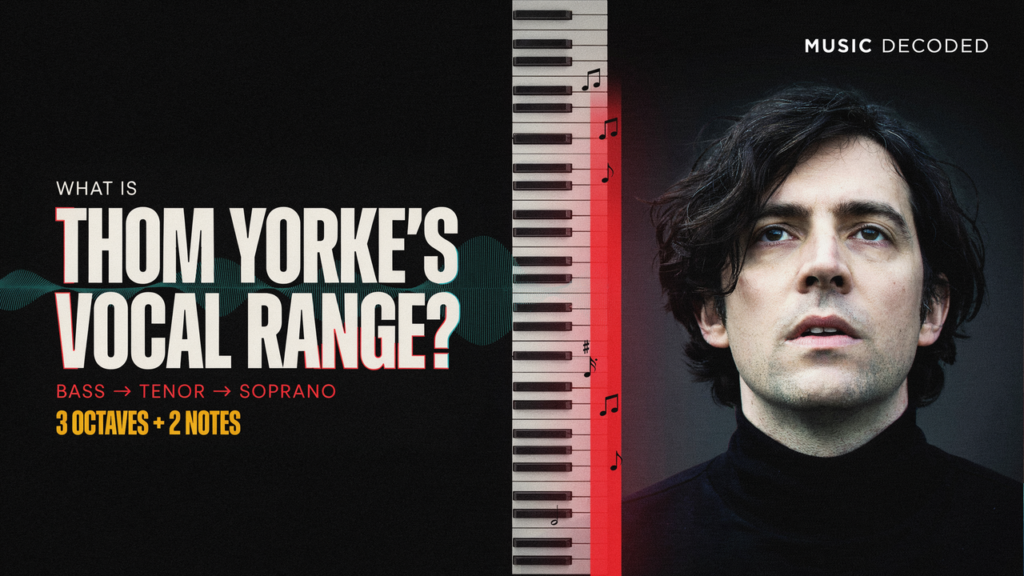
Thom Yorke’s Lowest and Highest Notes
When discussing any singer’s range, we separate modal (full voice) from falsetto. Mixing them together creates confusion.
If you want context for how this compares to the average singer, review the broader human vocal range to understand where these notes sit.
Lowest Notes
His lowest recorded tones sit around the lower second octave. These notes are usually soft and stylistic rather than resonant, chest-heavy lows.
He is not a baritone or bass. His lower register exists, but it is not the foundation of his vocal identity.
Highest Modal Notes
In full voice, he reaches into the fifth octave with a head-dominant mix. These notes are bright and emotional, not thick or shouted.
The important point: he does not force chest voice upward. He transitions early.
Highest Falsetto Notes
His falsetto extends into the sixth octave. This airy upper extension is one of his trademarks.
If you’re unsure how falsetto differs from full voice, this explanation of chest voice vs head voice clarifies the mechanics.
How Many Octaves Can He Sing?
Including falsetto, he spans around three octaves.
That’s strong, but not extreme. Many trained tenors can reach similar spans. What makes his voice unique is not raw range but tonal control and stylistic placement.
If you want to compare his span to structured classifications, this overview of tenor vocal range helps clarify where he fits.
What Voice Type Is Thom Yorke?
He is widely described as a light lyric tenor.
Why Tenor?
- High tessitura
- Easy access to upper register
- Bright tonal color
- Frequent falsetto use
His speaking voice and singing placement support this classification.
If voice types still feel abstract, this guide on types of vocal ranges explains the broader framework.
Tessitura: The Real Story
Tessitura is the range where a singer is most comfortable and sustainable.
Even if someone can “hit” a low or high note once, that doesn’t mean they can live there musically. For deeper clarity, see this breakdown of what is tessitura.
Thom Yorke’s tessitura sits relatively high for a male singer. That’s why so many of his melodies float above what most baritones would find comfortable.
Register Breakdown Table
| Register | Approximate Area | Vocal Quality | How He Uses It |
|---|---|---|---|
| Lower Register | Low 2nd octave | Light, soft | Occasional depth |
| Mid Range | 3rd–4th octave | Clear, expressive | Main melodic space |
| Upper Modal | 4th–5th octave | Head-dominant mix | Emotional peaks |
| Falsetto | 5th–6th octave | Airy, floating | Signature sound |
Separating registers prevents exaggeration. A singer’s falsetto extension should not be confused with sustained chest power.
What Makes His Voice Unique?
Three elements define his sound:
- High, light placement
- Controlled falsetto transitions
- Emotional phrasing over vocal weight
Think of his voice like watercolor instead of oil paint. It’s translucent, layered, and delicate — not thick and heavy.
This is a technical choice, not an accident.
Use the vocal profile comparison to explore differences.
Step-by-Step: How to Safely Approach His Style
If you’re inspired by his sound, don’t start by pushing for high notes. Start with coordination.
Before anything else, test your range accurately using a vocal range calculator so you know your baseline.
Then follow this process:
1) Build a Stable Head Voice
Use light “woo” sounds on gentle scales. Avoid tension in the jaw and neck.
2) Transition Early
Do not drag chest voice upward. Shift into mix or head voice before strain appears.
3) Develop Falsetto Control
Practice soft sirens from mid-range upward. Keep airflow steady and relaxed.
4) Strengthen Breath Support
Gentle sustained tones help build consistency without squeezing.
5) Expand Gradually
Range extension takes months. If you’re serious about growth, structured vocal exercises to increase range are far safer than copying recordings.
If you’re unsure where you stand, this guide on how to find your vocal range gives a clear starting point.
Quick Self-Check
Ask yourself:
- Do high notes feel lifted or squeezed?
- Does your throat tighten when you go above mid-range?
- Can you switch to a lighter tone without cracking?
- Are you fatigued after a few attempts?
If tension appears quickly, you’re pushing too much chest voice.
Healthy high singing feels buoyant — not forced.
Common Mistakes When Analyzing His Range
- Counting falsetto as chest power
- Assuming octave span equals vocal superiority
- Ignoring tessitura comfort
- Trying to imitate tone instead of technique
- Skipping warm-ups before high singing
If you want safe expansion, this resource on how to extend vocal range outlines gradual development strategies.
Remember: strain is not progress.
Live vs Studio Considerations
Studio recordings allow multiple takes and layering. Live performance reveals stamina.
Thom Yorke’s strength is consistency. He stays in a sustainable range and uses falsetto strategically rather than belting aggressively.
That’s smart vocal health management.
Pushing chest voice repeatedly into the upper fifth octave would likely cause fatigue. He avoids that trap.
Realistic Expectations for Singers
Most untrained male singers have around two comfortable octaves.
Reaching three octaves with coordination and control requires time and patience.
Trying to leap directly into sixth-octave falsetto without balanced fundamentals increases tension risk. Your vocal folds respond to gradual conditioning — like any muscle.
If something hurts, stop. Singing should feel effortful but never painful.
What You Should Actually Learn From Him
Focus on:
- Light registration
- Emotional phrasing
- Smooth transitions
- Controlled airflow
- Sustainable high tessitura
Three octaves used intelligently will always outperform a wider range used recklessly.
Technique builds longevity.
FAQs
1) What is Thom Yorke’s vocal range in octaves?
He spans roughly three octaves when falsetto is included. In full modal voice, the range is slightly narrower but still strong for a tenor.
2) Is Thom Yorke a tenor or baritone?
He is generally classified as a light tenor. His high tessitura and upper-register comfort support that category.
3) What is his highest note?
In falsetto, he reaches into the sixth octave. In modal voice, he peaks in the upper fifth octave.
4) Does he use falsetto frequently?
Yes. Falsetto is central to his style. It gives his sound its airy, emotional quality.
5) Can an average male singer sing his songs?
Many can, but some may need key adjustments. His tessitura sits high, which can challenge lower-voiced singers.
6) Is a three-octave range rare?
It’s above average but not extraordinary. With structured training, many singers can approach it safely.
7) Should I try to copy his tone directly?
No. Focus on building balanced registers and healthy coordination first. Tone develops naturally from technique.

Cooke is a vocal training and singing education writer specializing in vocal range analysis, pitch recognition, voice development, and singing tools for vocalists, performers, musicians, and beginners. He creates practical content focused on vocal improvement, singing techniques, and voice analysis resources.