
Linda Ronstadt’s vocal range is commonly cited as approximately G3 to E6, spanning close to three octaves. She is often described as a lyric soprano with strong crossover ability, combining powerful chest resonance with clear, ringing head voice across rock, country, standards, and operetta repertoire.
Range numbers alone don’t explain her impact. Control and versatility do.
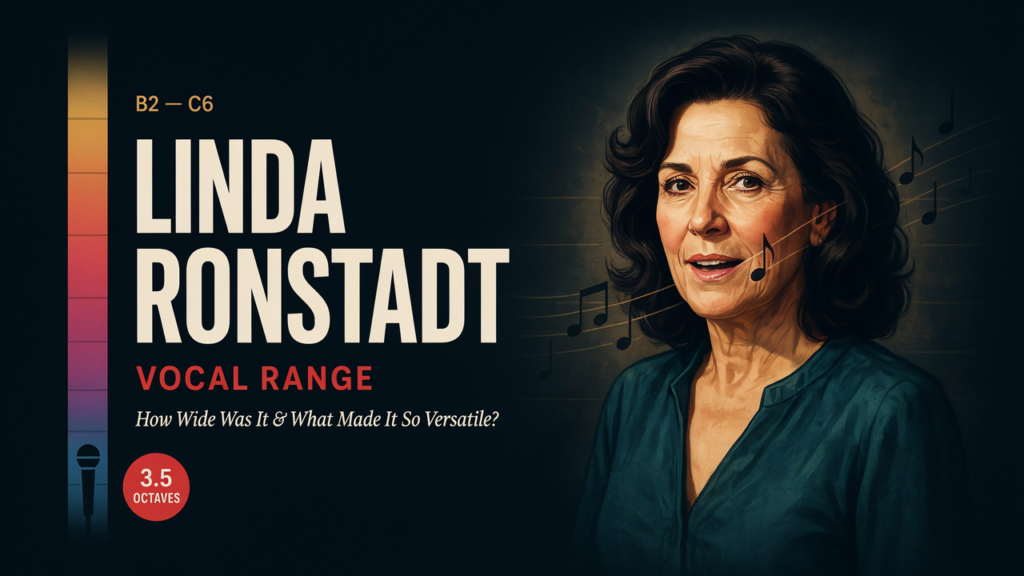
What Was Linda Ronstadt’s Actual Vocal Range?
Most documented performances place her lowest notes around G3 and her higher sustained notes near E6, depending on the era of her career.
That gives her a solid three-octave span.
However, as with any singer, it’s important to separate:
- Absolute extreme notes
- Supported performance range
- Comfortable tessitura
If you want to visualize how those notes fit structurally, reviewing a vocal range chart helps you see where soprano territory begins and ends.
Her most consistent singing sat in the upper-middle register, which supports the lyric soprano classification.
Was Linda Ronstadt a Soprano or Mezzo-Soprano?
She is most often classified as a lyric soprano.
Why Lyric Soprano Fits
- Bright upper register
- Strong sustained high notes
- Clear vibrato
- Comfortable singing above C5
If you compare the boundaries, the soprano vocal range aligns closely with her tessitura.
Why Some Hear Mezzo Qualities
She had warmth in her lower register.
She sang rock and country repertoire with chest resonance.
Her tone was rich rather than overly light.
Tone color can overlap between categories. Classification depends more on where the voice feels sustainable.
To understand these distinctions clearly, reviewing voice types explained provides helpful structural context.
Range vs Tessitura: Why It Matters
Range is the outer limit.
Tessitura is the comfort zone.
Think of range like the size of a piano keyboard.
Tessitura is the section you naturally play most often.
Linda Ronstadt’s tessitura often hovered in the upper middle of the female voice. She could sustain those notes with power and clarity across genres.
If you’re unsure where your own comfort zone lies, begin by learning how to find your vocal range accurately.
How She Balanced Rock, Country, and Operetta
Her versatility is what truly stands out.
Chest Voice Power
In rock and country songs, she used grounded chest resonance for strength without shouting.
Head Voice Clarity
In standards and operetta repertoire, she accessed a clean, resonant head voice that carried effortlessly.
If you’re not sure how these registers coordinate, understanding chest voice vs head voice makes the blend clearer.
Passaggio Control
Passaggio is the transition area between registers. Smooth transitions allow a singer to move upward without obvious breaks.
Her ability to move through this zone cleanly gave her crossover freedom.
Live vs Studio Performance Differences
Studio recordings allow precision and multiple takes.
Live performances demand endurance and breath management.
Some singers show slightly different extremes in studio settings versus live concerts. That doesn’t change their classification — it reflects stamina demands.
When analyzing any vocalist, distinguish between:
| Category | Meaning |
|---|---|
| Absolute Range | The lowest and highest notes ever produced |
| Supported Range | Notes consistently sung with control |
| Tessitura | The most comfortable performance zone |
This keeps expectations realistic.
Use the scale suggestion tool to add variation to daily routines.
How to Build Crossover Flexibility
If you want to sing across genres like she did, follow this progression:
- Strengthen clean mid-range notes first.
- Develop stable breath support on sustained tones.
- Practice smooth transitions between chest and head voice.
- Adjust vowel shape slightly as you ascend.
- Increase range gradually without increasing tension.
Versatility comes from coordination, not forcing your voice into different styles.
You can check your pitch consistency with a structured pitch accuracy test before experimenting with stylistic changes.
What Healthy Upper Notes Should Feel Like
- Supported from below
- Free in the throat
- Forward resonance
- No squeezing or strain
High notes should feel lifted, not pushed.
Are You a Lyric Soprano?
Ask yourself:
- Do high notes above C5 feel natural and clear?
- Does your voice brighten as you ascend?
- Do lower notes feel lighter compared to your highs?
- Is your speaking voice moderately high?
If yes, you may lean toward lyric soprano tendencies.
Only count notes that feel supported and sustainable. Extreme strained notes don’t define your type.
Common Mistakes When Analyzing Linda Ronstadt’s Range
Mistake 1: Equating Power With Mezzo
Strong chest voice does not automatically mean mezzo-soprano.
Mistake 2: Overemphasizing Lowest Notes
Her classification depended more on upper tessitura than low extremes.
Mistake 3: Ignoring Genre Influence
Rock tone and classical tone use different resonance strategies. Style does not redefine anatomy.
Mistake 4: Believing Range Equals Versatility
Versatility comes from coordination and stylistic control — not just octave span.
For perspective on exaggerated range claims, reviewing common vocal range myths helps separate hype from structure.
Developing Upper Extension Safely
Expanding your upper range requires patience.
Focus on These Foundations
- Steady airflow
- Relaxed jaw and tongue
- Gradual scale expansion
- Proper warm-ups
Think of range like stretching a muscle.
Push too fast, and you strain.
Build gradually, and flexibility increases safely.
Avoid chasing high notes without first stabilizing mid-range control.
Realistic Expectations About Her Range
Nearly three octaves is impressive but not extreme for a trained lyric soprano.
What made her voice remarkable was:
- Clarity across genres
- Controlled vibrato
- Smooth register blending
- Emotional authenticity
Range is a measurement.
Coordination creates artistry.
You don’t need extreme high notes to build a versatile career. You need consistency and control.
The Real Lesson From Her Vocal Profile
Linda Ronstadt demonstrates how a lyric soprano can balance power and finesse without sacrificing vocal health.
The key principles:
- Respect your natural tessitura
- Develop smooth transitions
- Strengthen support before expanding range
- Adjust style without altering structure
Master your foundation, and flexibility will follow.
FAQs
1. What was Linda Ronstadt’s vocal range?
Her range is commonly cited as approximately G3 to E6, spanning close to three octaves depending on how extreme notes are counted.
2. Was Linda Ronstadt a soprano?
She is most often classified as a lyric soprano due to her bright upper register and high tessitura.
3. How many octaves could she sing?
Around three octaves in supported performance settings.
4. Did she sing opera?
She performed operetta and classical-influenced repertoire, which showcased her head voice clarity and upper extension.
5. What was her tessitura?
Her tessitura sat in the upper-middle register, where she could sustain notes with power and consistency.
6. Was her range unusual for rock singers?
Her clarity and upper extension were distinctive, especially within crossover rock and country styles.
7. How can I build similar crossover flexibility?
Focus on breath support, smooth register transitions, and gradual range development. Avoid forcing tone darker or brighter than your natural placement.

Cooke is a vocal training and singing education writer specializing in vocal range analysis, pitch recognition, voice development, and singing tools for vocalists, performers, musicians, and beginners. He creates practical content focused on vocal improvement, singing techniques, and voice analysis resources.