
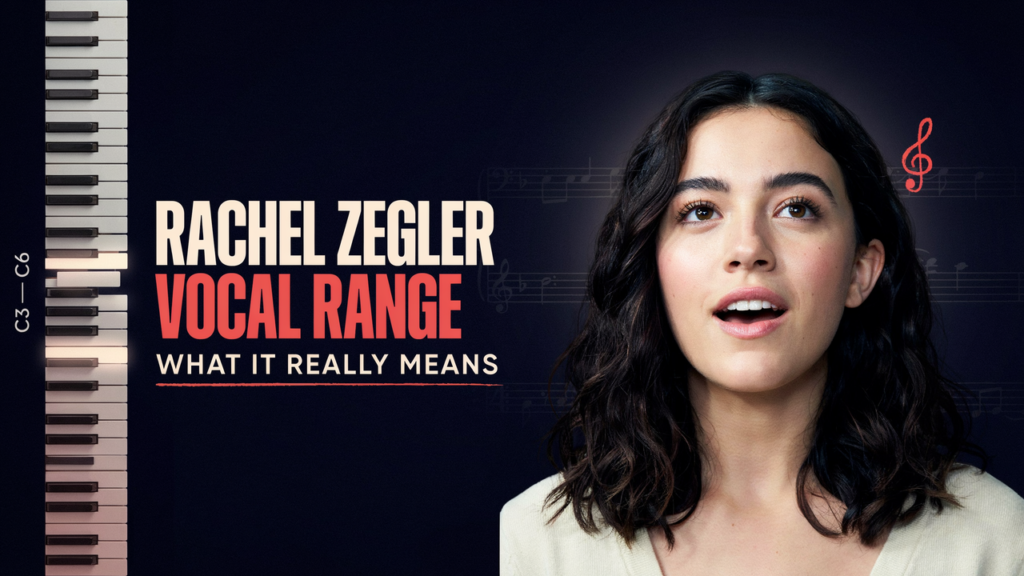
Rachel Zegler’s vocal range spans approximately from the lower third octave (around G3) up to high soprano notes around E6, giving her roughly 2.5 to 3 octaves of usable range. She is generally classified as a lyric soprano, known for a clear upper register, smooth head voice, and strong musical theatre belt.
That number alone doesn’t explain why her voice sounds effortless on high notes. Range tells you the outer limits. Tessitura tells you where the voice truly lives.
Let’s break this down the way a vocal coach would.
Understanding Her Range in Practical Terms
Lowest and Highest Notes
Her lower register sits comfortably in the mid-to-lower third octave. The upper extension reaches into the sixth octave with clarity, especially in head voice.
Here’s a simplified breakdown:
| Category | Approximate Range |
|---|---|
| Lowest Notes | Around G3 |
| Comfortable Range (Tessitura) | A3–C5 |
| Strong Belt Zone | D5–F5 |
| Upper Head Voice | Up to E6 |
| Likely Voice Type | Lyric Soprano |
The key is that her power isn’t coming from extreme lows or unusual depths. It comes from control in the upper middle and head voice.
If you’re unsure how your own voice compares, review the average female vocal range first for context.
Is Rachel Zegler a Soprano or Mezzo?
She is generally considered a lyric soprano.
A mezzo-soprano typically carries more weight in the lower-middle range. Rachel’s tone is brighter, lighter, and sits higher in tessitura, especially in musical theatre repertoire.
To understand that difference clearly, compare it to the standard soprano vocal range.
Why Her High Notes Sound So Easy
High notes feel easy when:
- Breath support is stable
- Jaw and tongue stay relaxed
- Resonance shifts forward
- The passaggio is smooth
Her upper register doesn’t sound forced because it’s coordinated, not pushed.
If you’re confused about where your own comfort zone sits, learn what tessitura actually means before focusing on extreme notes.
This range measurement tool is perfect for beginners.
How She Uses Her Registers
Head Voice Dominance
Her high notes are typically head voice or well-blended mix. They feel lifted and resonant rather than heavy.
Imagine the difference between shouting upward and floating upward. One tightens the throat. The other releases into space.
Controlled Belt
In musical theatre, belt is common. But good belt feels supported, not squeezed.
If you try to drag chest voice too high, the sound spreads and strains. Her belt stays focused and energized.
If you want clarity on how registers interact, review chest voice vs head voice before trying to imitate that sound.
Can You Sing in Rachel Zegler’s Range?
Before comparing yourself, measure your real starting point.
Follow a structured method like this guide on how to find your vocal range. Guessing based on one high note doesn’t give accurate information.
Range is like flexibility. You don’t measure it by one lucky stretch.
Step-by-Step: Training Toward a Lyric Soprano Sound
This approach focuses on coordination, not forcing.
- Warm up gently in mid-range with humming or lip trills.
- Slide upward slowly instead of attacking high notes.
- Keep the jaw relaxed and tongue forward.
- Stop if you feel throat tightening.
- Repeat small patterns instead of jumping to extremes.
Think of building upper range like climbing stairs. If you skip steps, you trip.
If your support feels unstable, revisit foundational breathing techniques for singers before pushing upward.
Developing Upper Head Voice
Light sirens on “oo” or “ee” vowels help release tension.
The goal is resonance shift, not volume increase.
If done correctly, high notes feel narrower but freer.
For structured practice, use exercises from vocal exercises to increase range.
Common Mistakes When Trying to Sing Like Rachel Zegler
Many singers misunderstand what makes soprano high notes work.
- Pushing chest voice too high
- Forcing volume instead of adjusting resonance
- Ignoring breath support
- Comparing one extreme note instead of overall tessitura
- Practicing high notes while fatigued
High soprano notes should feel buoyant, not muscular.
If you’re chasing range numbers, use a reliable vocal range calculator instead of estimating emotionally.
Quick Self-Check
Ask yourself:
- Can I sing D5 lightly without jaw tension?
- Do my high notes feel narrow but free?
- Can I descend from a high note smoothly?
- Does my voice feel normal the next day?
If you answer “no” to most of these, focus on coordination before extension.
Realistic Expectations
Not every female singer is a lyric soprano. Anatomy plays a role.
Your vocal folds have a natural length and thickness. That influences where your voice settles.
Most trained female singers develop 2 to 3 healthy octaves of usable range. That’s completely normal.
Trying to force E6 before your voice is ready can lead to swelling and fatigue. High notes should be trained gradually, not attacked.
If long-term expansion is your goal, follow a smart progression like this guide on how to extend vocal range.
The Musical Theatre Factor
Musical theatre demands stamina, clarity, and consistency.
High notes must project over orchestration. That requires forward placement and breath efficiency.
It’s not about screaming higher. It’s about balanced resonance.
Think of it like shining a flashlight. You focus the beam rather than turning up the bulb.
What Really Makes Her Voice Stand Out
Her tone is:
- Clear
- Bright
- Flexible
- Emotionally connected
Range matters. But coordination and expression matter more.
Many singers obsess over how high they can go. The better question is how stable and repeatable the note is.
Consistency beats occasional extremes.
Final Coaching Perspective
Rachel Zegler’s vocal range is impressive because it’s controlled and well-placed, not because it’s unusually wide.
If you want a similar upper clarity:
- Stabilize your middle first
- Strengthen breath control
- Develop smooth register transitions
- Train gradually
High soprano notes are built, not forced.
And remember: your healthiest voice is always better than your highest note.
FAQs
1. What is Rachel Zegler’s vocal range in notes?
Her range spans roughly from G3 up to around E6. Her strongest and most comfortable singing sits in the mid-to-upper soprano range.
2. Is Rachel Zegler a soprano or mezzo-soprano?
She is generally classified as a lyric soprano. Her tone is bright, and her tessitura sits higher than a typical mezzo.
3. How many octaves can Rachel Zegler sing?
Approximately 2.5 to 3 octaves of usable range. The exact number depends on how you count extreme head voice notes.
4. Does Rachel Zegler belt high notes?
Yes, particularly in musical theatre contexts. Her belt remains focused and supported rather than pushed.
5. What is Rachel Zegler’s highest note?
Reported performances show notes reaching into the sixth octave. These are typically sung in head voice rather than heavy chest voice.
6. Can I train to sing in Rachel Zegler’s range?
You can expand your range gradually with consistent technique. However, natural anatomy influences your upper limits.
7. Why do her high notes sound effortless?
Efficient breath support, relaxed jaw position, and smooth register transitions allow her upper notes to feel stable and clear rather than strained.

Cooke is a vocal training and singing education writer specializing in vocal range analysis, pitch recognition, voice development, and singing tools for vocalists, performers, musicians, and beginners. He creates practical content focused on vocal improvement, singing techniques, and voice analysis resources.