
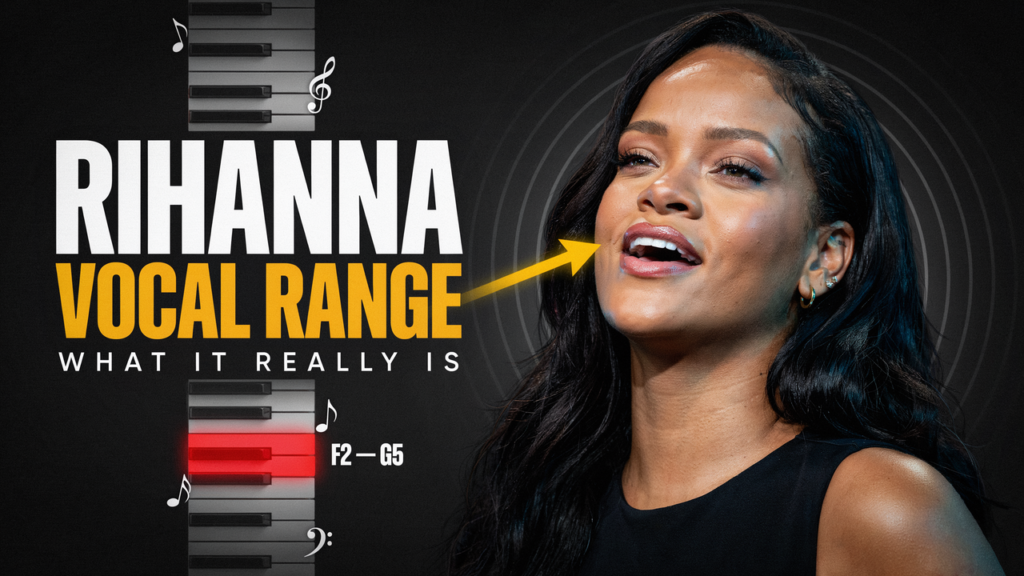
Rihanna’s vocal range spans approximately from the lower third octave (around B2–C3) up to upper fifth or early sixth octave notes (around C6 in head voice), giving her roughly 2.5 to 3 octaves of usable range. She is generally classified as a mezzo-soprano, though her darker tone often leads to contralto comparisons.
That definition gives you numbers. But numbers don’t explain tone, comfort zone, or vocal identity.
Let’s break this down like a coach would.
Understanding Rihanna’s Range in Context
Lowest and Highest Notes
Her lower register is one of her strengths. She has depth and weight in the lower third octave, which creates that smoky, grounded tone.
Her upper notes typically sit in head voice or mix. They are controlled, but not pushed into extreme soprano territory.
Here’s a simplified overview:
| Category | Approximate Range |
|---|---|
| Lowest Notes | Around B2 |
| Comfortable Range (Tessitura) | E3–C5 |
| Strong Belt Zone | D5–F5 |
| Upper Head Voice | Up to C6 |
| Likely Voice Type | Mezzo-Soprano |
If you want perspective, compare this to the average female vocal range before assuming her range is unusually wide.
Her range is solid and versatile — but her tone and control are what stand out most.
Is Rihanna a Contralto?
This is one of the most common questions.
True contraltos are rare. They have a consistently low tessitura and a darker, heavier vocal weight across the entire range.
Rihanna has a darker tone, but her tessitura and upper mix align more closely with mezzo-soprano territory.
If you’re unsure how those categories differ, review the characteristics of the mezzo-soprano vocal range to see why classification matters.
Tone color alone does not determine voice type. Tessitura does.
If that concept is new, study what tessitura really means before labeling your own voice.
What Makes Her Voice Sound Deep
Depth doesn’t always come from low notes.
It often comes from:
- Chest-dominant resonance
- Relaxed laryngeal position
- Balanced breath flow
- Slight huskiness in tone
Think of tone like paint color. Two singers may hit the same note, but the shade feels different.
Her darker color leads many people to assume contralto. But classification requires more than tone.
Use the vocal range calculator to find your lowest and highest comfortable notes.
How Rihanna Uses Her Registers
Strong Lower Register
She maintains clarity and presence in her lower range without losing support.
Many singers get breathy in low notes. She keeps them grounded.
If your low notes disappear, revisit fundamentals in breathing techniques for singers before trying to sing lower.
Controlled Upper Mix
Her higher notes are not aggressive belts. They are often mixed or head voice dominant.
If you’re still confused about how chest and head coordination works, read about chest voice vs head voice before attempting upper-range expansion.
Can You Sing in Rihanna’s Range?
Before comparing yourself, test your own limits properly.
Follow a structured process like this guide on how to find your vocal range so you know your starting point.
Guessing based on one high note is unreliable.
Range should be measured by notes you can repeat comfortably — not lucky attempts.
Step-by-Step: Building a Strong Lower and Mid Range
Rihanna’s power comes from stability, not extreme height.
Here’s a safe progression:
- Warm up with gentle humming in mid-range.
- Slide downward slowly instead of dropping abruptly.
- Keep breath steady — avoid pushing extra air.
- Maintain relaxed jaw and tongue.
- Stop immediately if the throat tightens.
Low notes should feel supported and full, not forced downward.
If you want structured drills, use exercises from vocal exercises to increase range.
Developing Upper Notes Without Strain
Upper notes require coordination, not aggression.
Think of reaching upward like stretching your arm overhead. You extend gradually. You don’t jerk upward.
Work light ascending patterns first. Only increase intensity once coordination feels stable.
If extension is your long-term goal, follow a gradual approach like this guide on how to extend vocal range.
Common Mistakes When Trying to Sing Like Rihanna
Many singers misunderstand what makes her sound powerful.
- Forcing low notes by depressing the larynx
- Confusing huskiness with healthy tone
- Pushing chest voice too high
- Ignoring breath support
- Measuring range by one extreme note
If you want objective data instead of guessing, use a vocal range calculator to measure accurately.
Remember: darker tone does not equal lower voice type.
Quick Self-Check
Ask yourself:
- Do my low notes feel steady or airy?
- Can I sustain E3 without tension?
- Do my high notes feel supported, not squeezed?
- Does my voice recover easily after singing?
If your voice feels tight or fatigued after trying to sing lower or higher, that’s a signal to slow down.
Coordination comes before expansion.
Realistic Expectations
Most trained female singers develop about 2 to 3 healthy octaves of usable range.
Rihanna’s range falls within that normal span. What makes her distinctive is tone color and control — not an extreme octave count.
Trying to force lower notes beyond your natural comfort zone can cause unnecessary strain. Low notes require support and resonance adjustment, not pressure.
Likewise, chasing higher notes without stable mix coordination increases tension risk.
Healthy singing always prioritizes sustainability over impressiveness.
What You Should Learn From Her Voice
The real takeaway isn’t “how many octaves.”
It’s:
- Stability in lower register
- Controlled upper mix
- Consistent tone color
- Emotional phrasing
Range is like the size of your toolbox. Technique is how well you use the tools.
Build coordination first. Let range expand gradually.
FAQs
1. What is Rihanna’s vocal range in notes?
Her range spans roughly from B2 up to around C6 in head voice. Her most comfortable singing range sits in the lower-middle mezzo-soprano zone.
2. How many octaves can Rihanna sing?
She has approximately 2.5 to 3 usable octaves. The exact count depends on whether you include head voice extremes.
3. Is Rihanna really a contralto?
She is generally considered a mezzo-soprano. While her tone is darker than many pop singers, her tessitura aligns more with mezzo territory.
4. What is Rihanna’s highest recorded note?
Reported performances suggest she can reach around C6 in head voice. These notes are typically mixed or head voice dominant rather than heavy belt.
5. Why does Rihanna’s voice sound so deep?
Her chest-dominant resonance and relaxed tonal placement give her sound depth. Tone color is not the same as voice classification.
6. Can I train to sing as low as Rihanna?
You can strengthen your lower register gradually with proper support. However, anatomical structure influences how low your voice can comfortably go.
7. Does Rihanna belt high notes?
She does use belt in certain songs, but much of her upper singing is controlled mix or head voice. Sustainable power always comes from coordination, not force.

Cooke is a vocal training and singing education writer specializing in vocal range analysis, pitch recognition, voice development, and singing tools for vocalists, performers, musicians, and beginners. He creates practical content focused on vocal improvement, singing techniques, and voice analysis resources.