
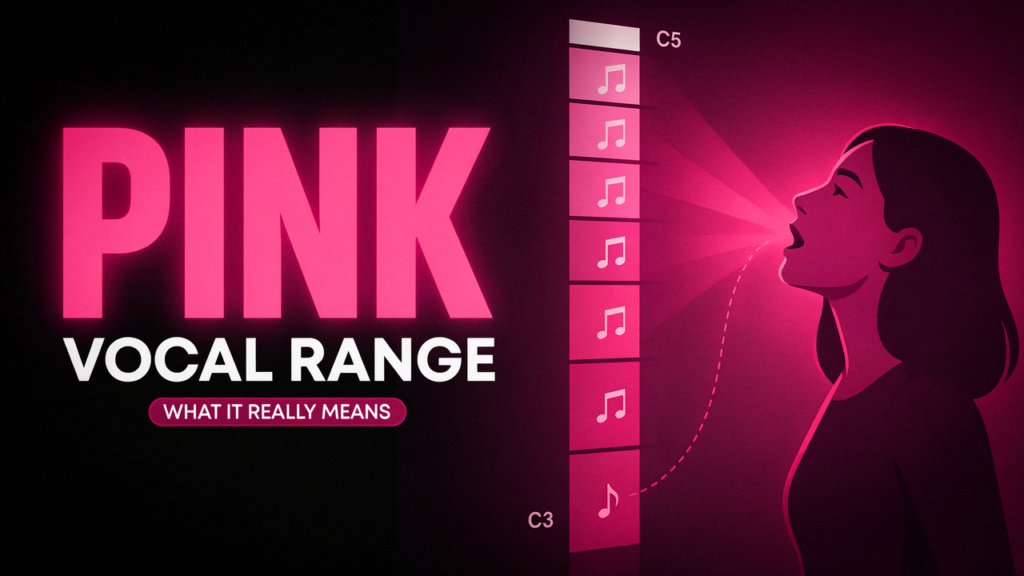
Pink’s vocal range spans roughly from the lower third octave (around G3) up to powerful high belts around C6, covering about 2.5 to 3 octaves depending on live performance context. She is generally classified as a mezzo-soprano, known for her strong chest voice, athletic belting, and emotional intensity.
That number alone doesn’t explain why her voice feels so powerful. Range tells us how high and low someone can sing. It does not tell us where their voice is strongest, healthiest, or most consistent.
Let’s break it down like a coach would.
What Makes Pink’s Voice Unique
Strong Chest-Dominant Power
Pink’s signature sound comes from a thick, well-supported chest voice. When she belts, the tone stays grounded instead of airy or thin.
Think of chest voice like speaking loudly across a room — it has weight and clarity. Pink carries that same grounded quality into higher notes without losing intensity.
If you’re unsure how registers work, review the difference between chest voice and head voice so you understand where that power is coming from.
High Belt, Not Whistle
Many people assume big high notes mean whistle register. That’s not the case here. Pink’s high notes are usually strong belt or mixed voice, not flute-like whistle tones.
That’s a key distinction. Belted high notes require breath support and efficient cord closure — not just pushing harder.
Tessitura vs. Extreme Notes
Her highest notes grab attention. But her tessitura — where she is most comfortable — sits in the mid-to-upper middle range.
If you’re new to that concept, read more about what tessitura really means before judging your own voice based on extreme notes.
Pink’s Vocal Range in Context
Here’s a simplified breakdown:
| Category | Approximate Range |
|---|---|
| Lowest Notes | Around G3 |
| Comfortable Range | A3–F5 |
| Highest Belts | Up to C6 |
| Voice Type | Mezzo-soprano |
Compared to the average female vocal range, Pink sits slightly higher in her belting capacity but very typical in her lower register.
This is important: impressive belting doesn’t mean unusually wide range. It means efficient coordination.
Can You Sing in Pink’s Range?
Before you try copying those high belts, understand this:
Her strength comes from technique, not forcing.
If you haven’t measured your voice yet, use a simple method from this guide on how to find your vocal range so you know your starting point.
Step-by-Step: Testing If You’re Near Pink’s Range
- Warm up gently for 5–7 minutes with lip trills or humming.
- Start at a comfortable mid-range note and descend slowly.
- Ascend gradually using light “gee” or “nay” sounds.
- Stop immediately if the tone strains, cracks painfully, or feels tight.
- Write down your lowest clean note and highest sustainable note.
Do not chase extreme notes. Clean, controlled sound matters more than stretching.
If you want structure, follow a routine like this daily vocal warm up before testing limits.
How Pink Develops Power (And How You Can Too)
Breath Support Comes First
Belting without breath support is like trying to push a car in neutral. You’ll strain.
Support means expanding through your ribs and keeping airflow steady. The sound should feel buoyant, not squeezed.
If you struggle here, review foundational breathing techniques for singers before attempting high belts.
Controlled Compression, Not Force
Pink’s high notes feel aggressive emotionally — but technically they are balanced.
If you shout upward, the throat tightens. If you compress the sound slightly and allow forward resonance, the pitch stabilizes.
Imagine throwing a dart. You don’t tense your whole body — you direct focused energy.
Training Toward That Upper Belt Safely
If your goal is expanding upward, follow a gradual plan.
Phase 1: Stability First
Strengthen your mid-range before touching extreme notes. If F4–A4 feels unstable, C6 is not the next step.
Work scales in a comfortable zone.
Phase 2: Mixed Voice Development
Blend chest and head voice gradually. Slides and light sirens help.
You can follow structured drills from these vocal exercises to increase range without pushing into strain.
Phase 3: Belt Conditioning
Only after coordination is stable should you experiment with short, supported belt patterns.
Keep repetitions short. Hydrate. Rest.
If strain appears, stop. No note is worth inflammation.
Common Mistakes When Trying to Sing Like Pink
- Forcing volume instead of building support
- Confusing loudness with resonance
- Skipping warmups before high notes
- Comparing extreme notes instead of comfortable range
- Ignoring vocal fatigue
One big myth is that more octaves equal better singer. If you’re wondering about that idea, read this discussion on vocal range myths before setting unrealistic goals.
Quick Self-Check
Ask yourself:
- Can I belt mid-range notes without throat tightness?
- Does my voice recover quickly after singing?
- Do high notes feel forward and supported, not squeezed?
- Can I sing softly in the same range I belt?
If you answer “no” to most of these, focus on coordination first — not expansion.
Realistic Expectations
Pink’s sound combines athletic conditioning, years of touring, and strong breath control.
Most singers can safely develop 2–3 octaves of usable range. That is completely normal.
Trying to reach C6 within weeks is unrealistic and potentially harmful. Vocal folds are muscle tissue. They adapt gradually — not instantly.
If your long-term goal is extension, follow a smart plan like this guide on how to extend your vocal range instead of pushing aggressively.
Final Perspective
Pink’s vocal range is impressive not because it’s the widest ever recorded, but because it’s powerful, controlled, and emotionally expressive.
The real lesson isn’t “how high can you go?”
It’s “how strong and sustainable is your coordination?”
Master that, and your range will grow naturally.
FAQs
1. What is Pink’s highest note?
Pink has been reported to belt up to around C6 in performance contexts. The key point is that these are strong mixed or belt notes, not whistle tones. Extreme notes should not be confused with comfortable singing range.
2. Is Pink a soprano or mezzo-soprano?
She is generally classified as a mezzo-soprano. Her tessitura and tonal weight sit lower than a typical soprano, especially in chest voice passages.
3. How many octaves can Pink sing?
Roughly 2.5 to 3 octaves depending on how you measure live versus studio recordings. The number varies slightly because extreme notes are not always repeated consistently.
4. Does Pink use whistle register?
No, her high notes are typically belt or mixed voice. Whistle register sounds lighter and flute-like, which is not her signature style.
5. Can an average singer train to reach Pink’s range?
Some singers can expand upward with consistent training. However, not everyone’s anatomy supports the same upper limit, and that’s normal.
6. Why does Pink’s voice sound so powerful?
Strong breath support, efficient cord closure, and forward resonance give her belt intensity without excessive strain.
7. Should I try to copy Pink’s high belts?
Use her as inspiration, not a blueprint. Focus on building healthy coordination first, then expand gradually under safe vocal habits.

Cooke is a vocal training and singing education writer specializing in vocal range analysis, pitch recognition, voice development, and singing tools for vocalists, performers, musicians, and beginners. He creates practical content focused on vocal improvement, singing techniques, and voice analysis resources.