
Barry Gibb’s vocal range is the span of notes he can sing from his lowest usable chest voice to his highest upper-register pitches. He’s famous for a strong, controlled falsetto that extends his range upward and shapes his signature sound. Range estimates vary depending on whether falsetto notes are included and how “usable” is defined.
Most pages online try to turn this into a single number. As a coach, I want you to leave with something better: a clear explanation of what his range means, why his falsetto works, and how you can train similar skills safely.
If you want to compare your own range to his, start by using a test your vocal range tool so you’re working with real notes.
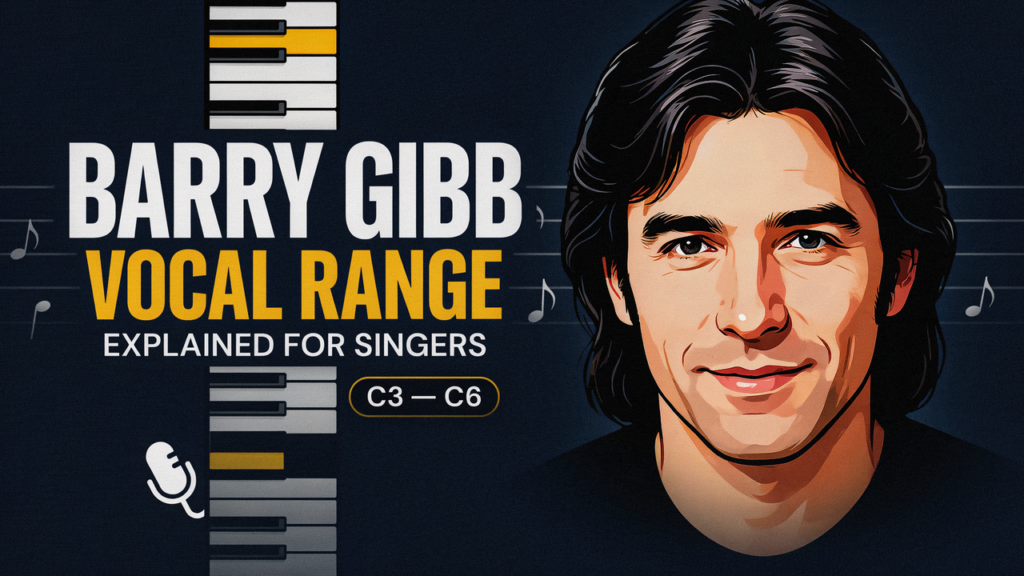
What Is Barry Gibb’s Vocal Range
Barry Gibb is widely considered a tenor-leaning male singer with an unusually high, consistent upper register.
Why you’ll see different answers online
Because people don’t agree on what counts.
Some sources count only:
- clean, sustained musical notes
Others count:
- falsetto extremes
- brief high “hits”
- live moments that aren’t repeatable
For singers, the useful question isn’t “What’s the biggest number?”
It’s: What range could he use musically with control?
If you’re still learning note names, this guide to vocal range notes makes the system simple.
How Many Octaves Does Barry Gibb Have?
You’ll often see estimates in the 3+ octave zone, and some claims go higher depending on what’s included.
The coaching truth about octave counts
Octave counts are like measuring a car’s top speed.
A sports car might hit 200 mph once… but what matters is how it drives every day.
Barry’s “everyday driving” was extremely high for a male singer. That’s why his sound feels so distinctive.
Try the two-octave test to track increases.
Does Falsetto Count as Vocal Range?
Yes—with context.
Falsetto is a real register. It produces real pitches. And Barry’s falsetto wasn’t a weak whisper; it was strong, focused, and musically reliable.
The mistake people make
They treat falsetto like it’s cheating.
But in singing, registers are like gears on a bike:
- chest voice = lower gears (power and weight)
- mix/head voice = middle gears (balance)
- falsetto = higher gears (light, fast, efficient)
You’re still moving forward. You’re just using a different gear.
Falsetto vs Head Voice (And Why Barry’s Sound Is Special)
A lot of singers confuse these terms, so let’s make it practical.
Head voice (in simple terms)
Head voice is a coordination where the voice feels lighter and higher, but still has good closure and resonance.
Falsetto (in simple terms)
Falsetto is typically lighter, often airier, and can feel less “connected” unless trained well.
What Barry did differently
Barry’s falsetto often had:
- better closure than most singers
- a focused “ring”
- stable pitch and phrasing
That’s why it didn’t sound like a gimmick. It sounded like a real singing voice.
To understand how registers behave, this breakdown of head voice vs chest voice will give you a solid foundation.
What Voice Type Is Barry Gibb?
Barry is usually described as a tenor, but there’s nuance.
Why the label gets complicated
Voice type isn’t just your highest note.
It’s about:
- your tessitura (where you live comfortably)
- your tone weight
- how your voice transitions through the passaggio
Barry’s tessitura sat high for long periods, which supports the tenor classification.
If you want a clean reference point, compare his “home zone” to the tenor vocal range.
Range vs Tessitura: Why Barry Sounded “High” All the Time
This is the missing piece in most range articles.
Range is the edges. Tessitura is the home.
Barry’s range is impressive, but his tessitura is the real story.
He didn’t just visit high notes.
He lived in them.
That’s why his singing feels like it floats above the track instead of pushing through it.
If you want a clear explanation with examples, read tessitura explained.
The One Table You Need: Barry’s “Register Map”
This table is more useful than arguing about a single highest note.
| Register | What it sounds like | What singers should learn |
|---|---|---|
| Chest voice | Warm, speech-like | Don’t force it upward |
| Mix / head-dominant | Bright, balanced | Smooth bridge control |
| Falsetto | Light but focused | Closure + pitch stability |
| Falsetto “peaks” | Very high, dramatic | Short hits, not long holds |
Barry’s genius was using these registers like a palette. He didn’t try to paint everything with one color.
What Singers Can Learn From Barry Gibb (That Actually Transfers)
Barry’s voice is not just “high.”
It’s efficient.
Here are the transferable skills:
- Smooth transitions (no sudden flips)
- Falsetto that stays on pitch
- High singing without pushing volume
- Vowel shapes that keep resonance focused
That last one matters more than most singers realize. High notes don’t need bigger vowels. They usually need smarter vowels.
Step-by-Step: How to Train a Strong Falsetto
This is the part singers actually want.
You’re going to train:
- clean onset
- stable airflow
- smooth bridge
- and falsetto strength without strain
If you feel scratchy, tight, or hoarse at any point, stop. Falsetto training should feel light, not punishing.
The 6-step practice plan (numbered list)
- Warm up with gentle humming for 60 seconds
- Do “NG” sirens for 2 minutes (bridge training)
- Sing “OO” in a light head voice for 2 minutes
- Switch to falsetto on “OO” for 2 minutes (same notes, lighter)
- Add “GEE” for closure for 2 minutes (small and bright)
- Cool down with soft slides downward for 60 seconds
This sequence works because it trains coordination first, then adds strength.
If you want a consistent routine you can repeat, start with a daily vocal warm-up and keep the intensity moderate.
The most important skill — bridging without panic
Most singers lose their upper range because they fight the bridge.
They try to:
- keep chest voice too high
- or jump to falsetto too suddenly
Barry’s sound works because the bridge is smooth.
Think of it like stepping onto an escalator instead of leaping onto a moving train.
How to get Barry-style falsetto strength (without yelling)
Falsetto strength does NOT come from more air.
It comes from:
- better vocal fold closure
- better resonance focus
- and less throat tension
A great check is to use a pitch detector while you practice and see if your falsetto stays centered as you get louder.
Quick Self-Check (90 Seconds)
Use this after practice.
Ask yourself:
- Can I enter falsetto without a breathy “whoosh”?
- Can I sing 5 notes in falsetto without going sharp?
- Do my high notes feel light rather than squeezed?
- Does my speaking voice feel normal afterward?
If your speaking voice feels tired, your practice was too intense or too long.
Common Mistakes When Copying Barry Gibb
Barry’s style is inspiring, but copying it incorrectly is how singers get strained.
Mistake 1: Forcing chest voice upward
If you try to “muscle” your way into the high range, you’ll hit a wall.
Barry didn’t brute-force high notes. He coordinated them.
Mistake 2: Making falsetto too breathy
Breathy falsetto feels easy, but it often goes flat and unstable.
Train a clean onset and a focused vowel instead.
Mistake 3: Trying to sing high notes too loud
Barry’s high singing often feels loud because it’s bright, not because it’s pushed.
Brightness is resonance. Loudness is pressure.
Don’t confuse them.
Mistake 4: Practicing high every day without recovery
High singing uses small muscles and fine coordination.
If you grind it daily, your voice will lose consistency.
Mistake 5: Chasing range instead of control
A wider range is useless if:
- pitch is unstable
- tone is thin
- or your voice gets hoarse afterward
If you want a better benchmark, compare your results to the male vocal range chart and focus on making your comfortable notes stronger first.
Realistic Expectations (And Vocal Health)
Barry Gibb is an outlier.
Not every male singer will have that kind of falsetto strength or that high of a tessitura. That’s partly anatomy and partly years of coordination.
But most singers can improve:
- falsetto stability
- head voice clarity
- bridge smoothness
- and upper-range endurance
If you ever feel pain, burning, or persistent hoarseness, stop and rest. Training should feel like athletic conditioning, not injury.
The Bottom Line
Barry Gibb’s vocal range is famous because it’s wide, but his real superpower is how he used registers—especially falsetto—as a reliable, musical tool.
If you train the bridge, strengthen closure, and keep high notes light and focused, you can build a high register that’s usable, safe, and genuinely musical.
FAQs
1) What is Barry Gibb’s vocal range?
Barry Gibb is widely credited with a very wide range, especially because of his strong falsetto. Exact note lists vary depending on whether you count brief extremes or only sustained musical notes. The key takeaway is that his usable high register is unusually consistent.
2) How many octaves does Barry Gibb have?
Most estimates place him around the 3+ octave range, with some claims going higher depending on measurement. The bigger story is that his tessitura sits high, meaning he could sing in a high zone comfortably for long stretches. That’s what made his voice feel so distinctive.
3) Does falsetto count as part of vocal range?
Yes—falsetto produces real pitches and is a legitimate register. It should be labeled clearly because it’s a different coordination than chest voice. Barry’s falsetto counts especially because it was musically controlled, not just an effect.
4) What voice type is Barry Gibb?
He’s generally described as tenor-leaning because of his high tessitura and upper range. But pop voice types don’t map perfectly to classical labels. The more useful approach is understanding his register strategy and comfort zone.
5) Why is Barry Gibb’s falsetto so strong?
Because it has good closure, focused resonance, and consistent pitch control. Many singers have falsetto, but fewer have falsetto that stays stable and musical at high intensity. That stability is a trained skill.
6) Can men learn to sing like Barry Gibb?
You can learn many of the same skills: smooth bridging, falsetto stability, and bright resonance. But your exact tone and maximum notes will depend on your anatomy. Aim to build the coordination, not to clone the sound.
7) What’s the safest way to train falsetto?
Train lightly, focus on clean onset, and keep volume moderate. Use short exercises and stop if your voice feels irritated. Consistency and recovery will build falsetto faster than pushing.

Cooke is a vocal training and singing education writer specializing in vocal range analysis, pitch recognition, voice development, and singing tools for vocalists, performers, musicians, and beginners. He creates practical content focused on vocal improvement, singing techniques, and voice analysis resources.