
Benson Boone’s vocal range is the span of notes he can sing from his lowest usable chest voice to his highest upper-register pitches. He’s known for emotional pop vocals that combine a strong mix voice, high belts, and occasional falsetto. Exact range numbers vary depending on whether brief high notes and falsetto are included.
Most people search this because they hear him hit big, dramatic high notes and wonder: Is his voice naturally that high? What voice type is he? And can I sing like that without wrecking my throat?
Let’s answer it like a coach.
If you want to compare your voice to his, start by taking a vocal range test so you’re not guessing.
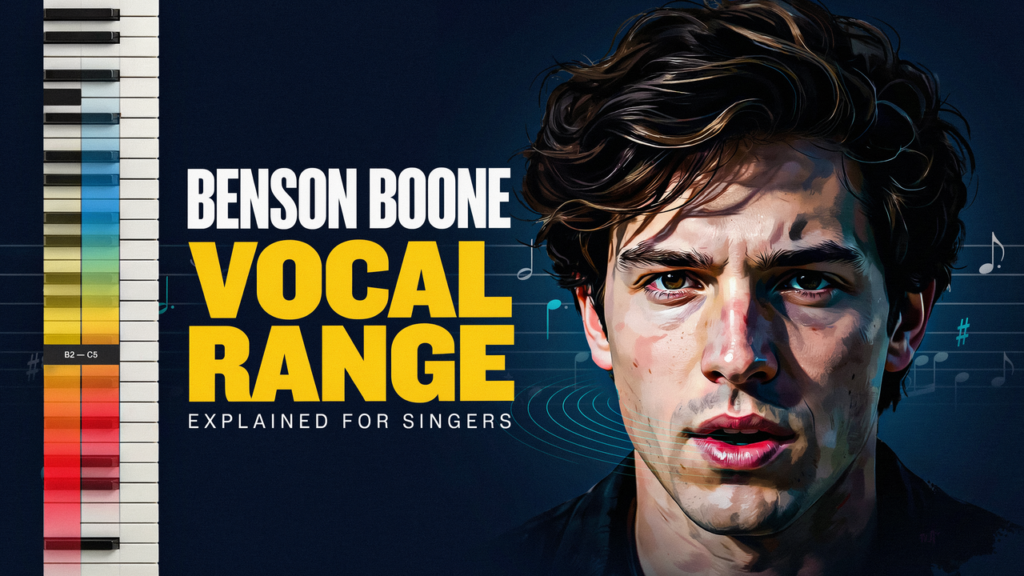
What Is Benson Boone’s Vocal Range (The Practical Answer)
Benson Boone is a tenor-leaning modern pop singer with a high tessitura and a strong mix.
That means he doesn’t just “visit” high notes for a second. He often sings in a high zone for full phrases, then peaks into bigger belts for emotional impact.
Why the internet can’t agree on his exact range
Because people measure range differently.
Some count only:
- clean, sustained, musical notes
Others count:
- brief high hits
- falsetto extremes
- studio-layered moments
For singers, the useful question is not “What’s the biggest number?”
It’s: What notes can he sing with control, consistently, and musically?
If you want to understand how note names work (C4, A4, etc.), this guide to vocal range notes makes it clear fast.
How Many Octaves Does Benson Boone Have?
You’ll see a lot of “octave” claims online, but here’s the coaching truth:
Octaves are not the main story
Octaves are like measuring a car’s top speed.
It’s interesting, but it doesn’t tell you:
- how stable the steering is
- how long the engine lasts
- or whether the driver has control
Benson’s standout trait isn’t just range size.
It’s that his high range is usable, emotional, and repeatable.
The range extension check is useful for daily logging.
What Voice Type Is Benson Boone?
Most singers trying to label Benson Boone end up stuck between “tenor” and “high baritone.”
Here’s the most accurate, singer-friendly answer:
Benson Boone is tenor-leaning in pop terms
His voice sits high in the mix and he sustains high phrases comfortably, which is a strong tenor indicator.
But voice type isn’t just about your highest note. It’s also about where your voice feels best for long stretches.
That’s tessitura.
If you want a clean explanation of classification, this overview of voice types will help you frame it correctly.
Range vs Tessitura: Why Benson Sounds “High” All the Time
Most people confuse range and tessitura.
Range is the edges. Tessitura is the home.
Range = your lowest and highest possible notes.
Tessitura = the range where you can sing the most comfortably and consistently.
Benson’s tessitura is high.
That’s why his songs often feel like they “live” near the top of the staff, even before the big climax note happens.
If you want the clearest definition, read what tessitura means.
The Secret Behind His High Notes: Mix Voice
If you want to understand Benson Boone’s singing, you need one concept:
Mix voice is the bridge between chest and head
Mix is a coordination where you keep:
- some chest-like strength
- while allowing head-voice flexibility
That’s how singers get high notes that sound powerful without being pure shouting.
Why Benson’s mix works so well
His mix tends to have:
- strong closure (not breathy)
- bright resonance
- stable vowels
- emotional intensity without constant pushing
If you’re still fuzzy on registers, start with chest voice vs head voice because mix only makes sense once those two are clear.
Does Benson Boone Use Falsetto?
Yes, but it’s not the main engine of his sound.
Falsetto is the “light gear”
Falsetto is real singing, but it’s usually:
- lighter
- thinner
- and less weighty than mix
Benson’s signature emotional peaks are usually mix-dominant, not falsetto-dominant.
That’s important because it tells you what to train if you want to sing his songs.
Use the octave span tool to explore your range limits.
The One Table You Need: Benson Boone’s Range Profile (By Register)
This is more useful than chasing one “highest note.”
| Zone | What it sounds like | What singers should focus on |
|---|---|---|
| Low chest | Warm, speech-like | Relaxed support, no pushing |
| Mid range | Clear and emotional | Breath pacing + vowel clarity |
| High mix | Big, intense, controlled | Narrow vowels + stable closure |
| Falsetto | Light, airy, floating | Clean onset + pitch accuracy |
This is why he’s challenging: the song climaxes happen in the high mix zone, where most singers either crack or strain.
What Singers Can Learn From Benson Boone (That Actually Helps)
Here’s the coaching takeaway: Benson’s sound is not “random talent.”
It’s a set of skills working together.
- He paces breath well so phrases don’t collapse
- He narrows vowels as pitch rises
- He uses brightness (twang/resonance) instead of brute force
- He commits emotionally without over-squeezing the throat
This is why his climaxes sound huge: the voice is coordinated, not muscled.
Step-by-Step: How to Train Benson-Style High Notes Safely
If you want to sing like Benson Boone, you don’t start by screaming the chorus.
You start by building:
- a stable bridge
- a clean mix
- and controlled intensity
The 10–12 minute training plan (numbered list)
- Warm up with gentle hum slides (1 minute)
- Do “NG” sirens from low to high (2 minutes)
- Sing five-note scales on “OO” (2 minutes)
- Sing five-note scales on “GEE” (2 minutes)
- Practice short “HEY!” hits in a comfortable high area (2 minutes)
- Sing one short phrase from a song softly (2 minutes)
- Cool down with light slides downward (1 minute)
This plan trains coordination first, then intensity.
If you want a routine you can repeat daily, this daily vocal warm-up fits perfectly before your song work.
The most important drill for this style
The “NG” siren is your best friend.
It teaches your voice to cross the bridge without:
- flipping
- squeezing
- or pushing extra air
Think of it like learning to shift gears smoothly instead of grinding the engine.
The vowel strategy that makes high notes possible
Most singers fail high notes for one reason:
They open vowels too wide.
High notes don’t want a huge “AH.”
They want a slightly narrower shape, closer to “UH” or “EH,” depending on the word.
That small adjustment is like aiming a flashlight. You’re focusing the beam, not making it brighter by burning more fuel.
Quick Self-Check (90 Seconds)
After practice, ask yourself:
- Can I sing higher without my jaw clenching?
- Do my high notes feel bright, not squeezed?
- Can I do a short high phrase without throat burn?
- Does my speaking voice feel normal afterward?
If your speaking voice feels raspy, you practiced too hard.
For a reality check on pitch, use a pitch detector and see whether your high notes are actually centered.
Common Mistakes When Copying Benson Boone
This section matters because Benson’s style is where singers get hurt.
Mistake 1: Trying to belt in pure chest voice
If you drag chest voice upward, you will eventually hit a wall.
Benson’s power is mix coordination, not brute chest.
Mistake 2: Using more air to “force” the note
More air doesn’t create high notes.
More air usually creates:
- sharp pitch
- throat tension
- and vocal fatigue
Mistake 3: Singing the chorus at full volume every time
If you rehearse at 100% daily, your voice won’t recover.
Train at 60–80% most of the time. Save 100% for performance.
Mistake 4: Ignoring the bridge
If you don’t train the bridge, your voice will crack unpredictably.
That crack isn’t “lack of talent.” It’s lack of coordination.
Mistake 5: Treating his songs like they’re beginner-friendly
They aren’t.
Many Benson Boone songs sit high and demand emotional intensity. That’s a hard combo.
If you want a structured approach to building the upper range, use sing higher notes safely as your foundation.
Realistic Expectations (And Vocal Health)
Benson Boone’s voice is a blend of:
- anatomy
- style choices
- and coordination
You can absolutely train:
- a stronger mix
- better breath pacing
- more stable high notes
- and cleaner transitions
But you can’t copy his exact tone. That’s okay.
Also: if you feel pain, burning, or persistent hoarseness, stop and rest. High-note training should feel like athletic work—challenging, not damaging.
The Bottom Line
Benson Boone’s vocal range is impressive, but the real reason he sounds powerful is mix voice, vowel control, and emotional phrasing that stays coordinated.
If you train the bridge, narrow vowels as you rise, and build intensity in short controlled bursts, you can develop a high register that’s strong, musical, and safe.
FAQs
1) What is Benson Boone’s vocal range?
Benson Boone has a wide, tenor-leaning range with a strong upper mix that he uses for emotional climaxes. Exact note lists vary depending on whether falsetto and brief high hits are included. The most useful takeaway is that his high range is repeatable and central to his style.
2) How many octaves does Benson Boone have?
Most octave estimates are rough because they depend on what you count as “usable.” Some measurements include falsetto extremes, while others only count sustained musical notes. For singers, his high tessitura matters more than the exact octave number.
3) Is Benson Boone a tenor or baritone?
He’s best described as tenor-leaning in pop terms because he sustains high phrases comfortably and relies heavily on upper mix. A baritone can sometimes sing his songs, but usually only with transposition or excellent mix development. Voice type is about comfort zone, not just the highest note.
4) Does Benson Boone use falsetto?
Yes, but his signature climaxes are usually mix-dominant rather than pure falsetto. Falsetto shows up more as a color or lighter texture. The power moments are typically a coordinated high mix.
5) Why do Benson Boone songs feel so hard to sing?
Because they sit high for long stretches and demand emotional intensity. That combination exposes weak bridging and unstable vowels quickly. It’s not just range—it’s stamina, coordination, and phrasing.
6) Can beginners learn to sing like Benson Boone?
Beginners can learn the foundations, but they should not start by forcing the high choruses. Start with breath pacing, clean head voice, and gentle mix-building. Then gradually increase intensity as coordination improves.
7) What’s the safest way to practice his high notes?
Train high notes in short bursts, not long holds. Focus on vowel narrowing, stable airflow, and smooth bridging. Stop immediately if you feel throat burn or persistent hoarseness, and give your voice recovery time.

Cooke is a vocal training and singing education writer specializing in vocal range analysis, pitch recognition, voice development, and singing tools for vocalists, performers, musicians, and beginners. He creates practical content focused on vocal improvement, singing techniques, and voice analysis resources.