
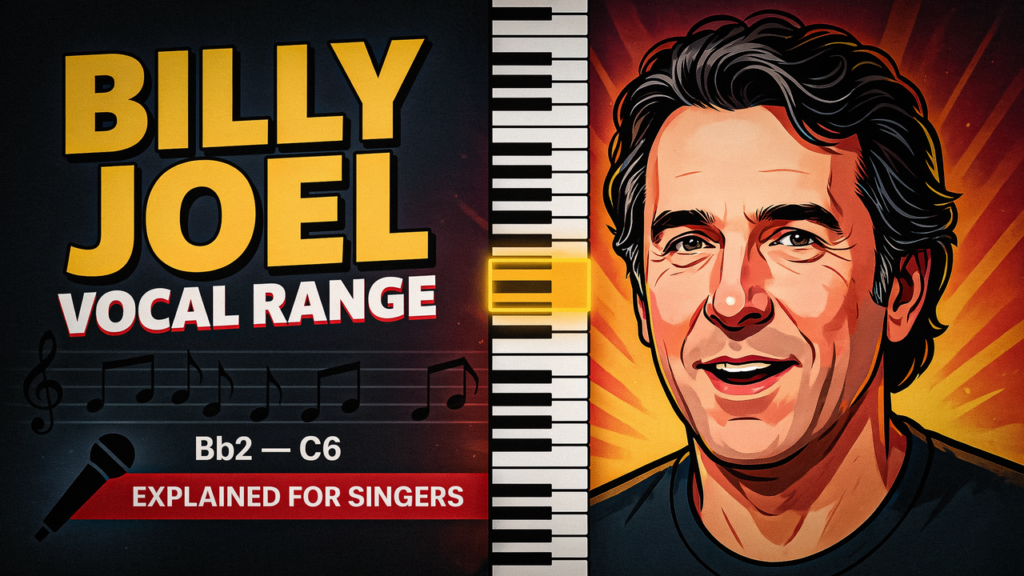
Billy Joel’s vocal range is the span of notes he could sing from his lowest usable pitches to his highest controlled notes. He’s often described as a baritone-leaning singer with a strong upper extension, using chest voice for weight and a head-dominant mix for higher phrases. Range estimates vary by era, recording, and what counts as a “usable” note.
Most people look this up because they want a number.
As a coach, I want you to leave with something more valuable: what his voice type likely is, why his songs feel the way they do, how his voice changed over time, and how you can sing his repertoire without strain.
If you want to compare your voice to his, start by using a find your vocal range tool so you’re working with real notes, not guesswork.
What Is Billy Joel’s Vocal Range (The Practical Answer)
Billy Joel’s range is impressive, but it’s not “superhuman.”
His real strength is that he wrote and performed songs that sit in a musically powerful zone for his voice—especially in his early and mid-career.
Why range numbers online don’t match
Different sources count different things, such as:
- studio notes vs live notes
- brief “hits” vs sustained pitches
- falsetto moments vs full-voiced singing
That’s why you’ll see one page claim one octave count and another claim something else.
For singers, the better metric is working range: the notes he used consistently with control.
If you’re still learning note names (C3, G4, etc.), this guide to vocal range notes will make the whole topic easier instantly.
How Many Octaves Does Billy Joel Have?
Octave counts are fun, but they’re often misleading.
The coaching truth about octave numbers
Octaves are like measuring the top speed of a car.
It’s interesting, but it doesn’t tell you:
- how well the car handles
- how long it lasts
- or whether you can drive it comfortably for an hour
Billy Joel’s best vocal years weren’t defined by a massive octave count.
They were defined by stamina, tone, and songwriting that fit his tessitura.
Try this octave measurement test before choosing songs.
What Voice Type Is Billy Joel?
Billy Joel is commonly described as either:
- a baritone
- or a baritone-leaning tenor
Both can be “true” depending on how you define voice type.
The most accurate singer-friendly answer
Billy Joel is best understood as a baritone-leaning singer with strong upper range.
That means:
- his voice has weight and warmth in the middle
- but he can climb high when needed
- especially in a head-dominant mix
If you want a quick reference point for the categories, compare baritone vocal range and tenor vocal range and notice where you feel most comfortable, not just what you can “hit.”
Range vs Tessitura: Why His Songs Feel “High” or “Comfortable”
This is the part most people miss.
Range is the edges. Tessitura is the home.
Range is the lowest and highest notes you can reach.
Tessitura is where your voice can sing for a long time and still sound good.
Billy Joel’s best songs sit in a tessitura that matches his natural strengths: strong midrange with frequent climbs into a bright upper zone.
If you want the clearest explanation, this breakdown of tessitura is essential.
How Billy Joel Used Registers (And Why It Worked)
Billy Joel wasn’t a “register show-off.”
He wasn’t trying to impress with whistle notes or extreme belts.
His voice worked because he used registers like a smart musician.
Chest voice: the foundation
His chest voice carries most of the storytelling.
It’s speech-like, rhythmic, and grounded—perfect for piano-driven rock and pop.
Head-dominant mix: the emotional lift
When he needed intensity, he often moved into a brighter, lighter coordination.
This is what gives the chorus that “lift” without making it sound like yelling.
Falsetto: occasional color, not a main tool
Billy Joel wasn’t known as a falsetto singer.
If falsetto appears, it’s usually for a moment of color rather than the core sound.
If you want to understand the mechanics behind these shifts, start with chest voice vs head voice.
The One Table You Need: What Makes His Singing Work
Instead of obsessing over one “highest note,” use this as the singer’s takeaway.
| Skill | What it sounds like | Why it matters in Billy Joel songs |
|---|---|---|
| Strong midrange | Warm, direct storytelling | Most verses live here |
| Upper extension | Bright, intense choruses | Creates lift without screaming |
| Breath pacing | Long phrases stay stable | Piano songs demand line |
| Clear diction | Words stay understandable | His songs are lyric-driven |
Billy Joel’s singing is proof that range isn’t the main event.
Control is.
Did Billy Joel’s Voice Change Over Time?
Yes—and this is a major part of why people search this keyword.
What changed
Over time, many singers experience:
- less easy access to the highest notes
- more vocal fatigue after long shows
- a darker or rougher tone
- a slightly lower tessitura preference
Billy Joel’s voice matured and thickened, and his upper range became less consistent than in his earlier recordings.
Why this happens (without drama)
This can happen due to:
- natural aging
- years of touring
- vocal swelling from heavy schedules
- changes in lifestyle and recovery
This isn’t “failure.” It’s a normal reality for many professional voices.
What Singers Can Learn From Billy Joel (That Improves Your Voice)
If you sing piano-based pop or rock, Billy Joel is an excellent model.
Here are the lessons that transfer directly:
- Sing like you speak, but on pitch
- Keep vowels stable as you rise
- Don’t over-belt the chorus
- Use phrasing and rhythm to create intensity
- Choose keys that match your tessitura
That last point is huge. Billy Joel’s songs are often easier when transposed slightly for your voice.
Step-by-Step: How to Sing Billy Joel Songs Without Strain
This is a simple 10–12 minute routine designed for singers who want:
- strong midrange
- clean upper notes
- and stamina for full songs
The practice goal
You’re building a “piano singer” voice:
- stable
- clear
- and emotionally expressive without pushing
If you feel throat burn, hoarseness, or pain, stop and rest. Strain is not training.
The 6-step routine (numbered list)
- Gentle humming for 60 seconds (midrange only)
- “NG” sirens for 2 minutes (smooth bridge training)
- Five-note scales on “EH” for 2 minutes (clear diction)
- Five-note scales on “OO” for 2 minutes (vowel stability)
- Short chorus phrases at 70% volume for 3 minutes
- Cooldown slides downward for 60 seconds
If you want a routine you can use daily, this daily vocal warm-up pairs perfectly with Billy Joel-style singing.
The key skill — intensity without yelling
Billy Joel’s choruses feel powerful because of:
- rhythm
- clarity
- and resonance
Not because he’s forcing maximum volume.
A great analogy:
You don’t make a piano louder by smashing the keys. You make it louder by playing with controlled force and better tone.
Singing is the same.
The “right key” is not cheating
Many singers hurt themselves trying to sing Billy Joel in the original key.
That’s not bravery. That’s bad planning.
If a chorus sits right at your bridge, it will feel like a tightrope walk every time.
Choose a key where the chorus sits in your best zone, and you’ll sound more confident instantly.
To understand where your voice sits compared to typical male singers, this male vocal range chart is a useful baseline.
Quick Self-Check (90 Seconds)
After practicing a Billy Joel chorus, ask yourself:
- Can I sing the chorus twice without tightening?
- Do my high notes feel bright instead of squeezed?
- Can I keep diction clear without jaw tension?
- Does my speaking voice feel normal afterward?
If your speaking voice is raspy, you pushed too hard.
If you want to check pitch accuracy, use a pitch detector and see if your chorus notes are drifting sharp when you get louder.
Common Mistakes When Singing Billy Joel
These mistakes are why singers feel “stuck” on his songs.
Mistake 1: Singing everything at full volume
Billy Joel’s dynamics matter.
If you sing verses too loudly, you’ll have nothing left for the chorus.
Mistake 2: Forcing chest voice into the high chorus
If you drag chest voice upward, you’ll either:
- strain
- go flat
- or crack
Use a head-dominant mix for the chorus lift.
Mistake 3: Losing vowels and diction
Billy Joel’s songs are lyric-driven.
If your vowels spread wide on high notes, your tone will splat and your words will disappear.
Mistake 4: Not training stamina
Piano-vocal songs often have long phrases.
If your breath collapses, your pitch and tone collapse with it.
Mistake 5: Choosing the wrong key for your tessitura
This is the biggest one.
The “right key” is the one you can sing repeatedly without vocal fatigue.
The Bottom Line
Billy Joel’s vocal range is interesting, but the real story is how he used his voice: strong midrange, a reliable upper extension, and smart phrasing that fits his tessitura.
If you train the bridge, pace your breath, and choose keys that match your comfort zone, you can sing Billy Joel songs with power and control—without pushing your voice past its limits.
FAQs
1) What is Billy Joel’s vocal range?
Billy Joel is often described as a baritone-leaning singer with a strong upper extension. Exact range claims vary depending on the era and whether you count brief notes or only sustained ones. His working range is the more useful measurement for singers.
2) How many octaves does Billy Joel have?
Octave estimates differ because sources measure range differently. Some include quick high notes, while others only count repeatable, musical pitches. The most important point is that he had a solid midrange and dependable upper range in his prime.
3) Is Billy Joel a tenor or baritone?
He’s best described as baritone-leaning with tenor-like access to higher notes. His tessitura and vocal weight suggest baritone, but he could sing high when needed. In pop music, these labels are flexible and often overlap.
4) Did Billy Joel’s voice change over time?
Yes, his voice matured and his highest notes became less consistent over the years. That’s common for singers with long touring careers. It doesn’t mean he “lost” his voice—it means the instrument changed.
5) What songs show Billy Joel’s range best?
Songs with softer verses and high choruses tend to show his full range. The biggest range moments usually appear in choruses where he lifts into a brighter, higher coordination. For singers, those are also the most demanding sections.
6) Can a baritone sing Billy Joel songs?
Yes, but many baritones need to transpose songs slightly to avoid living on the bridge. If the chorus sits too high, the singer will strain or shout. A small key change often makes the performance sound dramatically better.
7) What’s the difference between range and tessitura?
Range is the full span of notes you can reach, while tessitura is where your voice is comfortable most of the time. Billy Joel’s songwriting often sits in a tessitura that matched his strengths. Most singers improve faster by training tessitura before chasing extreme notes.

Cooke is a vocal training and singing education writer specializing in vocal range analysis, pitch recognition, voice development, and singing tools for vocalists, performers, musicians, and beginners. He creates practical content focused on vocal improvement, singing techniques, and voice analysis resources.