
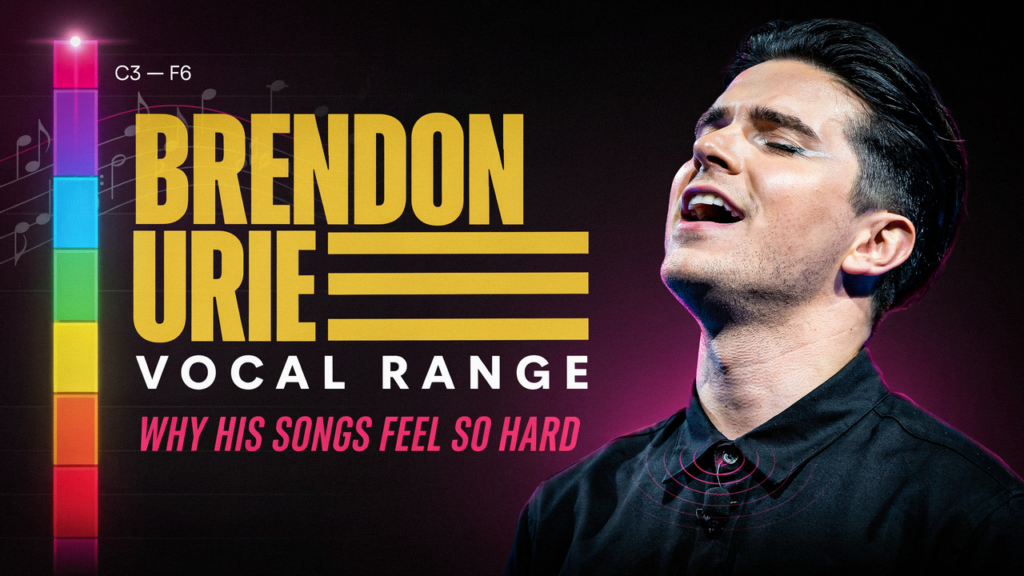
Brendon Urie’s vocal range is widely described as a wide tenor range, with strong high notes in mixed voice and additional extension in falsetto. While exact highest and lowest notes vary by performance, his real “superpower” is a high tessitura—he sings high for long stretches, not just for one peak note.
If you’ve ever tried to sing Panic! songs and thought, “Why does this feel impossible?”—this is why.
The Big Idea: Range vs Tessitura (This Is the Whole Story)
Most people search “Brendon Urie vocal range” because they want:
- the highest note
- the octave count
- proof he’s a freak of nature
But as a coach, I want you to focus on what actually affects your singing.
Range is the extremes
Range is your highest and lowest possible notes.
You might hit them once in a while, under perfect conditions.
Tessitura is the truth
Tessitura is where you can sing comfortably, repeatedly, and with good tone.
Brendon’s music is hard because the tessitura sits high for a long time. That’s like doing a sprint for three minutes straight.
If you want the concept in plain language, read this tessitura breakdown before you judge your voice.
What Voice Type Is Brendon Urie?
Brendon is best described as a tenor, with strong high-tenor traits.
That doesn’t mean he can’t sing low notes. It means his voice is built to live higher than most male singers without sounding strained.
Why people argue about it
People confuse three things:
- voice type (where your voice works best)
- tone (bright vs dark)
- range (extremes)
Brendon’s tone is bright, his tessitura is high, and his technique is efficient. That combination makes people think he’s “superhuman.”
If you want a clean baseline for comparison, start with this tenor vocal range guide.
What Makes Brendon’s High Notes So Powerful?
Brendon doesn’t sing high by “pushing harder.”
He sings high by using the right coordination.
1) Mixed voice, not pure chest
A lot of singers try to take chest voice straight up like they’re lifting a heavy box.
Brendon’s highs are more like lifting a suitcase with wheels. Still strong—but smarter.
If you’re confused about registers, this chest voice vs head voice explanation will clear up 80% of the confusion.
2) Bright resonance and twang
He uses a focused, bright resonance that helps the voice cut through without extra volume.
Think of it like aiming a laser pointer instead of using a floodlight.
3) Vowel modification
Brendon subtly changes vowels as he goes higher.
This is not “singing weird.” This is how high notes stay stable.
4) Stamina (the hidden skill)
The hardest part of his singing isn’t one high note.
It’s singing high for a full chorus, then doing it again, then again.
The live pitch detector makes it easy to practice clean intonation.
Why Panic! Songs Feel High Even When the Notes Aren’t Extreme
This is the part most singers miss.
Many Panic choruses sit in the upper-mid tenor zone—notes that are “reachable,” but exhausting if your technique isn’t efficient.
The real challenge is the middle-high zone
Brendon’s songs often live where many male singers start to feel:
- tightness
- vowel strain
- breath pressure
- fatigue
That’s tessitura pressure.
If you want to compare your own voice realistically, use this vocal range calculator and pay attention to your comfortable middle-high notes, not just your top note.
Full Voice vs Falsetto: What Counts as “His Range”?
When people quote massive ranges online, they often mix:
- full voice (chest/mix/head coordination)
- falsetto (lighter, airy top register)
Brendon has both.
But they are different tools.
Full voice high notes = athletic
These are the notes that feel like power and intensity.
Falsetto high notes = lighter extension
Falsetto can go higher, but it doesn’t carry the same weight.
A singer can have a huge falsetto range and still struggle to belt.
The smartest way to describe Brendon is:
- strong full-voice high range
- additional falsetto extension
- unusually high tessitura
Step-by-Step: How to Sing Like Brendon Urie
If you try to copy his sound by yelling, you will burn out.
This approach trains the right coordination without wrecking your voice.
Step 1: Pick a key you can actually sing
Do not treat the original key like it’s sacred.
If you’re not a tenor, you’ll need to transpose down. That’s normal.
If you want a fast way to experiment with keys, use this song key finder and test 2–3 options.
Step 2: Build the high notes quietly first
This is the rule most singers ignore.
High notes should be trained at medium to low volume first.
If you can only hit the note by getting louder, you’re not ready to sing it on stage.
Step 3: Use “ng” to find the right placement
Try this:
- hum on “ng” (like the end of “sing”)
- slide up gently
- feel the resonance in the face
Then open to a vowel like “uh” or “eh.”
This helps you find a high coordination without pushing.
Step 4: Modify vowels as you go higher
As you approach the upper part of your range:
- “ee” becomes more like “ih”
- “eh” becomes more like “ay”
- “ah” becomes more like “uh”
That keeps the throat from squeezing.
Step 5: Add twang without shouting
Use a slightly bratty “yeah” sound.
Not loud. Just focused.
This gives you ring and clarity without extra pressure.
Step 6: Train stamina, not just the note
Practice short phrases in the high zone, then rest.
Brendon’s strength is that he can repeat high phrases without losing control.
The Brendon Training Routine (Numbered List)
Do this 3–5 times per week for 10–15 minutes.
- Warm up gently in the middle range for 2 minutes
- Do 3 light slides up into your high zone (no pushing)
- Sing a chorus phrase at 60% volume
- Rest for 20–30 seconds
- Repeat the phrase, focusing on vowel shape
- Record and listen for strain or shouting
- Stop the moment your throat feels tight
Stopping early is not weakness. It’s how you build endurance.
One Bullet List: Signs You’re Doing It Right
When you sing Brendon-style high phrases correctly, you’ll notice:
- the sound feels smaller, not bigger
- your throat stays relaxed
- you don’t need to get louder to go higher
- the pitch stays stable
- your vowels feel easy to shape
- your neck doesn’t tense up
- you can repeat the phrase without fatigue
If you want to check whether you’re actually staying on pitch while training, use the pitch detector tool for quick feedback.
One Table That Helps: What You Hear vs What You Should Do
| What you hear in Brendon | What it actually is | What you should practice |
|---|---|---|
| Huge high chorus | High tessitura | Repeating high phrases with rest |
| Powerful belt | Mixed voice + twang | Medium volume, focused “yeah” |
| Clean high vowels | Vowel modification | Slight vowel narrowing up high |
| “Effortless” tone | Efficient coordination | Light onset, no pushing |
| Extreme highs | Falsetto extension | Falsetto control without breathiness |
Quick Self-Check (60 Seconds)
This will tell you if you’re training smart or just surviving.
Check 1: Can you sing the phrase twice?
Pick one high chorus line.
Sing it once, rest 10 seconds, sing it again.
If the second time feels worse, you’re pushing.
Check 2: Is your throat scratchy afterward?
Scratchy is a red flag.
Stop and reset. High singing should not leave your throat irritated.
Check 3: Is your volume creeping up?
Many singers accidentally get louder to “reach” the note.
If your volume is rising, you’re replacing technique with force.
If you want a simple tool-based check, use this pitch accuracy test after your session to see if fatigue is affecting your tuning.
Common Mistakes (That Make Brendon Singing Dangerous)
Mistake 1: Pushing chest voice too high
This is the fastest way to strain.
If you feel pressure in the throat, you’re forcing the wrong register.
Mistake 2: Trying to sing high by singing louder
High notes are not a volume contest.
They are a coordination contest.
Mistake 3: Copying the brightness by squeezing
Brendon’s brightness comes from resonance and twang, not from tightening the throat.
If your neck muscles tense up, you’re doing it wrong.
Mistake 4: Ignoring vowel changes
Singers often try to keep vowels “pure.”
Up high, pure vowels become stiff and cause strain.
Mistake 5: Practicing too long in the high zone
High tessitura singing is athletic.
If you grind it for 45 minutes, you’ll get worse, not better.
If you want a structured approach to expanding your upper range safely, follow this guide on how to sing higher notes and treat it like training, not proving.
Realistic Expectations
If you’re not naturally a tenor, Brendon’s original keys may never feel comfortable.
That doesn’t mean you can’t sing the songs.
It means you should:
- transpose down
- focus on style and phrasing
- build your own high range gradually
You can absolutely improve your high notes over time. But the goal is never “hit it once.”
The goal is:
hit it cleanly, repeatably, without strain.
If you feel tightness, hoarseness, or pain, stop. Rest your voice and return with lighter volume and better placement.
FAQs
1) What is Brendon Urie’s vocal range?
Brendon Urie is widely considered a tenor with a wide range and strong high notes. His range includes powerful mixed voice highs and additional extension in falsetto. The exact highest and lowest notes can vary by performance and song choice.
2) Is Brendon Urie a tenor or baritone?
He’s best classified as a tenor, especially based on where his voice sits comfortably in songs. Many of his choruses live in a high tessitura that most baritones find tiring. A baritone can still sing his music, but usually in a lower key.
3) What is Brendon Urie’s highest note?
People often debate his single highest note, but the bigger point is how consistently he sings high in full voice. Some extreme highs are falsetto, which can extend higher than his belted range. Focus on what he sustains and repeats, not just the peak.
4) Does Brendon Urie use falsetto?
Yes, and he uses it well. Falsetto is part of his top range and adds flexibility for high lines. It’s different from his mixed voice belt, which carries more weight and intensity.
5) Why are Panic! songs so hard to sing?
Because they sit high for long stretches. Even if the notes are technically reachable, the tessitura creates fatigue. That’s why the choruses feel like a workout.
6) Can a baritone sing Brendon Urie songs?
Yes—if you transpose down and don’t force the original key. Many baritones sound great on these songs when they keep the style but choose a key that fits. The goal is control, not suffering.
7) How can I sing high like Brendon without straining?
Train high notes quietly first, use vowel modification, and build mix coordination gradually. Stop immediately if your throat feels scratchy or tight. Consistency over weeks matters more than pushing for a note today.

Cooke is a vocal training and singing education writer specializing in vocal range analysis, pitch recognition, voice development, and singing tools for vocalists, performers, musicians, and beginners. He creates practical content focused on vocal improvement, singing techniques, and voice analysis resources.