
Cynthia Erivo’s vocal range spans approximately E3 to E6 in modal and mixed voice, covering around three octaves, with occasional extensions slightly beyond that in performance. She is generally classified as a mezzo-soprano and is known for sustained Broadway belts, strong upper mix coordination, and exceptional dynamic control.
Those numbers are impressive. But what truly defines her voice is how she uses that range.
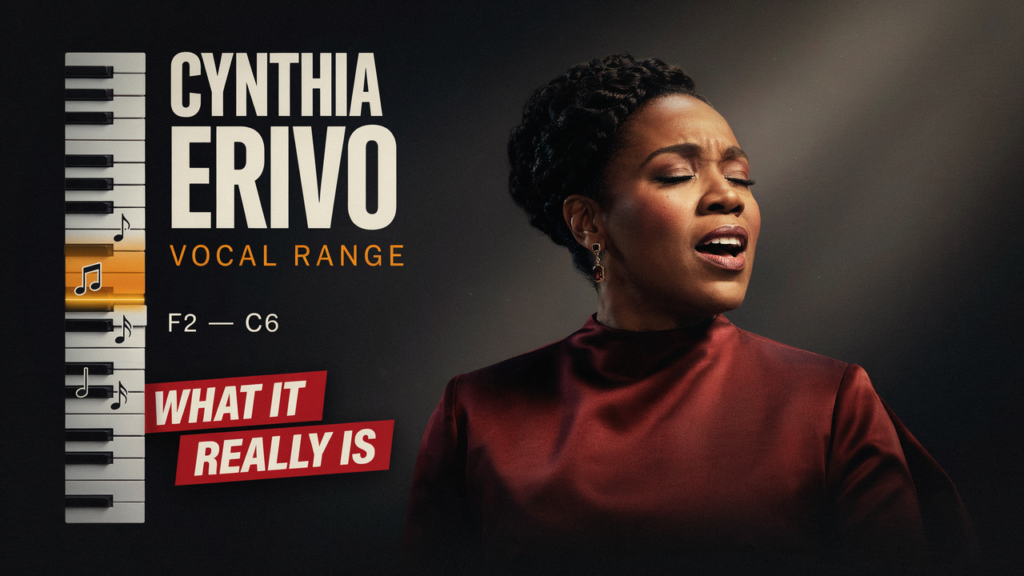
What Is Cynthia Erivo’s True Singing Range?
Most documented performances show:
- Lower notes around E3
- Strong sustained belts up to E♭5–E5
- Head voice extensions approaching E6
That gives her about three solid octaves of functional range.
But the key is not the highest pitch. It’s the tessitura—the zone where the voice feels powerful and repeatable. If you’re unsure what that means, review what is tessitura before comparing ranges.
Erivo’s tessitura often sits in the fourth and fifth octaves, where Broadway roles demand stamina.
Is Cynthia Erivo a Mezzo-Soprano or Soprano?
She is most often classified as a mezzo-soprano.
Why Mezzo-Soprano Fits
- Rich lower tone compared to light sopranos
- Strong chest-dominant belt
- Slightly darker tonal color
- Balanced weight in the middle register
If you want context, compare with the typical mezzo-soprano vocal range.
Her voice has warmth and density, not just brightness.
How She Produces Broadway-Level Belts
Broadway belting is not shouting.
It is controlled, supported intensity.
Cynthia Erivo’s upper belts rely on:
- Strong breath management
- Balanced mix coordination
- Open vowel shaping
- Stable laryngeal position
To understand how this works mechanically, study the difference between chest voice vs head voice.
Think of belting like lifting a heavy object with good posture. If your alignment is correct, the lift feels powerful. If it’s not, strain happens quickly.
Belt vs Head Voice: Why the Distinction Matters
Many singers hear a high note and assume it’s pure chest.
In reality, most sustainable Broadway belts involve a mix.
Here’s a simplified breakdown:
| Category | Approximate Notes |
|---|---|
| Lowest recorded note | E3 |
| Strong belt zone | C5–E♭5 |
| Head voice extension | Up to E6 |
| Comfortable tessitura | G3–C5 |
If you want to see how female voices are mapped more broadly, check a female vocal range chart.
Understanding where your belt transitions into mix prevents injury.
Building a Strong, Sustainable Belt
If you want to develop power like Cynthia Erivo, follow this progression carefully.
1. Stabilize Your Mid-Range
Your G4–B4 must feel balanced before you attempt E5 belts.
If that area feels unstable, strengthen it first using structured best singing exercises.
2. Develop Head Voice First
Strong head voice makes strong belt possible.
Practice sliding upward lightly before adding intensity.
3. Blend Through the Passaggio
The vocal break is where most singers push.
Instead of dragging chest upward, allow some head coordination to mix in.
4. Add Volume Gradually
Power should be layered on top of stability.
If you cannot sing a note softly, you are not ready to sing it loudly.
If you feel tightness, revisit technique with guidance from sing higher notes.
How She Sustains High Notes Live
Broadway demands repetition.
Sustained high notes require:
- Efficient airflow
- Consistent vowel shaping
- Controlled vibrato
- Emotional pacing
It’s like running a marathon. Sprinting works for one note. Stamina wins the show.
Use the pitch detector to track your vocal pitch in real time.
Are You Ready to Belt Higher?
Ask yourself:
- Can I sustain C5 comfortably?
- Does my throat feel relaxed at high volume?
- Can I sing softly at that pitch?
- Do I recover easily the next day?
If recovery is slow or tension builds, step back.
You can objectively measure your range using a vocal range calculator rather than guessing.
Common Mistakes When Trying to Sing Like Cynthia Erivo
Mistake 1: Forcing Chest Voice Too High
Dragging chest upward without mixing causes strain.
Mistake 2: Ignoring Breath Support
High belts collapse without consistent airflow.
Mistake 3: Comparing Octave Numbers
Three strong octaves outperform four unstable ones. Review typical spans in female vocal range before chasing extremes.
Mistake 4: Skipping Warm-Ups
Cold belting increases risk of tension.
If you’re unsure of your current limits, test them gradually using an octave range test.
Realistic Expectations
Most trained female singers have two to three comfortable octaves.
Erivo’s range is impressive because of control, not just height.
You do not need an E6 to sing powerfully. You need coordination.
Range expands slowly over months and years—not days.
What Makes Her Voice Unique
Cynthia Erivo combines:
- Dense lower resonance
- Controlled upper mix
- Sustained Broadway belts
- Emotional phrasing
- Dynamic range from soft to powerful
Her impact comes from control and storytelling.
Range supports artistry. It does not replace it.
Final Coaching Takeaway
Cynthia Erivo’s vocal range spans roughly E3 to E6, with a powerful mezzo-soprano tessitura centered in the fourth and fifth octaves. Her strength lies in sustained, supported Broadway belts—not exaggerated octave claims.
Build coordination first.
Add intensity second.
Chase balance, not numbers.
That’s how range grows safely.
FAQs
1. What is Cynthia Erivo’s highest note?
Her strong head voice extensions reach around E6. Sustained Broadway belts typically sit slightly lower.
2. How many octaves can she sing?
She demonstrates around three functional octaves in modal and mixed voice.
3. Is Cynthia Erivo a soprano?
She is generally classified as a mezzo-soprano based on tonal weight and tessitura.
4. Does she belt high notes?
Yes, she uses strong mixed coordination to sustain Broadway-style belts.
5. Can I train to belt like her?
You can develop stronger upper mix with proper technique and patience. Never force volume before stability.
6. What is her tessitura?
Her comfortable, powerful singing zone sits mainly between G3 and C5.
7. Is it normal not to sing as high as her?
Yes. Most singers have two to three comfortable octaves. Sustainable control matters more than extreme height.

Cooke is a vocal training and singing education writer specializing in vocal range analysis, pitch recognition, voice development, and singing tools for vocalists, performers, musicians, and beginners. He creates practical content focused on vocal improvement, singing techniques, and voice analysis resources.