
Taehyung’s vocal range refers to the lowest and highest notes he can sing, measured in musical pitch (for example, E2 to C5). Based on recorded performances, his range spans roughly E2 to C5, covering about three octaves, with a naturally low tessitura that supports a baritone classification.
That’s the short answer. Now let’s break down what that actually means in practical, vocal terms.
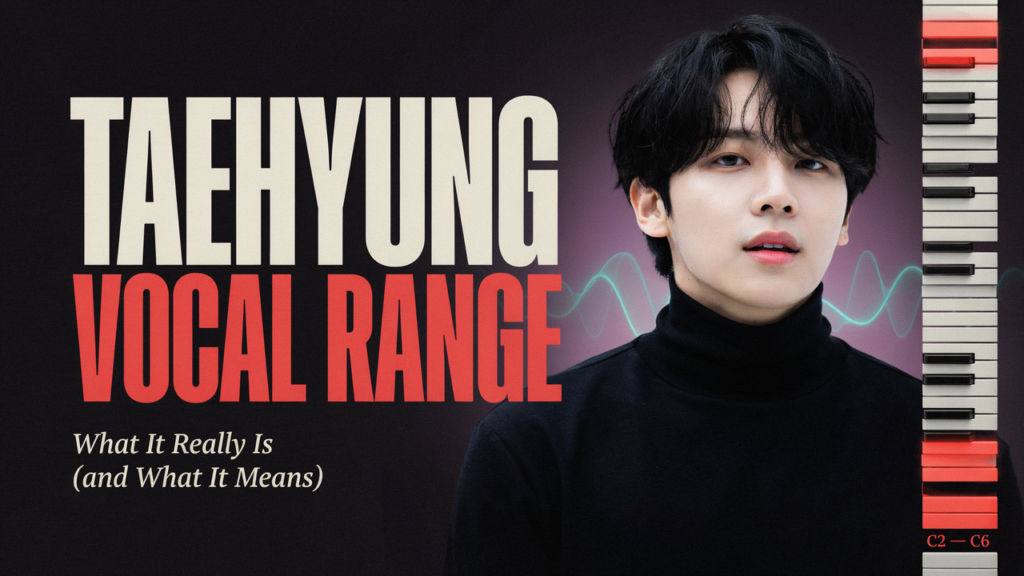
What Is Taehyung’s Lowest and Highest Note?
E2 sits deep in the male lower register. It requires solid chest resonance and relaxed laryngeal positioning. Notes in this area are not just “low” — they must be supported to sound full rather than breathy.
Taehyung’s tone in this range is warm and rounded, which is typical of a natural baritone.
Highest Note: Around C5
C5 is significantly above a standard baritone tessitura. This note typically requires strong mixed coordination or reinforced head voice.
It’s important to understand something here: a highest note does not define a voice type. Many baritones can touch higher notes with training. What matters more is where the voice is most comfortable.
Total Octave Span
From E2 to C5 equals roughly three octaves.
Three octaves is above average for untrained singers. However, range alone does not equal vocal skill. Control, tone consistency, stamina, and comfort matter far more.
If you want context, compare this to a typical average vocal range and you’ll see that three octaves places him above many casual singers.
Is Taehyung a Baritone or Tenor?
Most vocal educators classify him as a baritone.
Here’s why:
- His speaking voice sits low.
- His most comfortable singing area lies in the mid-lower range.
- His timbre is dark and warm.
- His passaggio (bridge area) aligns more closely with baritone placement.
If you’re unsure what defines these categories, review the fundamentals of voice types to understand how classification works beyond just high notes.
Tessitura vs. Extreme Notes
This is where many fans get confused.
Your range is the full stretch from lowest to highest note you can produce.
Your tessitura is the part of your range you can sustain comfortably with consistent tone.
Taehyung’s tessitura sits lower than a tenor’s. Even if he can sing C5, that doesn’t make him a tenor.
Think of it like sprinting. You might be able to sprint once at top speed, but your sustainable pace defines your athletic category.
If you want to understand this distinction more deeply, learning about what tessitura means will clarify why voice type isn’t about one impressive high note.
Register Breakdown
Chest Voice
His lower notes are grounded and resonant. The sound carries weight without sounding forced.
Baritones typically have strength in this register, and Taehyung demonstrates solid control in the E2–B3 region.
Mixed Voice
To reach upper fourth octave notes, coordination shifts. Mixed voice blends chest and head resonance.
This is where many singers strain. When supported correctly, the tone stays connected rather than flipping.
Head Voice / Falsetto
Higher notes near C5 rely more on head resonance.
Head voice should feel lifted, not squeezed. When tension appears in the neck or jaw, that’s strain—not skill.
For a broader look at how notes map across voice categories, see this vocal range chart.
Supported vs. Extreme Notes
Not all high notes are created equal.
A singer may “touch” a pitch once under perfect conditions. That doesn’t mean it’s repeatable or sustainable.
Here’s a simplified breakdown:
| Category | What It Means |
|---|---|
| Lowest recorded note | Deepest pitch documented |
| Highest recorded note | Top pitch achieved |
| Supported range | Notes sung consistently with stable tone |
| Tessitura | Most comfortable singing zone |
As a coach, I focus far more on supported range than on extremes.
Beginners find the warm-up builder helpful.
How to Compare Your Voice to Taehyung’s (Safely)
If you’re curious whether you share a similar range, follow this simple method.
- Warm up gently for 5–10 minutes.
- Start at a comfortable mid note.
- Slide downward slowly until tone becomes breathy or unstable.
- Return to center and slide upward until tension appears.
- Record both endpoints.
Never push beyond comfort just to “match” someone else.
If you want to measure accurately, try using a vocal range calculator to track exact pitches rather than guessing.
What Makes His Voice Distinct?
Range alone doesn’t explain his vocal identity.
Key characteristics include:
- Dark timbre
- Soft, airy onset in ballads
- Emotional phrasing
- Lower tessitura comfort
- Smooth transitions into head voice
Tone color often matters more than raw range. A three-octave voice with expressive control will outperform a four-octave voice with poor coordination.
For context, compare this with the typical human vocal range to see where most singers fall.
Common Mistakes When Analyzing Vocal Range
Many people misinterpret what they hear. Here are common errors:
- Assuming one high note defines voice type
- Ignoring tessitura
- Confusing falsetto with full voice
- Believing more octaves automatically mean better singing
- Comparing studio recordings to live strain
A voice is not a scoreboard. It’s a coordination system.
Quick Self-Check: Are You a Baritone?
Ask yourself:
- Does your speaking voice sit comfortably low?
- Do high notes feel effortful or thin?
- Do mid-range notes feel most stable?
- Does your tone naturally sound darker than bright?
If yes, you may lean baritone.
If you’re unsure, compare your span against a standard baritone vocal range to see if your tessitura aligns.
Realistic Expectations
Three octaves is achievable with consistent training, but not everyone needs that span.
Healthy progress looks like:
- Gradual extension over months
- No throat pain
- No loss of tone the next day
- Improved control before increased range
If you feel pressure, strain, or hoarseness, stop. Vocal development is gradual. It is not forced.
If you want to analyze pitch accuracy before chasing range, try testing yourself with a pitch accuracy test. Control comes before expansion.
Final Takeaway
Taehyung’s vocal range spans approximately E2 to C5, about three octaves, with a baritone tessitura and a rich lower register. His strength lies not just in how high or low he can sing, but in tonal color, emotional delivery, and controlled register transitions.
Range is impressive. Control is powerful. Consistency is professional.
Train for balance—not extremes.
FAQs
1. What is Taehyung’s exact vocal range?
His documented range is approximately E2 to C5. That equals about three octaves. The most important factor, however, is his lower tessitura, which supports a baritone classification.
2. Is Taehyung officially a baritone?
He is widely considered a baritone due to his natural speaking pitch, tonal color, and comfort zone. Voice type classification is based more on tessitura than on one high note.
3. How many octaves can Taehyung sing?
Around three octaves based on recorded performances. That is above average for many singers, but range alone does not determine skill level.
4. Does Taehyung use falsetto?
Yes, particularly for upper notes near C5. Falsetto allows access to higher pitches without pushing chest voice upward.
5. Can a baritone sing as high as C5?
Some trained baritones can reach C5 using mixed voice or head voice. However, it may not be their most comfortable or sustainable note.
6. Is three octaves considered good?
Yes. Three octaves is strong for most singers. More important than the number is tone quality and consistency across that span.
7. Should I try to match his range?
No. Focus on developing your own healthy range. Comparing extremes can lead to strain. Build gradually and prioritize control over high notes.

Cooke is a vocal training and singing education writer specializing in vocal range analysis, pitch recognition, voice development, and singing tools for vocalists, performers, musicians, and beginners. He creates practical content focused on vocal improvement, singing techniques, and voice analysis resources.