
Jay Chou’s vocal range spans roughly two to three octaves, extending from a lower male register into upper tenor territory. He is generally classified as a light tenor based on his tessitura and comfortable mid-to-high placement, even though his soft, breathy delivery can make his voice seem lower than it actually is.
His strength is not explosive belting. It’s subtle control, phrasing, and smooth melodic lines.
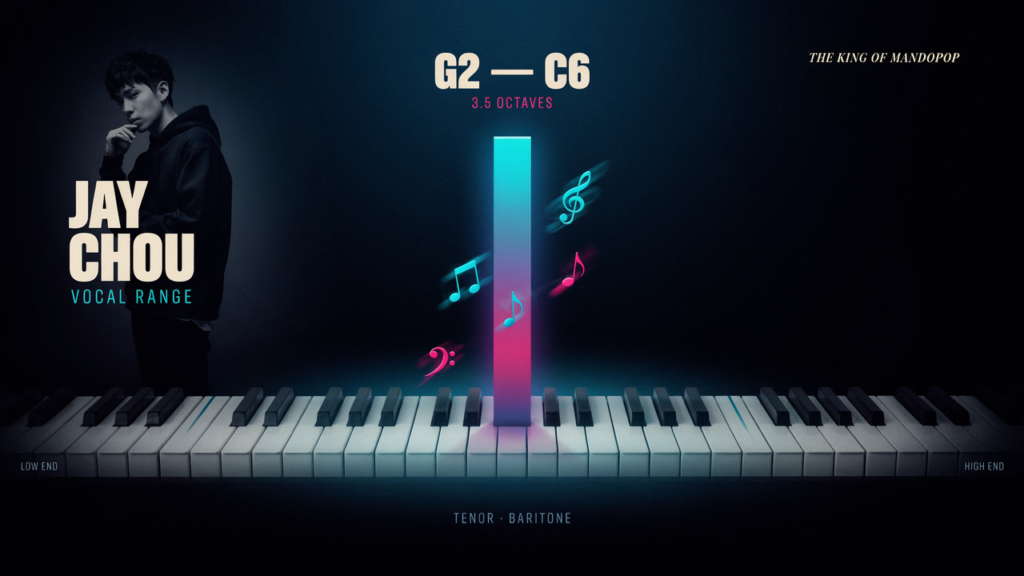
What Is His Actual Vocal Range?
Most analyses place his supported range around A2 or B2 on the low end, extending up to approximately C5 or D5 in full voice. He can reach slightly higher in head voice, but those notes are not heavily belted.
That gives him about two and a half octaves of practical, usable range.
If you compare this to a typical male vocal range, you’ll see his upper notes sit comfortably in tenor territory.
Is Jay Chou a Tenor or Baritone?
He is generally considered a light tenor.
Here’s why:
- His comfortable singing zone sits mid-to-high.
- His speaking voice is not deeply resonant like most baritones.
- His songs frequently center in upper mid-range placement.
When you compare him to characteristics listed under baritone vocal range, you’ll notice baritones usually live lower in both tone and tessitura.
Tessitura Matters More Than Extremes
Range is the total stretch of notes.
Tessitura is where the voice feels natural and sustainable.
Jay Chou’s tessitura sits above the average baritone comfort zone. That’s a stronger indicator than his single lowest note.
If you’re unsure where you sit, reviewing different voice types helps clarify the distinction.
Style vs Raw Range
Many listeners assume his soft delivery means he has a limited range.
That’s not accurate.
Soft singing is a stylistic choice. It reduces vocal weight, not pitch capability.
Think of it like dimming a light. The brightness control doesn’t change how high the bulb can reach—it changes how intensely it shines.
Jay Chou often sings with a relaxed airflow and lighter resonance, which creates intimacy rather than power.
The warm-up routine builder helps structure sessions.
Register Breakdown
Understanding his registers helps explain how he sings.
Chest Voice
His chest voice is light and speech-like.
He avoids heavy weight in the lower register, which keeps his tone agile.
Mixed Voice
In the upper mid-range, he uses a light mix rather than pushing chest voice upward.
This prevents strain and keeps transitions smooth.
Head Voice
He can access upper head voice notes, but he uses them selectively rather than as a primary sound.
If you want to identify your own transitions, learning how to find your vocal range will show where your break points occur.
Vocal Range Summary
| Element | Approximate Profile |
|---|---|
| Lowest Supported Note | Around A2–B2 |
| Highest Modal Note | Around C5–D5 |
| Upper Extension | Slightly higher in head voice |
| Total Span | ~2.5 octaves |
| Likely Classification | Light tenor |
| Strongest Area | Upper mid-range |
This table separates supported notes from stylistic extension, which keeps expectations realistic.
Measure Your Own Range Like This
If you want to analyze your range using the same approach:
- Start in your speaking pitch and glide downward gently.
- Stop when tone becomes airy or unstable.
- Sing upward in full voice until tension begins.
- Switch into head voice to test upper extension.
- Compare your results using a reliable vocal range chart.
Avoid forcing extremes. Coordination matters more than pushing for higher numbers.
How His Voice Has Changed Over Time
Like most singers, his tone has matured.
Upper notes may feel slightly heavier than in earlier recordings, but that’s normal. Vocal folds change gradually with age.
Healthy singers adapt. They adjust keys, rely more on phrasing, and avoid unnecessary strain.
Longevity depends on working with your instrument—not against it.
If you’re developing upper notes, structured vocal exercises to increase range can help you expand gradually and safely.
Is Your Soft Tone Hiding Tension?
Ask yourself:
- Can I sustain mid-range notes without breathiness?
- Do my upper notes feel relaxed or squeezed?
- Does my throat tighten when I sing louder?
- Can I repeat high phrases multiple times without fatigue?
Soft singing should feel supported, not weak.
If tension appears, scale back and rebuild coordination.
Using a vocal range calculator can give you objective pitch numbers instead of guessing.
Common Mistakes When Comparing Yourself to Jay Chou
1. Assuming Soft Equals Easy
Soft singing still requires strong breath control.
2. Forcing Chest Voice Higher
Pushing chest voice above your passaggio leads to strain.
3. Ignoring Lower Support
Lower notes should feel grounded, not hollow.
4. Skipping Warm-Ups
Consistent vocal warm-ups for beginners improve flexibility and reduce tension before you test range.
Building Upper Range Without Strain
Upper notes should feel like lifting—not shoving.
Focus on:
- Steady airflow
- Relaxed jaw and tongue
- Gradual scale patterns
- Moderate volume
Think of range expansion like stretching before exercise. You increase flexibility over time.
If you feel throat pressure or hoarseness afterward, stop and reassess. Vocal health always comes first.
The Bigger Lesson From His Voice
Jay Chou proves that musical expression does not require extreme belting.
His voice works because it is controlled, intentional, and stylistically consistent.
Range is measurable.
Artistry is built through phrasing and tone control.
If you strengthen your comfortable range and allow upper notes to grow gradually, your voice will sound more stable and expressive over time.
Chasing dramatic high notes without coordination rarely produces lasting results.
FAQs
1. How many octaves does Jay Chou have?
He spans roughly two to three octaves in practical singing range. Most of his work sits comfortably within about two and a half octaves.
2. Is Jay Chou technically a tenor?
Yes, he is generally classified as a light tenor because his tessitura sits in the mid-to-upper male range.
3. What is his highest note?
He has reached notes around C5–D5 in supported singing, with slightly higher head voice extension.
4. What is his lowest note?
He can sing down to approximately A2 or B2 in supported tone.
5. Does soft singing mean limited range?
No. Soft delivery is a stylistic choice. It does not automatically reflect vocal limitations.
6. Has his range changed over time?
Like most singers, subtle changes occur with age. Upper notes may be used more selectively, which is healthy and normal.
7. Should I train to copy his style?
You can learn from his smooth phrasing, but focus first on developing your own balanced coordination and healthy range.

Cooke is a vocal training and singing education writer specializing in vocal range analysis, pitch recognition, voice development, and singing tools for vocalists, performers, musicians, and beginners. He creates practical content focused on vocal improvement, singing techniques, and voice analysis resources.