
Katy Perry’s vocal range spans approximately A2 to F#6, covering about 3.5 octaves. Her most comfortable singing range (tessitura) sits in the mezzo-soprano territory, where she delivers strong chest-dominant belts and bright mixed voice notes. While she can access higher notes, her power zone lies in mid-to-upper chest and mix.
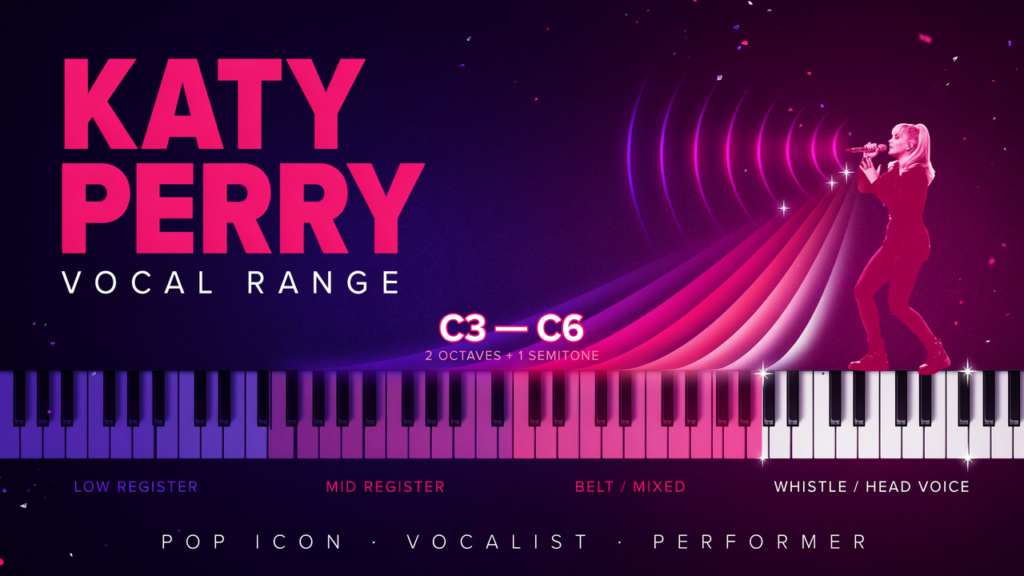
What Is Her Lowest and Highest Note?
Lowest Note
Katy Perry has reached notes around A2 in recorded material. These tones sit in the lower chest register and are not frequently used in her mainstream pop repertoire.
Low notes like this require relaxed vocal folds and steady breath support. They are less about power and more about resonance and depth.
Highest Note
Her highest documented notes reach approximately F#6, which fall into the upper head voice or light whistle-adjacent territory. These are not sustained belts but lighter, thinner high notes.
It’s important to understand the difference between:
- A quick high note in a studio take
- A repeatable, live-performance note
Those are not always the same.
Total Octave Span
From A2 to F#6 equals roughly 3.5 octaves. That’s above average for a pop singer, but not extreme compared to some vocal gymnasts.
For comparison, you can review what counts as typical in the average vocal range.
What Is Katy Perry’s Voice Type?
Katy Perry is generally classified as a mezzo-soprano.
Why Mezzo-Soprano?
Her strongest notes sit in the middle register, where her tone has weight and presence. She does not consistently live in high soprano territory, nor does she rely heavily on airy head voice textures.
If you want clarity on classifications, explore how voice categories work in this breakdown of voice types explained.
Tessitura vs. Full Range
Her full range includes extremes.
Her tessitura — the range she sings most comfortably and repeatedly — is narrower.
Think of it like this:
Your full range is how far your arm can stretch.
Your tessitura is where your arm works strongest and most efficiently.
Understanding that difference is critical when comparing singers.
You can see how this fits into a broader context on the human vocal range.
Register Breakdown
Chest Voice
This is where Katy Perry shines. Her chest voice is bold, forward, and energetic. Songs like her pop anthems rely heavily on chest-dominant belting.
Her chest voice:
- Has strong vocal fold closure
- Carries emotional intensity
- Sits comfortably in mid-range notes
Mixed Voice
Her mix allows her to bridge higher without strain. Instead of dragging chest voice too high, she shifts resonance forward and slightly upward.
This keeps brightness without shouting.
Head Voice
She uses head voice for color and lift rather than sustained classical-style singing. It’s lighter and less operatic.
If you’re unsure where your own registers sit, you can measure them using a vocal range calculator.
How Her Range Compares to the Average Singer
Most untrained female singers have a usable range of about 1.5–2 octaves.
Katy Perry’s 3.5-octave span places her well above average in flexibility, though her musical success relies more on tone, phrasing, and style than raw range.
If you’re curious about soprano territory specifically, compare her range to the standard soprano vocal range.
Range alone does not equal vocal superiority. Control and consistency matter more.
Can You Sing Like Katy Perry?
Short answer: you can develop similar range zones, but not identical tone.
Tone is influenced by anatomy, vocal fold thickness, resonance space, and stylistic choices.
Here’s a practical approach to building similar pop strength safely:
- Develop solid breath support before attempting high belts.
- Strengthen mid-range chest voice gradually.
- Train mixed voice transitions slowly.
- Avoid pushing high notes from pure chest voice.
- Rest adequately between intense sessions.
If you want structured guidance, start with how to find your vocal range so you know your baseline.
Step-by-Step: Training Toward Her Style Safely
Step 1: Establish Your Comfortable Range
Sing through a gentle five-note scale starting mid-range. Identify where tension begins.
Step 2: Strengthen Breath Control
Imagine inflating a balloon slowly and steadily. Your airflow should feel controlled, not explosive.
Step 3: Build Mix Before Belt
Instead of shouting higher notes, lighten the sound slightly while keeping forward resonance.
Step 4: Train Consistency
It’s better to sing a note cleanly five times than to hit a higher note once with strain.
Step 5: Monitor Fatigue
If your throat feels tight or sore, stop. Hoarseness is a sign you’ve exceeded safe limits.
To expand range gradually, study proper technique from this guide on how to increase your vocal range.
Self-Check: Are You Ready for High Pop Belts?
Ask yourself:
- Can I sing mid-range notes for 10 minutes without tension?
- Does my throat feel relaxed after practice?
- Can I shift from chest to lighter mix smoothly?
- Am I hitting high notes with control rather than force?
If you answered “no” to multiple questions, focus on foundation first.
Use the warm-up suggestion tool to vary exercises.
Common Mistakes When Comparing Yourself to Katy Perry
Forcing Chest Voice Too High
Dragging chest upward creates strain and vocal fatigue. High belts require mix coordination.
Ignoring Tessitura
Just because she can hit a high note doesn’t mean she sings there all night.
Copying Tone Instead of Technique
Trying to imitate vocal color often leads to artificial tension. Focus on healthy production first.
Chasing Extreme Notes
Extreme notes are impressive but rarely musically necessary. Sustainable range matters more.
Vocal Range Snapshot Table
| Category | Approximate Data |
|---|---|
| Lowest Note | A2 |
| Highest Note | F#6 |
| Total Range | ~3.5 Octaves |
| Likely Voice Type | Mezzo-Soprano |
| Strongest Register | Chest / Mixed Voice |
Use this as reference, not comparison pressure.
Realistic Expectations
You do not need 3+ octaves to be a strong singer.
Most professional pop songs sit within 1.5–2 octaves. What makes a voice compelling is emotional delivery, phrasing, rhythm, and resonance balance.
Train smart. Build gradually. Protect your vocal health.
FAQs
1. How many octaves does Katy Perry have?
She spans about 3.5 octaves from A2 to F#6. However, her comfortable singing range is narrower than her extreme notes.
2. Is Katy Perry a soprano?
She is generally considered a mezzo-soprano because her strongest tessitura sits in the middle female range rather than high soprano territory.
3. What is her highest note?
Her highest recorded notes reach around F#6. These are lighter high notes rather than sustained belt notes.
4. What is her lowest note?
She has reached approximately A2 in recorded material, which lies in her lower chest register.
5. Can beginners sing Katy Perry songs safely?
Yes, if you choose songs within your comfortable range and avoid forcing high belts. Adjust keys if needed.
6. Has her vocal range changed over time?
Like most singers, live performance demands and age can affect consistency. Extreme high notes may become less frequent, but core range often remains stable.
7. Do I need a 3-octave range to sing pop music?
No. Most pop songs sit within two octaves. Technique and control matter far more than extreme range.

Cooke is a vocal training and singing education writer specializing in vocal range analysis, pitch recognition, voice development, and singing tools for vocalists, performers, musicians, and beginners. He creates practical content focused on vocal improvement, singing techniques, and voice analysis resources.