
Kristin Chenoweth’s vocal range spans approximately A3 to F6, with occasional extension into whistle register above that. She is widely classified as a coloratura soprano, known for agile high notes, bright tone, and strong upper tessitura that allows her to sustain demanding Broadway roles with precision and control.
Her voice is not just high — it’s flexible, focused, and technically disciplined.
Let’s break it down clearly.
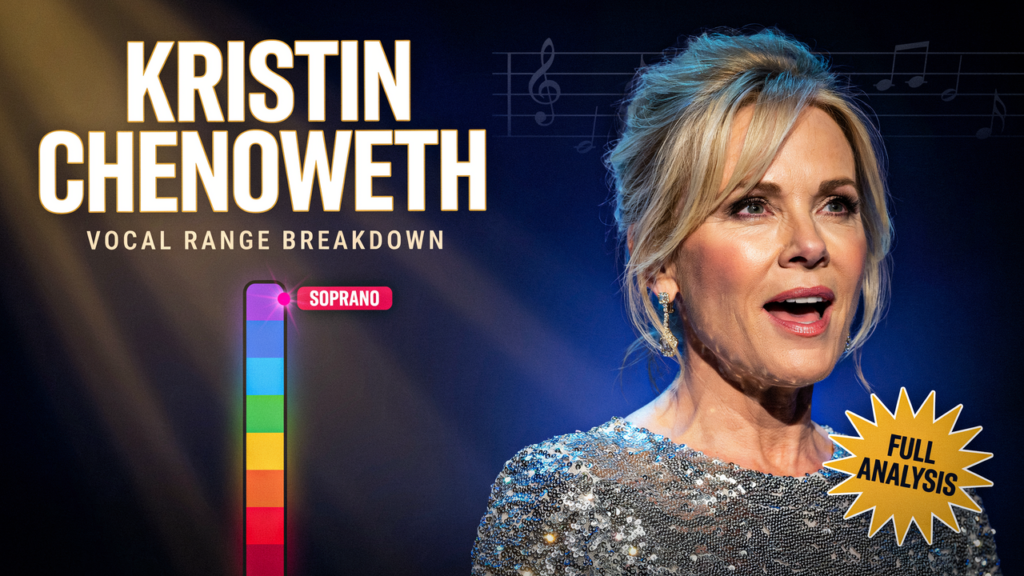
What Is Kristin Chenoweth’s Vocal Range?
Lowest Notes
Her lower register typically sits around A3. While she can access slightly lower tones, her repertoire rarely emphasizes deep chest voice.
Her strength begins in the midrange and climbs upward quickly.
Compared to the average female vocal range, she operates comfortably in the upper half of the spectrum.
Highest Notes
Kristin is known for reaching F6 in head voice and occasionally extending higher in whistle register during select performances.
However, extreme notes are not the full story.
Her tessitura — the range she sustains most comfortably — sits around C5 to E6, which is high even among sopranos.
Range Breakdown Table
| Category | Approximate Note | Register | Role in Performance |
|---|---|---|---|
| Lowest Note | A3 | Chest voice | Lower phrasing |
| Comfortable Midrange | C4–B4 | Chest/Head mix | Narrative sections |
| High Soprano Zone | C5–E6 | Head voice | Primary power area |
| Extreme Extension | F6+ | Whistle (occasional) | Ornamentation |
Notice something important: her working range is different from her extreme range.
A singer’s highest note does not define their voice type. Tessitura does.
What Voice Type Is Kristin Chenoweth?
Kristin Chenoweth is considered a coloratura soprano.
That means she has:
- Light vocal weight
- Excellent agility
- Strong upper head voice
- Bright resonance
- Comfortable access above C6
If you review the typical soprano vocal range, her tessitura sits in the higher, lighter end of that category.
Coloratura sopranos specialize in speed and altitude — not power belting.
Why Her High Notes Sound Effortless
Her upper register works because of coordination, not force.
High notes require:
- Thin but efficient vocal fold closure
- Stable airflow
- Narrowed vowel shaping
- Lifted soft palate
Think of high notes like balancing on a tightrope. If you tense up, you fall. If you stay aligned and relaxed, you move freely.
Her brightness comes from focused resonance rather than pushing volume.
The voice metrics tool provides a snapshot of attributes.
Step-by-Step: How to Train a High Soprano Range Safely
If you’re inspired by her upper register, build it carefully.
Follow this progression:
- Strengthen head voice gently through C5.
- Practice smooth transitions across your passaggio.
- Develop light agility with small interval patterns.
- Increase pitch gradually — never jump to extremes.
- Stop immediately if you feel throat tightness or dryness.
Whistle register, if explored at all, must be approached cautiously and never forced.
Before attempting high soprano training, measure your baseline using the vocal range calculator.
Tessitura vs. Highest Note
Many singers obsess over extreme highs.
But Kristin’s power comes from sustained upper tessitura — not just F6.
Tessitura is the “comfort zone of strength.”
If you compare her position on a vocal range chart, her working zone sits firmly in upper soprano territory.
If you’re unsure where your comfort zone lies, use a structured voice type test.
How Her Range Compares to Most Singers
Most untrained female singers:
- Struggle above C5
- Flip abruptly into weak head voice
- Lack agility in rapid passages
Kristin sustains E6 with clarity and control.
Placed against the broader human vocal range, her extension is rare but not impossible with proper training and natural suitability.
Genetics and vocal fold structure do matter.
Quick Self-Check: Are You a High Soprano?
Ask yourself:
- Can you sing C6 without pushing?
- Does head voice feel natural rather than breathy?
- Are high notes easier than low chest tones?
- Is your voice naturally bright and light?
If yes, you may have high soprano tendencies.
If low notes feel stronger and high notes feel unstable, you likely belong in a different category — and that’s perfectly healthy.
You can compare your results to the female vocal range chart to see where you fall.
Common Mistakes Singers Make When Copying Her
Forcing Volume in High Notes
High soprano singing is not about loudness. It’s about precision.
Ignoring Breath Control
Airflow must stay steady. Too much air creates instability.
Overreaching Too Soon
Jumping to F6 before mastering C5–D5 coordination invites strain.
Confusing Head Voice With Whistle
Head voice is connected and resonant. Whistle is thinner and more flute-like.
Pushing either can cause vocal fatigue.
If you feel soreness that lasts more than a few hours, rest.
Does Kristin Chenoweth Use Whistle Register?
Occasionally, yes — but it is not her primary register.
Most of her sustained high notes are produced in well-coordinated head voice.
Whistle register should never be treated as a shortcut to range expansion.
What Makes Her Voice So Agile?
Coloratura technique relies on:
- Efficient onset
- Flexible tongue positioning
- Minimal jaw tension
- Stable breath support
Agility is like running scales on a piano. If your fingers are stiff, the notes blur. If your coordination is light, they sparkle.
Her training emphasizes flexibility over force.
Realistic Expectations for Singers
Not every singer can become a coloratura soprano.
Voice type depends on:
- Vocal fold length
- Resonance space
- Natural tessitura
- Physical structure
Your goal should not be copying F6.
Your goal should be mastering your own comfortable upper range safely.
If you want to build upper extension carefully, study techniques from how to sing higher notes.
What Singers Can Learn From Kristin Chenoweth
Her technique teaches:
- Upper-range efficiency
- Precision over power
- Agility training
- Controlled vibrato
- Breath discipline
Range without control is unstable.
Control creates longevity.
FAQs
1. What is Kristin Chenoweth’s highest note?
She has reached approximately F6 in head voice, with occasional extension slightly above in whistle register during select performances.
2. What is Kristin Chenoweth’s lowest note?
Her lower register typically reaches around A3, though her repertoire focuses primarily on mid-to-upper soprano territory.
3. Is Kristin Chenoweth a coloratura soprano?
Yes, she is widely classified as a coloratura soprano due to her agility, light vocal weight, and sustained high tessitura.
4. Does Kristin Chenoweth use whistle register?
Occasionally, but it is not her main register. Most of her high notes are produced in well-coordinated head voice.
5. How many octaves can Kristin Chenoweth sing?
Including extended highs, she spans close to three octaves. Her strongest working range is in the upper two octaves.
6. Can beginners train to sing as high as Kristin Chenoweth?
Beginners can expand their upper range gradually, but extreme soprano notes require both proper technique and natural suitability.
7. Why does her voice sound so bright?
Her brightness comes from focused resonance, lifted soft palate positioning, and efficient vocal fold coordination rather than pushing air or volume.

Cooke is a vocal training and singing education writer specializing in vocal range analysis, pitch recognition, voice development, and singing tools for vocalists, performers, musicians, and beginners. He creates practical content focused on vocal improvement, singing techniques, and voice analysis resources.