
Jeff Buckley’s vocal range is commonly documented from approximately E2 to C6, spanning close to four octaves. He is generally classified as a lyric tenor, known for his extended upper register, fluid head voice, and expressive control rather than purely chest-dominant power singing.
That number alone doesn’t explain why his voice felt so powerful. Range is only part of the story. What made him unique was how he used it.
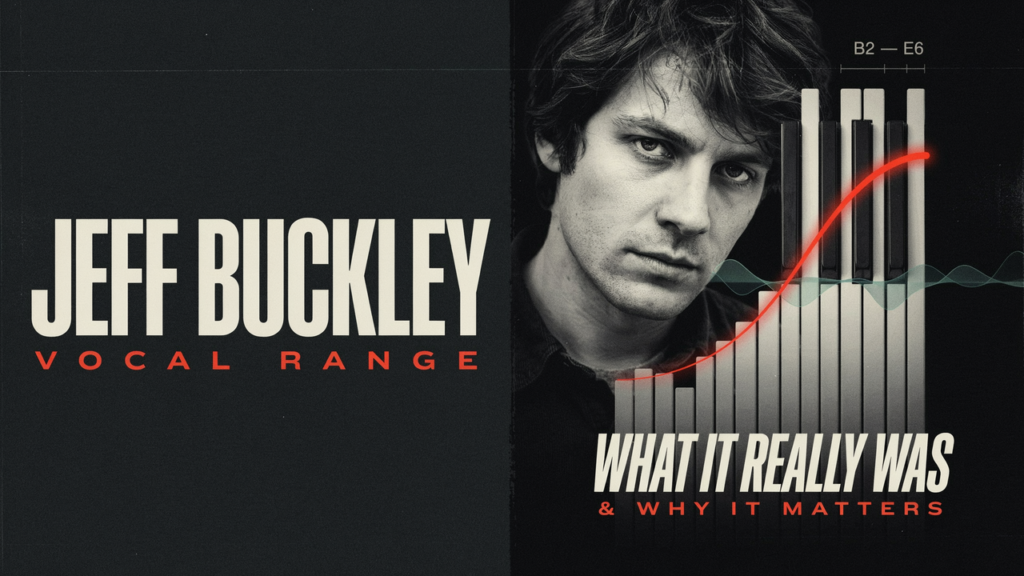
What Were Jeff Buckley’s Lowest and Highest Notes?
Let’s break this down in practical terms.
Lowest Note
Around E2 in the lower register.
This is a solid low note for a tenor but not unusually deep for male singers.
Highest Note
Often cited around C6, accessed in head voice or reinforced falsetto.
This is where his vocal identity really shines.
Total Span
Nearly four octaves when counting extreme notes.
But here’s the important coaching truth:
Extreme range is not the same as comfortable singing range.
He didn’t sing four octaves in chest voice. Very few singers do. His magic lived in the upper middle and high head voice area.
If you’re unsure how ranges are measured, you can see how this fits inside the broader human vocal range spectrum.
What Voice Type Was Jeff Buckley?
Most teachers classify him as a lyric tenor.
A lyric tenor typically has:
- A lighter, flexible tone
- Ease in higher passages
- Emotional clarity over raw weight
Some listeners call him a countertenor because of how high he sang. But technically, a countertenor primarily operates in reinforced falsetto as their main voice. Buckley’s high notes were expressive extensions—not his default speaking placement.
If you’re curious how tenor classification works in general, review a typical tenor vocal range profile.
Tessitura vs Full Range (This Is What Most People Miss)
Tessitura means the range where a singer is most comfortable and resonant.
Buckley’s full range stretched nearly four octaves.
His tessitura, however, sat higher than most male rock singers.
That’s why his voice felt bright, floating, and emotional.
Here’s a simplified comparison:
| Element | Description |
|---|---|
| Lowest extreme | E2 |
| Highest extreme | C6 |
| Comfortable core area | Upper mid-tenor |
| Dominant strength | Head voice clarity |
| Style impact | Emotional intensity |
When people debate whether he “really had four octaves,” they’re often confusing total span with usable singing range. If you want to understand octave math better, see how singers compare in the highest vocal range discussion.
How He Used Registers (And Why It Worked)
Jeff Buckley didn’t rely on brute force. He transitioned smoothly.
Chest Voice
Warm but not overly heavy.
Used more for storytelling sections.
Head Voice
This was his superpower.
Clear, ringing, emotionally transparent.
Falsetto
Soft and airy when stylistically needed.
Not breathy weakness—intentional color.
Think of his voice like a violin rather than a trumpet.
It soared instead of blasted.
The range vs singer tool shows where you fit globally.
Songs That Showcase His Range
In “Grace,” you hear upper-range intensity.
In “Hallelujah,” you hear delicate head voice control.
The key lesson here isn’t “sing high.”
It’s “control high.”
If you want to measure your own ability safely, try using a vocal range calculator before attempting upper extensions.
Could He Really Sing Four Octaves?
Yes—technically.
But here’s the grounded coaching answer:
He accessed notes across nearly four octaves.
He did not sing four octaves with equal power.
Very few singers maintain consistent tonal weight across four full octaves. When evaluating claims like this, it helps to understand what an average vocal range looks like for comparison.
How to Develop a Jeff Buckley–Style Upper Register
This is not about copying tone. It’s about building function.
1. Strengthen Head Voice First
Start with gentle “woo” slides from mid-range upward.
Never push volume.
2. Build Smooth Transitions
Practice sliding from chest into head voice slowly.
Avoid cracking by reducing airflow, not forcing more.
3. Train Light Coordination
Use vowel narrowing (ee → uh) as you ascend.
This reduces strain.
4. Increase Range Gradually
Work up by semitone steps only.
If tension appears, stop.
For structured daily work, follow a plan like this daily vocal warm up.
Are You Built for a Similar Range?
Ask yourself:
- Is my speaking voice naturally higher than average male voices?
- Do high notes feel easier than very low notes?
- Does my tone feel lighter rather than thick?
- Can I access head voice without strain?
If most answers are yes, you may lean toward a higher tenor placement.
If unsure, take a structured voice type test for clarity.
Common Mistakes When Trying to Sing Like Jeff Buckley
Forcing Chest Voice High
This creates tension and long-term strain.
Mistaking Volume for Intensity
Buckley used emotion, not shouting.
Ignoring Breath Control
High notes require controlled airflow—not more air.
Skipping Warm-Ups
Cold vocal folds are more injury-prone.
If you’re trying to expand range safely, focus on controlled progression as outlined in how to extend vocal range.
What Made His Voice Unique?
It wasn’t just range.
It was:
- Emotional vulnerability
- Dynamic contrast
- Upper-register freedom
- Subtle vibrato control
Technically speaking, he balanced airflow and cord closure efficiently. That balance allowed flexibility without sounding thin.
Realistic Expectations
Most male singers will not comfortably sing to C6.
And that’s okay.
Your goal should not be matching his extreme top note.
Your goal should be finding your strongest expressive range.
With safe training, many singers can extend 3–5 semitones over time. Large jumps rarely happen quickly and should never involve pain or tightness.
If your throat feels squeezed, dry, or fatigued—stop. Long-term progress depends on patience.
The Coaching Takeaway
Jeff Buckley’s vocal range was impressive, but his artistry came from control—not just span. He understood how to transition registers smoothly, keep tension low, and let emotion guide technique.
If you focus on building healthy coordination instead of chasing high notes, your range will grow naturally—and sustainably.
FAQs
1. What was Jeff Buckley’s highest note?
He is commonly documented reaching around C6 in head voice. That’s a very high note for a male singer and requires advanced upper-register coordination.
2. Was Jeff Buckley a tenor or countertenor?
He is generally considered a lyric tenor. While he sang very high, his primary vocal function and tonal center align more closely with tenor classification.
3. How many octaves did Jeff Buckley have?
Nearly four octaves when counting extreme low and high notes. His comfortable tessitura was narrower and sat higher than average male singers.
4. Did he use falsetto for his high notes?
He used both head voice and reinforced falsetto depending on the phrase. The sound was controlled, not weak or accidental.
5. Is a four-octave range rare?
Yes, especially with usable control. Most trained singers operate comfortably within two to three octaves.
6. Can I train to sing as high as Jeff Buckley?
You can improve your upper range with proper training, but genetics and vocal structure play a role. Progress should be gradual and tension-free.
7. What mattered more for him—range or control?
Control. His ability to move between registers smoothly and sing with emotional clarity made his voice stand out far more than the raw number of octaves.

Cooke is a vocal training and singing education writer specializing in vocal range analysis, pitch recognition, voice development, and singing tools for vocalists, performers, musicians, and beginners. He creates practical content focused on vocal improvement, singing techniques, and voice analysis resources.