
Laura Osnes’s vocal range is commonly cited as approximately G3 to E6, spanning close to three octaves. She is widely recognized as a legit or lyric soprano in musical theatre, with a high tessitura, strong head voice, and clear upper extension suited for Broadway repertoire.
Understanding her voice means looking beyond just high notes.
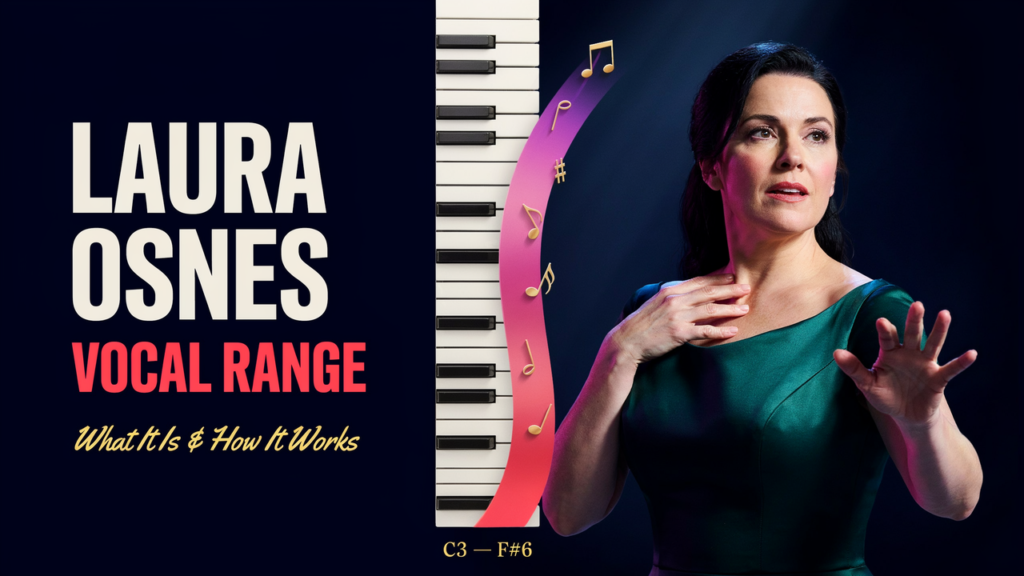
What Is Laura Osnes’s Actual Vocal Range?
Most documented performances place her lowest notes around G3 and her highest sustained notes around E6. That gives her a strong three-octave span.
However, range is only part of the story.
Her true strength lies in where she sings most comfortably — her tessitura. If you need a structural reference, reviewing the soprano vocal range helps frame where those notes typically sit.
Her voice sits naturally higher than many female singers, especially in musical theatre contexts.
Is Laura Osnes a Lyric or Legit Soprano?
In Broadway terminology, she is often described as a legit soprano, meaning her production leans toward classical resonance rather than contemporary belt-heavy technique.
What Defines a Legit Soprano?
- Clear, ringing head voice
- Consistent vibrato
- Smooth passaggio transitions
- Bright but not forced tone
Compared structurally, her voice aligns more closely with classical soprano production than chest-dominant belt styles.
If you want broader classification context, this overview of voice types explained clarifies how soprano categories differ.
Range vs Tessitura: Why It Matters More Than the Highest Note
Many singers focus only on the top note. That’s a mistake.
Tessitura is where your voice feels sustainable and strong. Laura’s tessitura sits high in the soprano range, meaning she can comfortably sustain notes that might strain other singers.
You can see how soprano placement compares across categories in the female vocal range chart.
Think of tessitura like your “home base.”
High notes are impressive.
Home base determines endurance.
How Her Broadway Technique Supports High Notes
Musical theatre demands clarity, projection, and stamina. That requires precise coordination.
Head Voice Dominance
Her upper register relies heavily on head voice resonance. This allows her to sing high notes without pushing chest voice upward.
If you’re unsure how registers function differently, reviewing chest voice vs head voice makes the distinction clear.
Passaggio Control
Passaggio is the transition zone between registers. Sopranos must navigate this area smoothly.
Strong technique keeps tone even across that shift. Without coordination, the voice cracks or tightens.
Breath Support
High legit soprano singing depends on steady airflow and balanced onset — not brute force.
How to Test If You Have Soprano Tendencies
If you’re wondering whether your voice leans soprano, follow this structured method:
- Begin with gentle ascending five-note scales starting around middle C.
- Notice where your voice feels open and easy.
- Continue upward slowly without increasing volume.
- Stop when tension appears in the throat or jaw.
- Repeat on different days to confirm consistency.
Only count notes that feel supported and sustainable.
To measure your range precisely, use a structured tool like this vocal range calculator.
Signs You May Be a Soprano
- High notes feel easier than low ones
- Your speaking voice is relatively bright
- You can sustain notes above C5 without strain
- Lower notes feel weaker or thinner
For a structured process, review how to find your vocal range safely and accurately.
Belt vs Legit: Understanding the Difference
Broadway often blends styles. But legit soprano technique differs from belt-dominant production.
| Technique | Primary Register | Sound Quality | Risk Level |
|---|---|---|---|
| Legit Soprano | Head voice dominant | Clear, ringing | Lower when supported |
| Belt | Chest-dominant mix | Strong, brassy | Higher if over-pushed |
Laura Osnes is known more for clear head-dominant production than aggressive belting.
That distinction explains why her upper notes sound pure rather than brassy.
Are You Forcing High Notes?
Answer honestly:
- Do you lift your chin when singing high?
- Does your throat tighten above C5?
- Do you push volume to reach pitch?
- Do high notes feel squeezed instead of resonant?
If yes, you’re likely compensating instead of coordinating.
High soprano singing should feel lifted and buoyant — not pressed.
Use the voice type test to estimate your singer category.
Common Mistakes When Analyzing Laura Osnes’s Range
Mistake 1: Thinking High Notes Equal Soprano
Some mezzos can hit high notes briefly. Classification depends on tessitura, not isolated peaks.
Mistake 2: Ignoring Passaggio
Many singers strain because they try to drag chest voice too high instead of transitioning smoothly.
Mistake 3: Overestimating Range from One Performance
Studio or peak performance notes don’t always reflect daily usable range.
Mistake 4: Forcing Head Voice
Head voice is not falsetto. It requires balanced closure and airflow.
If you’re unsure about structural placement, consult a full vocal range chart to visualize note positions clearly.
Developing a Healthy Upper Extension
Expanding high notes requires patience.
Focus on These Foundations
- Steady breath pressure
- Relaxed jaw and tongue
- Forward resonance placement
- Gradual scale expansion
Never force volume to “prove” range. High soprano singing is about efficiency, not effort.
If pitch accuracy fluctuates in the upper register, structured drills like a pitch accuracy test can strengthen stability before pushing higher.
Think of High Notes Like Balancing on a Wire
Too much pressure and you fall.
Too little coordination and you wobble.
Balance keeps you stable.
Realistic Expectations About Her Range
A near three-octave span is strong but not extreme for trained Broadway singers.
What makes her voice impressive is:
- Consistency across registers
- Clean vibrato
- Smooth passaggio
- High tessitura endurance
Range size alone does not create professional-level singing. Coordination does.
The Real Lesson From Her Vocal Profile
Laura Osnes demonstrates how refined head voice technique allows sustained high singing without strain.
The takeaway is simple:
- Develop coordination first
- Respect your natural tessitura
- Transition smoothly across registers
- Avoid pushing for dramatic effect
Your voice type is determined by structure, not ambition.
Work with what your instrument naturally supports, and you’ll build strength that lasts.
FAQs
1. What is Laura Osnes’s vocal range?
Her range is commonly cited as approximately G3 to E6. Her most comfortable singing area sits high in the soprano tessitura.
2. Is Laura Osnes a lyric soprano?
She is often described as a legit or lyric soprano in musical theatre. Her tone emphasizes clear head voice resonance rather than heavy belting.
3. How many octaves can she sing?
She spans close to three octaves. More important than the span is her ability to sustain high notes comfortably.
4. Does she belt high notes?
She can use belt technique when needed, but her singing is primarily head-dominant and legit in style.
5. What is her highest recorded note?
Her highest sustained notes are often cited around E6 in performance settings.
6. How do I know if I’m a soprano?
If high notes feel natural and low notes feel weaker, you may lean soprano. Consistency in upper tessitura is a stronger indicator than isolated high notes.
7. Can I train to extend my upper range safely?
Yes, but only through gradual coordination and breath support. Avoid forcing volume, and stop immediately if you feel throat tension or discomfort.

Cooke is a vocal training and singing education writer specializing in vocal range analysis, pitch recognition, voice development, and singing tools for vocalists, performers, musicians, and beginners. He creates practical content focused on vocal improvement, singing techniques, and voice analysis resources.