
Luther Vandross’s vocal range is commonly cited as approximately C2 to G5, spanning around three octaves. He is generally classified as a lyric tenor with a rich lower extension and exceptionally smooth upper register, blending chest voice, mix, and controlled falsetto in R&B and soul repertoire.
Range alone doesn’t explain his greatness. Control, breath, and tone do.
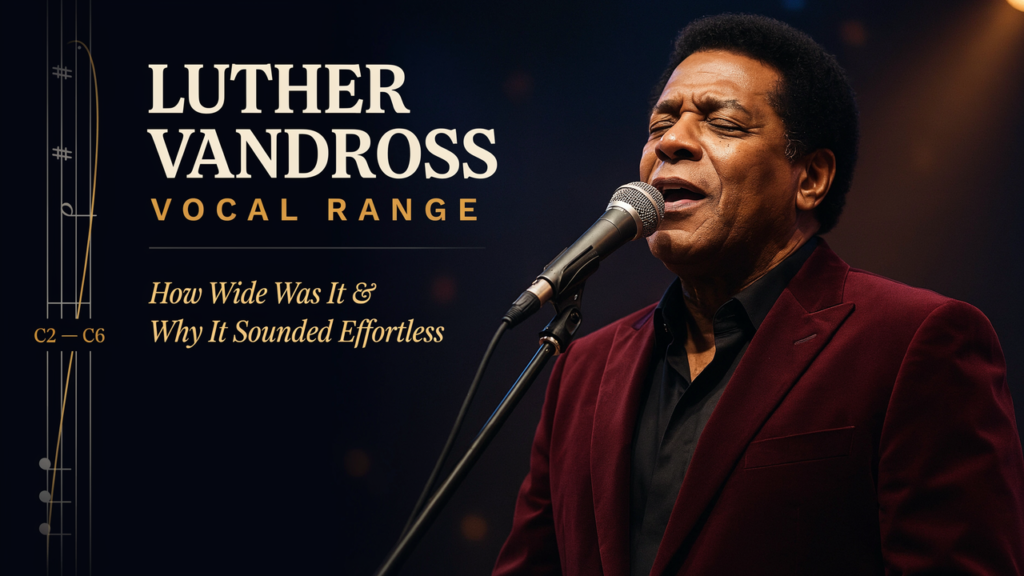
What Was Luther Vandross’s Actual Vocal Range?
Most documented performances place his lower notes around C2–E2 and his higher sustained notes near F5–G5, depending on the era and recording context.
That creates a span of roughly three octaves.
However, as with any singer, you must distinguish between:
- Absolute lowest and highest notes ever produced
- Consistently supported performance notes
- Comfortable tessitura
If you want to see how those notes compare structurally, reviewing a male vocal range guide gives helpful context.
His most consistent singing sat in the upper-mid tenor zone.
Was Luther Vandross a Tenor or Baritone?
He is most often classified as a lyric tenor.
Why Tenor Fits
- Comfortable sustained notes above C4
- Clear upper register
- Bright resonance in higher phrases
- Flexible head voice
The tenor vocal range aligns closely with where his tessitura lived.
Why Some Hear Baritone Warmth
His lower register had depth.
His tone was smooth and full.
His phrasing felt grounded.
Warm tone color does not automatically make someone a baritone. Classification depends more on where the voice sits naturally.
To understand these differences clearly, reviewing voice types explained helps separate tone from structure.
Range vs Tessitura: The Key Distinction
Range is your outer limit.
Tessitura is your comfort zone.
Think of range like the total height of a building.
Tessitura is the floor you live on.
Luther’s tessitura sat in the mid-to-upper tenor register, where he could sustain long phrases with ease.
If you want clarity about your own voice, learn how to find your vocal range before labeling it.
Did Luther Vandross Use Falsetto?
Yes — but strategically.
Falsetto is a lighter mechanism that produces a softer, airier sound. Luther used it for texture and emotional nuance, not as a crutch for reaching notes.
Falsetto vs Head Voice
Falsetto typically has less cord closure.
Head voice maintains fuller closure with resonance shift.
Understanding chest voice vs head voice helps clarify how he transitioned smoothly without obvious breaks.
His mastery came from blending these registers seamlessly.
How He Achieved Smooth High Notes
His upper register sounded effortless. That wasn’t luck.
Breath Support
Long, sustained R&B lines require steady airflow. He avoided pushing air excessively, which preserved vocal stability.
Legato Phrasing
Legato means connecting notes smoothly without breaks. He carried tone like a ribbon — continuous and fluid.
Controlled Vibrato
His vibrato was even and consistent, enhancing sustain rather than destabilizing pitch.
Before trying to copy stylistic runs, test your stability with a structured pitch accuracy test. Smoothness depends on pitch control.
Live vs Studio Performance
Studio recordings allow multiple takes.
Live concerts demand stamina.
His range in live settings reflected strong breath coordination. Extreme peaks were used musically, not constantly.
When analyzing any singer’s range, separate:
| Category | Meaning |
|---|---|
| Absolute Range | Lowest to highest isolated note |
| Supported Range | Notes sung consistently with control |
| Tessitura | Most comfortable singing zone |
This prevents exaggerated octave assumptions.
Building Smooth Tenor Control
If you want to develop a similar smooth upper register, follow this progression:
- Strengthen mid-range notes with steady breath support.
- Practice gentle slides between chest and head voice.
- Sustain vowels softly before increasing volume.
- Develop consistent vibrato without forcing it.
- Add stylistic runs only after tone remains stable.
Never rush upper extension.
Smooth high notes should feel lifted, not pressed.
Healthy High Notes Should Feel Like
- Supported from the diaphragm
- Open throat sensation
- Forward resonance
- No squeezing or tight jaw
If tension appears, reset immediately.
Are You a Lyric Tenor?
Ask yourself:
- Do higher notes above C4 feel accessible?
- Does your voice brighten as you ascend?
- Do low notes feel usable but not dominant?
- Is your speaking voice moderately high?
If yes, you may lean toward lyric tenor tendencies.
Only count notes that feel sustainable and free.
Try the warm-up scale builder before lessons.
Common Mistakes When Analyzing Luther Vandross’s Range
Mistake 1: Confusing Falsetto With Weak Singing
Falsetto is a stylistic tool, not a limitation.
Mistake 2: Overestimating Octave Claims
Some estimates include unstable extremes.
For perspective on exaggerated claims, reviewing common vocal range myths helps separate hype from structure.
Mistake 3: Forcing Smoothness
Smooth tone comes from airflow balance, not lowering volume artificially.
Mistake 4: Ignoring Mid-Range Strength
His power came from mid-range stability, not constant high notes.
Developing Upper Extension Safely
Expanding range takes time.
Focus On These Foundations
- Consistent breath management
- Relaxed jaw and tongue
- Gradual scale expansion
- Regular warm-ups
Think of range like stretching a rubber band.
Pull gently and repeatedly, and flexibility increases.
Yank suddenly, and it snaps.
Patience protects your voice.
Realistic Expectations About His Range
Three octaves with strong upper extension is impressive.
But what made him exceptional was:
- Smooth legato
- Dynamic control
- Emotional phrasing
- Seamless register blending
Range width does not equal musicality.
Control creates impact.
The Real Lesson From His Vocal Profile
Luther Vandross demonstrates how a lyric tenor can combine warmth and brightness without sacrificing consistency.
The takeaway:
- Identify your tessitura
- Build stable breath support
- Blend registers smoothly
- Avoid chasing extreme notes prematurely
Master the fundamentals.
Smoothness comes from balance, not force.
FAQs
1. What was Luther Vandross’s vocal range?
His range is commonly cited as approximately C2 to G5, spanning around three octaves depending on how extreme notes are counted.
2. Was Luther Vandross a tenor?
Yes, he is generally classified as a lyric tenor based on his tessitura and upper register strength.
3. How many octaves could he sing?
Around three octaves in supported performance settings.
4. Did he use falsetto?
Yes, he used falsetto strategically for stylistic color, especially in softer or expressive phrases.
5. What was his tessitura?
His tessitura sat in the mid-to-upper tenor range, where he could sustain notes comfortably and smoothly.
6. Was his range unusual for R&B singers?
His control and smoothness were distinctive, even among strong R&B tenors.
7. How can I develop smoother high notes?
Focus on breath support, gradual range expansion, and smooth register blending. Avoid forcing volume when ascending.

Cooke is a vocal training and singing education writer specializing in vocal range analysis, pitch recognition, voice development, and singing tools for vocalists, performers, musicians, and beginners. He creates practical content focused on vocal improvement, singing techniques, and voice analysis resources.