
Minnie Riperton’s vocal range is commonly cited as approximately F3 to F7, spanning around four to five octaves depending on the source. She is best known for her extraordinary whistle register, which allowed her to sing far above the typical soprano range with remarkable clarity and control.
Her range was impressive.
Her control made it legendary.
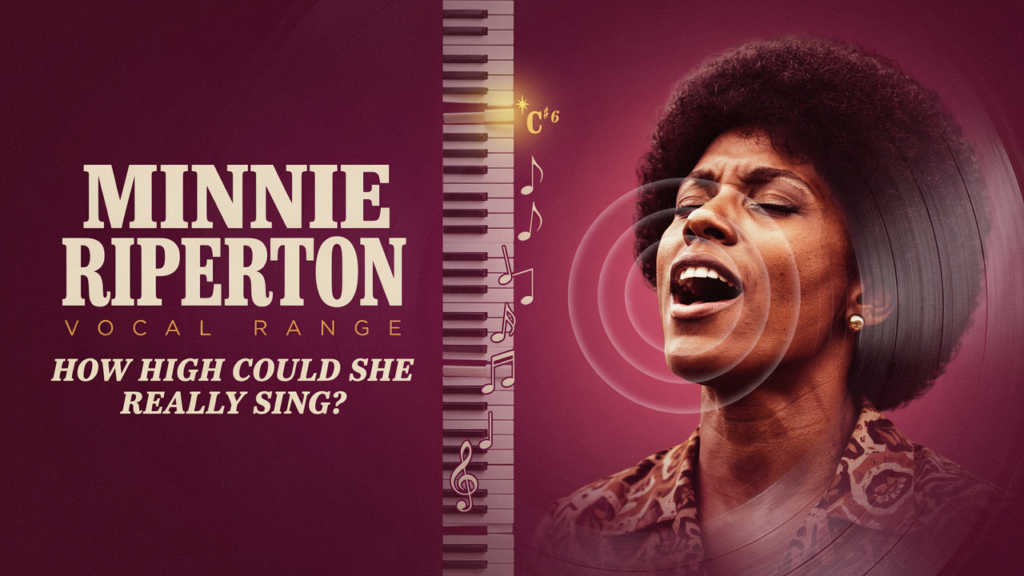
What Was Minnie Riperton’s Lowest and Highest Note?
Most vocal analyses place her lower register around F3, though her music rarely focused on deep lows.
Her highest documented notes reach approximately F7, produced in whistle register.
To see how extreme that is, compare it to a standard soprano vocal range. F7 sits well above traditional soprano territory.
But remember: the highest note someone can touch is not the same as their everyday singing range.
How Many Octaves Could She Sing?
Depending on documentation, her span is often described as four to five octaves.
That estimate includes:
- Chest register notes
- Head voice
- Whistle register
To visualize how these registers connect, reviewing a detailed vocal range chart helps you understand where whistle sits above head voice.
Octave numbers can sound dramatic. What matters more is how well those notes are produced.
What Made Her Whistle Register So Unique?
Whistle register is the highest vocal register in the human voice. It produces tones above the typical head voice.
How Whistle Register Works
In whistle register, only a small portion of the vocal folds vibrate. Airflow is highly focused, and resonance shifts upward.
Think of it like a piccolo compared to a flute.
Smaller vibration, brighter frequency.
Her whistle tones were:
- Clear
- Stable
- Controlled
- Musically intentional
They were not random squeaks. They were integrated into melody.
If you’re learning register transitions, understanding chest voice vs head voice is essential before even considering whistle exploration.
Was She a Lyric or Coloratura Soprano?
She is most often classified as a lyric soprano with exceptional upper extension, sometimes described as coloratura due to agility and high-note access.
Classification depends on tessitura.
Tessitura means the range where the voice feels most comfortable and resonant. If you need clarity on classifications, study the broader framework in voice types explained.
Her tessitura sat lower than her whistle peaks. That distinction matters.
Range vs Tessitura: Why the Difference Is Important
Range is the full measurable span.
Tessitura is where the voice lives comfortably.
Here’s a simple breakdown:
| Category | Detail |
|---|---|
| Lowest Note | Around F3 |
| Highest Note | Around F7 (whistle) |
| Total Span | Roughly 4–5 octaves |
| Tessitura | Mid-to-upper soprano |
| Signature Strength | Whistle register clarity |
If you want to measure your own limits safely, start by learning how to find your vocal range accurately.
Don’t confuse peak notes with sustainable comfort.
Building High Notes Safely
Before attempting extreme high notes, build foundation first.
- Strengthen breath support through slow sustained vowels.
- Develop head voice control without pushing.
- Practice smooth transitions through passaggio.
- Increase upper range gradually, semitone by semitone.
- Stop immediately if you feel throat tension or sharp discomfort.
Whistle register should never feel forced.
Healthy High Notes Should Feel Like
- Airflow is steady
- Jaw and tongue stay relaxed
- Throat feels open
- No burning sensation
If your voice becomes hoarse after practice, you pushed too far.
If you’re exploring your voice, start with the vocal range test.
Are You Ready for Whistle Exploration?
Ask yourself:
- Is your head voice stable and clear?
- Can you sustain high notes without strain?
- Do you recover quickly after upper-range practice?
- Is your breath support consistent?
If not, focus on fundamentals first.
Whistle register is advanced technique. It’s not step one.
Common Mistakes When Analyzing Minnie Riperton’s Range
Mistake 1: Assuming Everyone Can Reach F7
Whistle register is partly physiological. Not every singer has the same upper potential.
Mistake 2: Ignoring Tessitura
Her musical comfort zone was not exclusively at the top of her range.
Mistake 3: Forcing High Notes
Trying to “squeeze” into whistle creates tension and possible injury.
Mistake 4: Believing More Octaves Equals Better Singer
To reset expectations, review common vocal range myths.
Musicality beats numbers.
How She Integrated Whistle Musically
Her famous whistle passages were not just technical displays.
They were:
- Controlled vibrato
- Pitch-accurate
- Expressive
- Strategically placed
If you want to test your pitch stability before exploring higher notes, try evaluating yourself with a pitch accuracy test.
High notes require precision, not just altitude.
Developing Upper Extension Without Strain
Extreme highs require patience.
Focus On
- Consistent breath support
- Relaxed onset (no glottal slam)
- Gradual scale work
- Short, controlled repetitions
Think of upper range like climbing a mountain.
You acclimate slowly.
You don’t sprint to the summit.
Respect recovery time. Hydrate well. Rest when fatigued.
Realistic Expectations About Her Range
Four to five octaves is extraordinary.
But what made her voice special was:
- Purity of tone
- Seamless register shifts
- Musical intelligence
- Emotional expression
Range alone does not create artistry.
Control, coordination, and expression do.
The Real Lesson From Minnie Riperton’s Vocal Profile
Her voice teaches us that extreme range must be balanced with control.
Before chasing whistle notes:
- Master breath support
- Stabilize head voice
- Respect your natural tessitura
- Expand gradually
Your voice is an instrument, not a competition.
Develop strength.
Protect longevity.
Let extension grow naturally.
FAQs
1. What was Minnie Riperton’s vocal range?
Her vocal range is commonly cited as approximately F3 to F7, spanning about four to five octaves.
2. What was her highest recorded note?
Her highest documented notes are often listed around F7 in whistle register.
3. How many octaves could she sing?
Estimates range between four and five octaves, depending on what is included.
4. Did Minnie Riperton use whistle register?
Yes, she was widely known for her clear and controlled whistle register tones.
5. Was she a coloratura soprano?
She is often described as a lyric soprano with coloratura-like upper extension, though classification depends on tessitura.
6. Can most singers learn whistle register?
Some can develop it with training, but not all voices naturally access whistle register easily.
7. Are whistle notes safe to practice?
They can be safe if approached gradually and without strain. Stop immediately if you feel pain or persistent hoarseness.

Cooke is a vocal training and singing education writer specializing in vocal range analysis, pitch recognition, voice development, and singing tools for vocalists, performers, musicians, and beginners. He creates practical content focused on vocal improvement, singing techniques, and voice analysis resources.