
Tracy Chapman’s vocal range is generally estimated at around two to three octaves, centered in a low female tessitura often associated with contralto voices. She is known less for extreme high notes and more for her warm, dark tone and strong chest-dominant coordination.
Her power comes from depth and control, not vocal acrobatics.
Let’s break down what her range likely includes, how her voice is classified, and what singers can realistically learn from it.
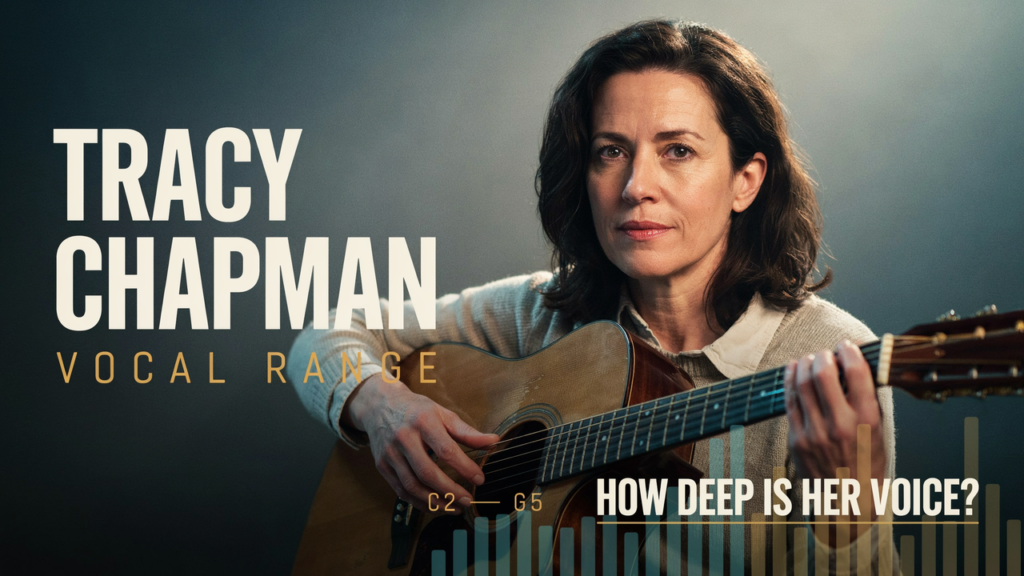
What Is Tracy Chapman’s Vocal Range?
Most analyses place her range from the lower third octave up into the fifth octave, with a strong emphasis on the lower and middle registers.
What stands out is not how high she sings, but how comfortably she lives in a low tessitura.
If you compare her span to a typical female vocal range, you’ll see that she operates toward the lower end of that spectrum.
Her voice feels grounded and centered, especially in acoustic performances where tone clarity matters more than volume.
Is Tracy Chapman a Contralto?
She is often described as a contralto, though some classify her as a low mezzo-soprano with contralto qualities.
The key difference lies in tessitura — where the voice sits most comfortably.
A true contralto tends to:
- Sit naturally in a lower tessitura
- Have a darker tonal color
- Sustain low notes with ease
- Avoid frequent upper-register belting
If you want to understand that classification more clearly, compare her placement to a typical alto vocal range and also review a mezzo-soprano vocal range to see how the comfort zone shifts.
Her music rarely requires extreme upper extension. That’s a strong indicator of a lower female tessitura.
Lowest and Highest Notes in Context
Many singers focus on “What’s her highest note?”
That misses the bigger picture.
Her voice thrives in the lower middle range. Even when she moves upward, the tone remains controlled and warm rather than bright and piercing.
To visualize how those notes sit musically, check a standard vocal range chart and notice how much of her repertoire centers in the lower half.
Range is one thing. Placement and comfort are another.
What Makes Her Voice Sound So Deep?
Depth doesn’t always come from extreme low notes.
It comes from:
- Strong chest resonance
- Minimal breathiness
- Balanced airflow
- Efficient vocal fold closure
Think of her tone like a cello rather than a violin.
It’s rich, steady, and grounded.
She doesn’t force her low notes.
They feel like an extension of her speaking voice.
Use the voice range checker to see how your top and bottom notes compare.
Developing a Warm, Low Female Tone
If you admire her sound, here’s how to build similar depth safely.
1. Strengthen Your Speaking Register
Your lower singing range should feel close to speech.
Practice reading lines aloud with relaxed breath support before singing them.
2. Build Chest Voice Stability
Use medium-volume scales on syllables like “mum” or “gee.”
Avoid pushing volume downward.
3. Maintain Upright Posture
Low notes collapse easily if posture drops.
Keep your rib cage lifted and your neck relaxed.
4. Avoid Over-Darkening
Some singers artificially depress the larynx to sound deeper.
This creates tension and reduces clarity.
If you want to track your lower progress objectively, use a structured voice type test to see where your tessitura naturally sits.
Range vs Tessitura: Why It Matters
A singer can technically hit certain notes without those notes being comfortable.
Tessitura is the true indicator of voice type.
Here’s a simple comparison:
| Factor | Wide Range | Low Tessitura Strength |
|---|---|---|
| Can hit occasional high note | Yes | Yes |
| Lives comfortably in low register | Not always | Yes |
| Tone remains full in lower notes | Sometimes | Consistently |
| Identity defined by depth | Rare | Yes |
Tracy Chapman’s identity is defined by depth and warmth.
If you’re unsure how average spans compare, reviewing an average vocal range baseline gives helpful perspective.
Is Your Lower Register Healthy?
Ask yourself:
- Do my low notes feel relaxed?
- Can I sustain them without breathiness?
- Does my speaking voice feel normal afterward?
- Am I lowering my chin or pushing my jaw forward?
Healthy low singing should feel grounded and stable, not heavy or forced.
If your throat feels tight, you’re likely compensating.
Common Mistakes When Trying to Sing Lower
Forcing the Larynx Down
Artificially lowering the voice creates tension and reduces resonance.
Confusing Darkness With Depth
A breathy tone can sound dark but lacks true support.
Ignoring Upper Range Balance
Only focusing downward can weaken flexibility.
Balanced development across registers helps maintain overall health, which is why structured guidance on how to extend vocal range is safer long-term.
Comparing Octave Counts
Depth of tone matters more than how many octaves you claim.
Realistic Expectations for Lower Female Voices
True contralto voices are rare.
Most women naturally sit in mezzo-soprano territory.
However, many singers can strengthen their lower register with proper technique.
That doesn’t mean you should chase extreme lows.
Your goal is clarity, warmth, and sustainability.
If you want to measure your full span before focusing on tone development, try a vocal range calculator to understand your current limits.
What Singers Can Learn From Tracy Chapman
She proves that you don’t need extreme high notes to create emotional impact.
Her strength comes from:
- Stable tone
- Controlled phrasing
- Natural resonance
- Consistency
Many singers overemphasize upper extension.
Her career shows that authenticity and comfort often resonate more than vocal extremes.
If you’re curious how low female voices compare in classification, exploring the broader female vocal range chart can help place her tessitura in context.
Final Coaching Takeaway
Tracy Chapman’s vocal range is solid and grounded, but her true power lies in how she uses it.
She doesn’t chase high belts or flashy runs.
She builds emotion through depth, stability, and tonal warmth.
Focus on comfort before expansion.
Build strength before power.
Protect your voice while developing range.
That’s how you create a voice that lasts.
FAQs
1. What is Tracy Chapman’s vocal range?
Her range is generally estimated at about two to three octaves, centered in a lower female tessitura. She is known more for depth than extreme high notes.
2. Is Tracy Chapman a true contralto?
She is often described as a contralto due to her dark tonal color and low tessitura. Some classify her as a low mezzo-soprano with contralto qualities.
3. What is Tracy Chapman’s lowest note?
Her lowest notes sit comfortably in the lower third octave. What stands out is the strength and resonance she maintains there.
4. Does Tracy Chapman belt high notes?
Her style rarely relies on powerful high belting. Instead, she emphasizes warmth and control in the lower and middle registers.
5. Are contralto voices rare?
Yes, true contraltos are uncommon. Many singers who identify as contralto are actually low mezzo-sopranos.
6. Can I train my voice to sound deeper?
You can strengthen your lower register with proper technique and breath support. However, anatomical factors influence how deep your voice can comfortably go.
7. Is range more important than tone?
No. Tone quality and control often matter more than extreme note counts. A stable, expressive voice will always be more effective than a wide but uncontrolled range.

Cooke is a vocal training and singing education writer specializing in vocal range analysis, pitch recognition, voice development, and singing tools for vocalists, performers, musicians, and beginners. He creates practical content focused on vocal improvement, singing techniques, and voice analysis resources.