
Luciano Pavarotti’s vocal range spanned approximately from C3 to C6, covering close to three octaves at his peak. He was classified as a lyric tenor, famous for his consistent, ringing high C and bright upper tessitura that defined his operatic sound.
Numbers matter — but in opera, placement and projection matter even more.
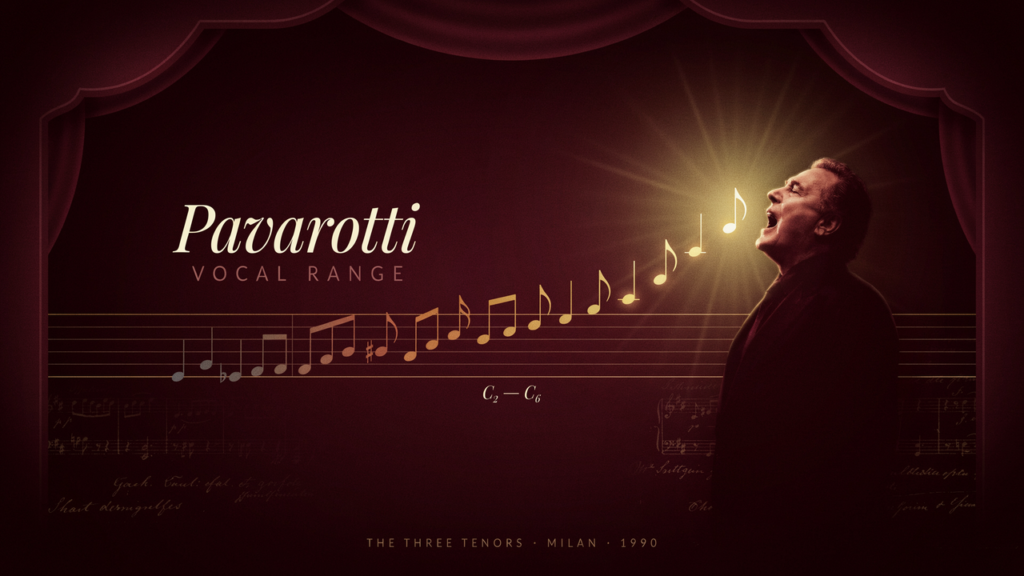
What Was Pavarotti’s Lowest and Highest Note?
Most documented performances place his lower extension around C3, with his most celebrated high note being the tenor high C (C5 in scientific pitch notation for tenors, often written as C6 in some systems).
That high C became legendary because he didn’t just reach it — he sustained it with clarity and ease.
To understand where this fits structurally, compare it to the typical tenor vocal range.
Why the High C Matters
For tenors, the high C is a milestone note.
It sits at the top of many operatic arias and requires balanced registration through the passaggio.
Pavarotti’s brilliance wasn’t that he sang “higher than everyone.” It was that his high C was:
- Consistent
- Resonant
- Free of visible strain
- Musically controlled
Many tenors can touch the note. Fewer can sustain it beautifully.
This pitch identification test makes it easy to measure improvement.
What Type of Tenor Was Pavarotti?
He was widely recognized as a lyric tenor.
Lyric Tenor Characteristics
A lyric tenor typically has:
- Bright, ringing upper register
- Smooth legato phrasing
- Flexible dynamics
- High tessitura comfort
If you want to understand how this differs from heavier classifications, explore the broader framework in a voice type guide.
Tessitura vs Total Range
His tessitura — where his voice comfortably lived — sat high. That’s what allowed him to sing demanding repertoire night after night.
If you’re unsure what tessitura truly means, review tessitura explained.
How Wide Was His Range Compared to Other Men?
Here’s a practical comparison:
| Category | Typical Range |
|---|---|
| Untrained male | 1.5–2 octaves |
| Trained contemporary singer | 2–3 octaves |
| Operatic tenor | ~2.5–3 octaves |
| Rare extreme outlier | 3+ octaves |
Pavarotti’s range was strong but not freakishly wide. What made it extraordinary was its quality.
To put it in context, review the broader male vocal range explained.
How He Produced His High Notes
Opera demands projection over an orchestra without microphones.
That requires efficient technique.
Breath Support
His airflow was steady and economical. He didn’t blast air; he managed it.
Imagine balancing a spinning plate. Too much force and it wobbles. Too little and it falls.
Passaggio Mastery
The passaggio is the transition area between registers. Many tenors struggle here.
Pavarotti navigated it smoothly, allowing his upper register to bloom rather than squeeze.
Resonance Placement
He used forward placement and lifted soft palate resonance to amplify tone naturally.
His sound was bright but not forced.
Can You Sing Within Pavarotti’s Range?
Possibly — but classification matters.
Before attempting high tenor repertoire, determine your own limits by learning how to find your vocal range.
If you’re unsure of your octave span, measure accurately using a vocal range calculator.
Not every male singer is a tenor. And not every tenor should attempt operatic high Cs immediately.
Step-by-Step: Approaching the Tenor High C Safely
If you’re training toward high C territory, use this progression:
- Warm up gently through your mid-range.
- Practice smooth ascending scales without pushing.
- Strengthen head-dominant mix coordination.
- Narrow vowels slightly as you ascend.
- Stop immediately if tension builds in the throat or jaw.
High notes should feel energized but not painful.
Range expands gradually. Expect semitone improvements over months, not overnight breakthroughs.
If upper notes feel unstable, consistent vocal exercises to increase range will build coordination over time.
Common Mistakes When Chasing High C
- Forcing chest voice too high
- Lifting the chin to “reach” notes
- Holding breath instead of flowing it
- Attempting repertoire beyond current tessitura
- Comparing yourself to operatic legends too early
A strained high C does more harm than good.
Opera technique prioritizes freedom and resonance, not brute force.
Quick Self-Check: Are You a Tenor?
Ask yourself:
- Is your comfortable speaking voice relatively high?
- Do upper-mid notes feel natural?
- Can you sing G4 or A4 without strain?
- Does your voice brighten easily as you ascend?
If yes, you may sit in tenor territory.
For comparison, look at the broader human vocal range limits to see how your extension fits.
Realistic Expectations About Tenor Development
Developing operatic high notes takes years of disciplined training.
Most singers gain a few semitones at a time with consistent practice. Tissue coordination strengthens slowly.
Your vocal folds are delicate. Treat them like athletes treat muscle — progressive training with adequate rest.
Attempting dramatic repertoire prematurely often causes fatigue, not growth.
What Made His Voice Legendary
It wasn’t just the high C.
It was:
- Consistency across performances
- Even tone from low to high
- Clear diction
- Effortless vibrato
- Emotional connection
Range gave him access. Technique made it reliable.
If you want to compare your own numbers with clarity, use a singer comparison tool within your own platform — but remember that projection and resonance are as important as pitch.
Final Coaching Perspective
Pavarotti’s vocal range covered roughly three octaves, anchored by a brilliant high C and a high-set lyric tenor tessitura.
He wasn’t famous for extreme octave claims. He was famous for mastery.
Focus on coordination before ambition. Build your upper register slowly. Protect your voice.
That’s how you train like a true tenor.
FAQs
1. What was Pavarotti’s highest note?
His most famous note was the tenor high C. He could sustain it with clarity and resonance in live operatic performances.
2. How many octaves did Pavarotti have?
He had close to three octaves of usable range at his peak. That is strong for a lyric tenor.
3. Was Pavarotti a lyric tenor?
Yes. He was widely recognized as a lyric tenor with a bright upper tessitura and smooth legato phrasing.
4. What is a tenor high C?
For tenors, the high C is a C5 (often labeled C6 in some notation systems). It marks a major technical milestone in operatic singing.
5. Did Pavarotti sing above high C?
His repertoire centered around high C rather than significantly above it. His strength was consistency, not extreme whistle-like extension.
6. Is a three-octave range typical for a tenor?
Yes, around 2.5 to 3 octaves is common for trained tenors. The quality of those notes matters more than raw span.
7. Can beginners train to sing high C?
Possibly, but it takes years of disciplined training. Build your upper range gradually and never force notes beyond your comfort zone.

Cooke is a vocal training and singing education writer specializing in vocal range analysis, pitch recognition, voice development, and singing tools for vocalists, performers, musicians, and beginners. He creates practical content focused on vocal improvement, singing techniques, and voice analysis resources.