
Bob Dylan’s vocal range is generally considered a low male range, often categorized around baritone, with most of his singing sitting in a narrow, speech-like zone rather than extreme high notes. His sound is defined more by timbre, phrasing, and resonance choices than by wide range or “perfect” tone.
If you’re here for a simple answer: Dylan isn’t famous because he can sing high or low. He’s famous because he can make a line feel like it’s aimed straight at your ribs.
That said—range still matters if you want to sing his songs comfortably, choose keys that fit your voice, or understand why his voice changed over time.
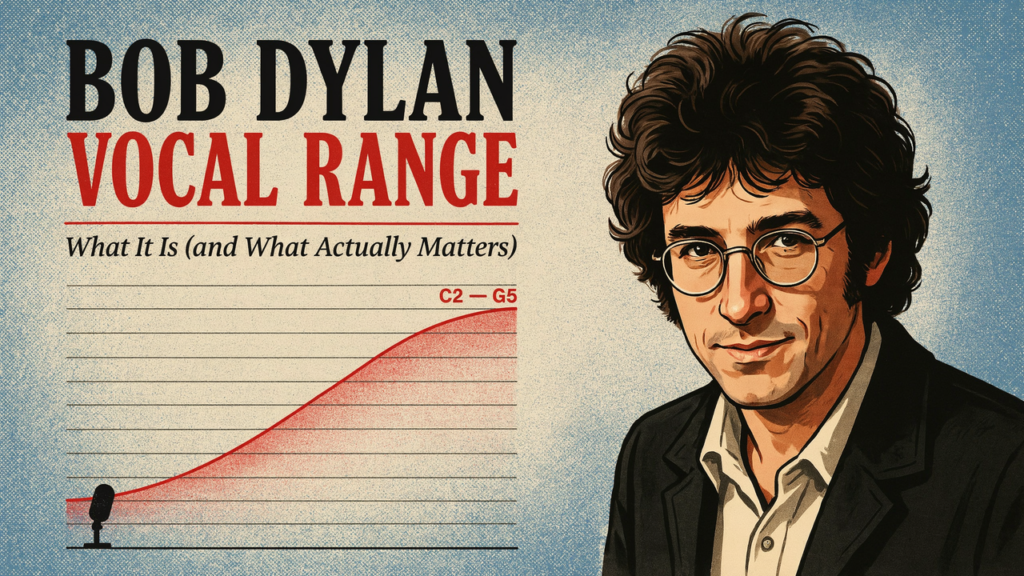
Bob Dylan’s Vocal Range (Quick, Practical Summary)
Most discussions place Dylan in a baritone-ish zone, with his comfortable singing sitting around the mid-low male range. His usable range varies a lot by era (early 60s vs later touring years), and by whether you count spoken-like notes, grit, and rasp.
The key coaching takeaway is this:
Dylan’s “range” is less important than his tessitura—the notes he lives in most of the time.
If you don’t know what tessitura is yet, read this simple tessitura explanation before you obsess over highest/lowest notes.
Range vs Tessitura: Why Dylan Sounds Higher Than He Is
A lot of singers hear Dylan and think, “He’s kind of high and nasal.” But that’s a trick your brain plays.
Dylan’s tone creates a pitch illusion
Dylan often uses a bright resonance strategy (think: forward, buzzy, pointed). That brightness can make notes feel higher than they are, even when the pitch is sitting comfortably in a baritone range.
Here’s an analogy:
A small flashlight can look brighter than a big lamp if it’s aimed directly into your eyes.
That’s Dylan’s resonance.
What this means for you
If you try to “match his sound” by forcing your voice up, you’ll strain. Instead, you want to match his placement, articulation, and phrasing, while keeping the pitch in your own comfortable range.
For a quick baseline of where your voice sits, use this guide to find your vocal range before choosing keys.
What Voice Type Is Bob Dylan?
Most people call Dylan a baritone, and that’s usually the most practical label.
But voice type labels are fuzzy in popular music. Dylan doesn’t sing like an opera baritone. He sings like a storyteller who happens to be male and low-ish.
Baritone vs low tenor (the real answer)
If you want a clean rule:
- If your speaking voice is naturally lower and your best notes sit in the mid-low range, you’ll probably feel Dylan-friendly.
- If you’re a tenor, you can still sing Dylan easily—you’ll just need to bring the key down or keep your tone speech-like.
If you’re curious about the difference in a way that actually helps your singing, read this baritone vs bass breakdown and this tenor vs baritone comparison.
Why Bob Dylan’s Voice Changed So Much Over Time
Dylan is one of the clearest examples of how voices evolve across decades.
What typically changes with age
Most male singers experience:
- A shift toward a lower tessitura
- Less easy access to bright high notes
- More rasp or breathiness (sometimes stylistic, sometimes physical)
This is normal. If you want the science-backed overview, check whether vocal range changes with age.
The coaching truth
Dylan didn’t “lose his voice.”
He changed his instrument—and leaned into a style that fit the new version.
That’s a great lesson for any singer: don’t fight your voice’s evolution. Build a style that suits it.
The Dylan Sound: What Makes It Unique
If you try to sing Dylan by copying his rasp, you’ll get tired fast. If you copy his coordination, you can sing for hours.
1) Speech-like singing
Dylan often sings close to speech, especially on verses. The pitch is there, but the feeling is conversational.
Try this:
- Speak the lyric with rhythm
- Then slide into pitch without “performing” it
2) Forward resonance (not “nasal singing”)
People call Dylan nasal, but most of what you’re hearing is forward resonance.
Forward resonance feels like vibration behind the nose and cheekbones, but the sound doesn’t need to be blocked or pinched.
A good test: if you pinch your nose and the sound collapses, you’re probably too nasal. If the sound stays mostly stable, you’re likely just forward.
3) Twang (the secret weapon)
Twang is that bright, slightly edgy ring that helps a voice cut through.
It’s not shouting. It’s more like aiming your voice.
If you want a simple way to measure whether you’re actually staying on pitch while you experiment, use the pitch detector tool so you don’t confuse “style” with “sloppy pitch.”
4) Controlled roughness (the risky part)
Dylan’s rasp is part style, part physiology, part era.
Here’s the safe rule:
Rasp should feel easy. If it feels scratchy, stop.
Scratchy = irritation.
Easy roughness = coordination.
If you’re not sure where your voice is sitting overall, use the vocal range calculator to get a baseline and keep your training realistic.
Step-by-Step: How to Sing Like Bob Dylan (Without Hurting Your Voice)
Use this as a practical training routine. Do it for 10–15 minutes, 3–5 days per week.
Step 1: Choose a comfortable key first
Dylan’s songs are frequently transposed live and covered in many keys. Don’t treat the original key like it’s sacred.
If you don’t know what keys fit you yet, this song key finder can help you experiment.
Step 2: Speak the lyrics in rhythm
Before you sing anything:
- Speak the line like you’re telling a friend
- Keep it relaxed
- Keep the rhythm consistent
This is the “Dylan engine.”
Step 3: Add pitch with minimal extra effort
Now repeat the same line, but let the pitch appear.
The goal is speech → pitch, not speech → performance voice.
Step 4: Add brightness using “nay” or “yeah”
To find Dylan’s forward ring, do a short exercise:
- Say “yeah, yeah” with a slightly bratty tone
- Then sing the lyric with that same placement
- Keep volume moderate
Step 5: Add phrasing (the real magic)
Dylan’s phrasing is rarely “smooth.” He bends timing, pushes consonants, and shapes vowels like a storyteller.
Pick one technique per verse:
- Lean on consonants (t, k, d)
- Stretch a vowel
- Speak-sing the first half, then sing the last word clearly
Step 6: Add texture only after everything else works
If you want grit:
- Lower the volume
- Keep airflow steady
- Add only a hint of roughness
If you need to push to create rasp, you’re doing it wrong.
A Simple Dylan-Style Practice Plan (Numbered Routine)
- Speak the verse in rhythm for 60 seconds
- Sing it lightly in your comfortable range
- Add forward resonance (bright but not louder)
- Record a short clip
- Fix one thing only: pitch, rhythm, or clarity
- Repeat once more and stop before fatigue
That “stop before fatigue” part matters. Dylan’s style is deceptive—it feels casual, but it can tire you out if you over-brighten or over-articulate.
The singing range vs octaves tool helps you map voice span.
One Table That Actually Helps: Dylan Technique vs What to Do
| What you hear in Dylan | What it actually is | What you should do |
|---|---|---|
| “Nasal voice” | Forward resonance + bright vowels | Aim sound forward without pinching |
| “Talk-singing” | Speech-like coordination | Speak first, then add pitch |
| “Rasp/grit” | Controlled texture (sometimes age-related) | Keep volume low, stop if scratchy |
| “Sharp/edgy tone” | Twang + consonant emphasis | Use “yeah/nay” placement drills |
| “Loose timing” | Intentional phrasing | Choose 1 phrasing choice per verse |
Short Self-Check (60 Seconds)
Use this to see if Dylan-style singing is working for you.
Check 1: Comfort
After one verse, ask:
- Does my throat feel normal?
- Is there any scratchiness?
- Do I feel like I need to cough?
If yes, back off brightness and volume.
Check 2: Clarity
Can you understand the words? Dylan’s style is conversational, but it’s still intelligible.
Check 3: Pitch stability
You don’t need perfection, but you should not drift wildly.
If you want a quick skill check, try this pitch accuracy test after a practice session.
Common Mistakes (That Ruin Dylan Style Fast)
Here’s where most singers go wrong.
- Forcing rasp
If it feels scratchy, you’re irritating tissue. Dylan’s roughness is not “push harder.” - Going too nasal
Forward resonance is good. Pinching the nose and blocking sound is not. - Trying to sound “pretty”
Dylan’s voice isn’t about beauty. It’s about message and rhythm. - Over-singing the chorus
Dylan choruses often work because they’re simple and direct. Don’t turn them into a power ballad. - Choosing the wrong key
If the song makes you reach for high notes, transpose. The key is a tool, not a rule.
If you want to understand how range categories work so you choose keys smarter, review the vocal range chart.
Realistic Expectations (The Coaching Truth)
If you’re hoping to sound exactly like Bob Dylan, you’re setting yourself up for frustration.
Your voice has different anatomy, habits, and resonance.
But you can learn:
- Dylan-style phrasing
- Speech-like singing
- Bright forward tone
- Storytelling delivery
- Safe texture (in your own version)
That’s the win.
And honestly? It’s a bigger win than imitation. Because Dylan’s whole point is authenticity.
FAQs
1) What is Bob Dylan’s vocal range?
Bob Dylan is generally considered a low male singer, often labeled around baritone. His usable range depends heavily on era and performance style. More importantly, he sings in a narrow tessitura that stays close to speech.
2) Is Bob Dylan a baritone or a tenor?
Most practical classifications put him closer to baritone, but popular music voice types aren’t strict. He uses a bright, forward resonance that can make him sound higher than he is. If you’re a tenor, you can still sing his songs easily by choosing a comfortable key.
3) Why does Bob Dylan sound nasal?
A lot of what people call “nasal” is actually forward resonance and bright vowels. True nasal singing collapses when you pinch your nose. Dylan’s sound is more like a focused, buzzy placement than blocked airflow.
4) Did Bob Dylan’s voice get worse over time?
It changed more than it “got worse.” Many singers shift lower with age and develop more texture. Dylan leaned into that change and built a style that fit his evolving voice.
5) Can beginners sing Bob Dylan songs?
Yes—many Dylan songs are beginner-friendly because the melodies are speech-like and not extremely rangy. The biggest challenge is rhythm, phrasing, and clarity of lyrics. Start with a comfortable key and keep volume moderate.
6) How do I sing with Dylan-style rasp safely?
Don’t force it. Keep volume low, airflow steady, and stop immediately if your throat feels scratchy or irritated. If rasp only happens when you push, it’s not safe or sustainable.
7) Do I need a big vocal range to sing like Bob Dylan?
No. Dylan’s signature is not a huge range—it’s tone, storytelling, and phrasing. A smaller, stable range with clear diction will get you much closer than chasing high notes. Focus on comfort and message first.

Cooke is a vocal training and singing education writer specializing in vocal range analysis, pitch recognition, voice development, and singing tools for vocalists, performers, musicians, and beginners. He creates practical content focused on vocal improvement, singing techniques, and voice analysis resources.