
Baritone and bass are both formal male voice types, but they are not separated by how low you can sing. The decisive differences are tessitura (where the voice is most comfortable), timbre (warm vs very dark), vocal weight, and stamina in the low register. Most men who sing low are baritones, not basses—true bass voices are comparatively rare.
Baritone and bass are male voice types, but bass sings lower and has a deeper, heavier tone. Baritones typically range G2–G4 with a warm mid-range, while basses range E2–E4 with a darker, fuller sound. Tessitura and vocal comfort—not just lowest notes—determine your true voice type.
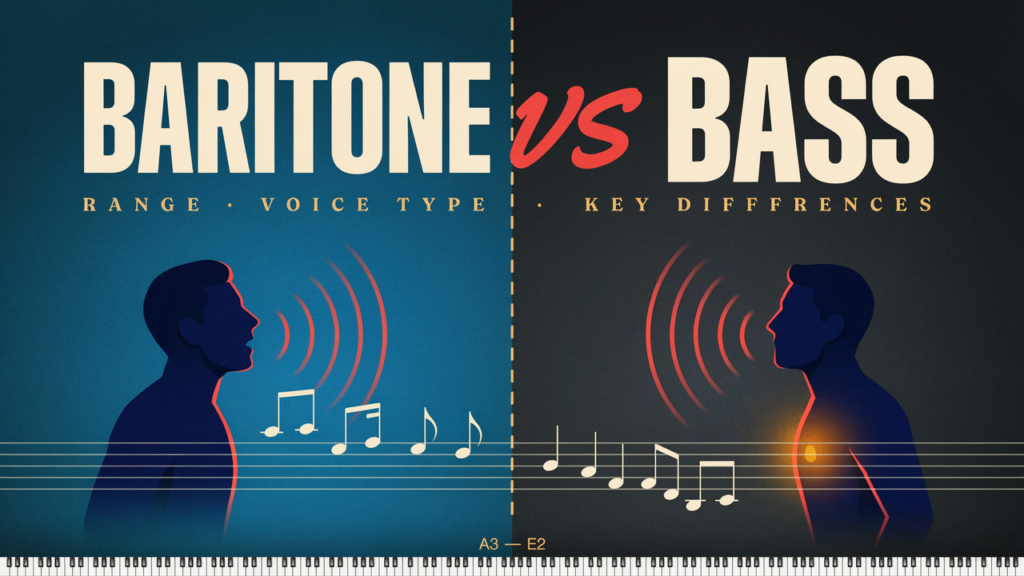
Why Baritone vs Bass Is So Often Confused
The confusion usually comes from three sources:
- Choir labels – Many singers assigned to the bass section assume that makes them basses.
- Range charts – Touching a low note once is mistaken for living there comfortably.
- Early vocal development – Young or untrained voices often sound darker before technique and flexibility develop.
As a result, singers who can sing low ask a reasonable question: “Am I a baritone or a bass?”
The vibrato analysis tool helps you see whether your vibrato is steady.
What Is a Baritone?
A baritone is the middle male voice type, sitting between tenor and bass.
Typical characteristics
- Approximate range: A₂–A₄ (varies by singer)
- Tessitura: Middle to low-middle
- Timbre: Warm, rich, flexible
- Vocal weight: Moderate
Baritones often have access to low notes, but their voice feels most reliable and resonant in the middle register, not at the extreme bottom.
A classic reference is Dietrich Fischer-Dieskau, whose voice exemplifies baritone warmth, clarity, and expressive range without the extreme depth of a true bass.
What Is a Bass?
A bass is the lowest male voice type in classical singing.
Typical characteristics
- Approximate range: E₂–E₄ (sometimes lower)
- Tessitura: Low
- Timbre: Very dark, heavy, resonant
- Vocal weight: Substantial
True basses are defined by consistent comfort and stamina below middle C. Their low notes are not just present—they are full, stable, and sustainable over long passages.
A benchmark example is Boris Christoff, whose voice demonstrates unmistakable depth and authority in the lowest register.
Baritone vs Bass: Side-by-Side Comparison
| Feature | Baritone | Bass |
|---|---|---|
| Voice type rank | Middle male voice | Lowest male voice |
| Tessitura | Middle / low-middle | Low |
| Timbre | Warm, rich | Dark, heavy |
| Vocal weight | Moderate | Heavy |
| Population | Most common | Relatively rare |
Sharing low notes does not mean sharing a voice type. Explore advanced features in our singing analysis tool.
The Biggest Myth About Low Male Voices
“If I sing low, I must be a bass.”
Reality:
Many baritones can sing low notes, especially in short phrases or choral settings. What matters is whether those notes remain comfortable, resonant, and reliable day after day.
Ask yourself:
- Do low notes feel effortless or heavy?
- Can you sustain low tessitura without fatigue?
- Does the voice naturally settle low when you’re relaxed?
If not, baritone is far more likely.
Tessitura: The True Deciding Factor
Tessitura refers to where your voice:
- Sounds best
- Feels easiest
- Can sing for long periods without strain
Baritones
- Thrive in the middle register
- Feel grounded but flexible
- May dip low, but don’t live there
Basses
- Thrive below middle C
- Feel stable and powerful low
- Often feel weighed down by higher tessitura
Two singers can have identical lowest notes and still belong to different voice types based on tessitura alone.
How Professionals Classify Baritone vs Bass
Voice teachers do not decide voice type by range charts alone. They evaluate voices using a hierarchy:
- Tessitura
- Timbre
- Vocal weight and response
- Passaggi (register transitions)
- Range extremes (last, not first)
Choir placement is considered functional, not diagnostic.
A Practical Self-Check (Directional, Not Diagnostic)
Use this as guidance—not a final label.
You may lean baritone if:
- Your strongest notes sit between A₂–E₄
- The voice feels flexible and responsive in the middle
- Very low notes exist but thin or tire quickly
You may lean bass if:
- Notes below middle C remain full and resonant
- Your voice prefers low tessitura every day
- Higher notes feel heavy and effortful
Young voices change significantly. Final classification often settles later with consistent training.
Repertoire Implications
Baritone repertoire
- Dramatic and lyrical operatic roles
- Art song centered in the middle register
- Wide crossover potential (musical theatre, contemporary)
Bass repertoire
- Authority and character roles
- Oratorio and sacred music
- Choral and ensemble music anchored low
Singing repertoire that fights your tessitura is one of the fastest ways to stall progress.
Can a Baritone Sing Bass Music?
Sometimes—but selectively.
- Short bass passages are usually fine
- Prolonged low tessitura can cause fatigue
- Constant “pushing down” dulls flexibility
Likewise, forcing a bass upward for long periods can strip the voice of its natural depth.
Why Correct Classification Matters
Misclassifying low male voices often leads to:
- Chronic downward pressure
- Loss of agility
- Reduced stamina
- Slower technical development
Correct classification allows technique to develop with the voice, not against it.
Final Verdict: Baritone vs Bass
- Most low male voices are baritones
- True basses are rare
- Range alone is misleading
- Tessitura and timbre decide
If accuracy matters—for auditions, training, or long-term vocal health—work with a qualified teacher and reassess as your voice matures.
Related Articles:
- To understand male voice classification better, explore this guide on tenor vs baritone.
- You can compare lower voice categories in more detail with this breakdown of tenor vs bass.
- Learning how singers are grouped becomes clearer in this overview of the vocal fach system.
- Choosing the right repertoire is easier when you understand what tessitura means.
- Discover how far voices can stretch by reading about a 3-octave vocal range.
- Improving vocal depth and flexibility can start with exercises to increase range.
- Seeing real-world examples helps when analyzing Aaliyah’s vocal range.

Cooke is a vocal training and singing education writer specializing in vocal range analysis, pitch recognition, voice development, and singing tools for vocalists, performers, musicians, and beginners. He creates practical content focused on vocal improvement, singing techniques, and voice analysis resources.