
Chester Bennington’s vocal range is commonly described as a wide tenor range, known for intense high notes delivered in mixed voice and extended further through distortion and screams. Exact highest and lowest notes vary by song and performance, but his real signature is high tessitura, stamina, and emotional intensity—not just one extreme note.
If you’re here because you want to sing Linkin Park songs, I’m going to be direct:
Chester’s vocals are athletic.
And copying them the wrong way is one of the fastest ways to strain your voice.
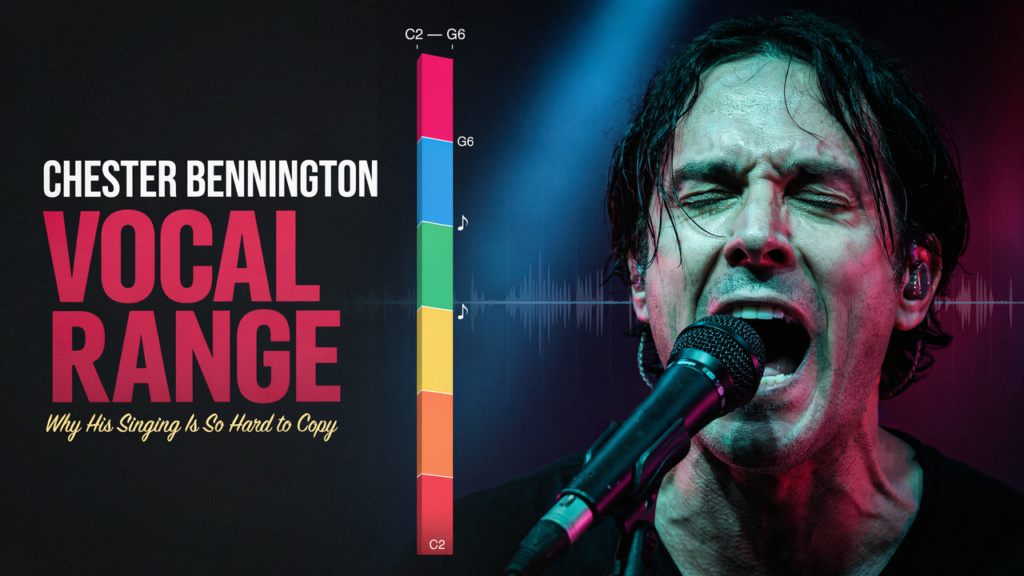
Range vs Tessitura: The Real Reason Linkin Park Feels High
Most people search “Chester Bennington vocal range” because they want:
- his highest note
- his lowest note
- how many octaves he had
That’s fair.
But Chester’s songs feel hard because of something more important.
Range is the extremes
Range is the lowest and highest notes you can hit on a good day.
Tessitura is where the song lives
Tessitura is where you can sing:
- repeatedly
- with stable tone
- without fatigue
- for an entire song
Chester’s tessitura sits high for a male rock singer. He doesn’t just hit one high note—he spends entire choruses up there.
If you want a clean explanation, read this guide to tessitura.
What Voice Type Was Chester Bennington?
Chester is best described as a tenor, often leaning into a high-tenor function in rock terms.
That doesn’t mean he never sang low.
It means his voice was built to handle:
- high chorus placement
- bright resonance
- repeated upper-mid lines
- intense sustained belts
If you want a baseline for what “tenor range” typically looks like, start with this tenor vocal range reference.
Why people argue about it
People confuse:
- voice type (where you sing best)
- tone color (bright vs dark)
- range (highest and lowest possible notes)
Chester’s tone could be bright and cutting, which makes his voice sound “higher” even when he isn’t singing the highest possible pitch.
The pitch detection tool is useful for singers and instrumentalists alike.
Clean Singing vs Screaming: What Counts as “Vocal Range”?
This is the most important part of the Chester conversation.
Because rock singers don’t just sing clean notes—they add distortion.
Clean range
This includes:
- chest voice
- mixed voice
- head voice
- falsetto
These are measurable pitches.
Distorted range
Distortion can be produced in different ways:
- vocal fry distortion
- false cord distortion
- compressed grit
Distortion can sit on top of a pitch, but it can also make pitch harder to identify.
So when you see huge range claims online, here’s the coaching truth:
The impressive part is not “how high the scream is.”
The impressive part is how high the clean singing already is—plus the stamina to add intensity.
Why Chester’s High Notes Sound So Intense
Chester didn’t sing high by “pushing harder.”
He sang high by using efficient coordination, then adding intensity.
1) Mixed voice (not pure chest)
A lot of singers try to sing Linkin Park by dragging chest voice upward.
That’s like trying to sprint in hiking boots.
Chester’s high notes were strong because they were mixed—meaning he blended chest power with head resonance.
If you’re confused about the difference, this chest voice vs head voice guide will clear up the basics quickly.
2) Bright resonance and “ring”
His tone cuts through loud guitars because it has ring.
Think of it like a trumpet. A trumpet doesn’t need to be “bigger” to be loud—it needs to be focused.
3) Vowel modification
Chester didn’t keep vowels wide when he went up.
Wide vowels cause strain.
Narrowing vowels keeps the sound stable and protects the throat.
4) Emotional intensity without losing pitch
This is rare.
Many singers get emotional and lose pitch accuracy.
Chester could be explosive and still land the note.
Why Linkin Park Songs Feel Brutal to Sing
Chester’s songs are not “hard because of one high note.”
They’re hard because the choruses often sit in the upper-middle tenor zone for a long time.
That’s tessitura fatigue.
The real challenge is repeatability
A singer might hit a high chorus once.
But can you hit it:
- again after the next verse
- again in the final chorus
- again on tour
- again tomorrow
That’s what separates a casual high note from a professional instrument.
If you want to see your own baseline before you compare, use the vocal range calculator.
Step-by-Step: How to Sing Like Chester
If you want to sing Chester’s material, you need to train in the right order.
Most singers do it backwards.
They start with screaming.
That’s like trying to deadlift before you can squat.
Step 1: Choose a key you can actually sing
Do not treat the original key as sacred.
If you’re not a tenor, you’ll likely need to transpose down.
That’s not cheating. That’s being smart.
Use this song key finder to test a few keys until the chorus sits in your comfort zone.
Step 2: Sing the chorus clean first
Before you add grit, you must be able to sing the chorus cleanly.
If you can’t sing it clean, distortion will not save you.
Distortion will just hide your pitch problems until your voice gets tired.
Step 3: Train the high notes at 60% volume
This is the rule that keeps you safe.
If you can only sing the note by getting louder, you are forcing.
High notes should feel:
- focused
- smaller
- “aimed” forward
Not louder.
Step 4: Use “ng” to find the right placement
Try this:
- hum “ng” (like the end of “sing”)
- slide up gently
- then open to “uh”
This helps you find a high coordination without throat pressure.
Step 5: Add intensity with resonance, not push
Chester’s intensity comes from:
- compression
- resonance
- clarity
Not from yelling.
Think of it like a pressure washer. The power comes from focus, not from flooding.
Step 6: Add distortion only when clean singing is stable
Distortion should never feel:
- scratchy
- burning
- painful
- dry in a sharp way
If it does, stop immediately.
Chester’s distortion sounded aggressive, but it wasn’t uncontrolled.
The Chester Practice Routine (Numbered List)
Do this 3–5 times per week for 10–15 minutes.
- Warm up gently in your middle range for 2 minutes
- Sing one chorus line clean at medium volume
- Rest for 20 seconds
- Repeat the line, focusing on vowels and pitch
- Record 20–30 seconds and listen back
- If clean is stable, add a tiny bit of grit (not a scream)
- Stop immediately if you feel scratchiness or tightness
This is how you build Chester-style intensity without wrecking your voice.
One Bullet List: What to Focus on (If You Want Chester’s Sound)
If you train these skills, you’ll get closer fast:
- high mixed voice coordination (not yelling)
- stable pitch in the upper-middle range
- vowel modification on high notes
- bright resonance and ring
- stamina for repeated choruses
- clean singing before distortion
- emotional intensity without tension
If you want to check your tuning while practicing, use the pitch detector tool and see whether tension is pulling you sharp.
One Table That Helps: What You Hear vs What You Should Practice
| What you hear in Chester | What it really is | What you should practice |
|---|---|---|
| Huge high choruses | High tessitura | Repeat chorus lines with rest |
| “Screamed” high notes | Mixed voice + distortion | Clean pitch first, grit second |
| Cutting tone | Bright resonance | Focused “forward” sound |
| Aggressive intensity | Compression | Medium volume, controlled breath |
| Consistency live | Conditioning | Short sets over weeks |
Quick Self-Check (60 Seconds)
Do this after a practice session.
Check 1: Can you repeat the chorus line twice?
Sing the line once.
Rest 10 seconds.
Sing it again.
If the second attempt feels tighter, you’re pushing.
Check 2: Is your throat scratchy afterward?
Scratchiness is a warning sign.
Stop and rest.
Distortion should never feel like sandpaper.
Check 3: Did you lose pitch when you got emotional?
If intensity makes you go sharp or flat, you need more stability before you add power.
If you want a simple measurement tool, run this pitch accuracy test after practice to see if fatigue is affecting your tuning.
Common Mistakes When Trying to Sing Like Chester Bennington
Mistake 1: Yelling instead of mixing
This is the #1 injury path.
If your neck veins pop and your throat clamps, you’re yelling.
Mistake 2: Adding distortion too early
Distortion is not a shortcut.
If your clean singing isn’t stable, distortion will just cover problems until you fatigue.
Mistake 3: Keeping vowels too wide
Wide vowels create tension.
Tension kills high notes.
Mistake 4: Practicing screams every day
This is like sprinting every day.
Your voice needs recovery.
Chester’s stamina was built over years—not by grinding daily.
Mistake 5: Ignoring vocal health warning signs
If you feel:
- hoarseness
- burning
- pain
- persistent tightness
Stop and rest.
If you want a simple baseline for safe training, keep these vocal health tips in mind.
Realistic Expectations
Chester’s singing combined:
- high tessitura
- strong mix
- resonance
- distortion
- emotional delivery
- stamina
That’s a rare combination.
You can absolutely train toward it, but you need time.
Here’s what’s realistic:
- In 2–4 weeks: better pitch stability and cleaner high vowels
- In 6–10 weeks: stronger mix and less strain
- In 3–6 months: noticeably better stamina and control
If you want to build your upper range safely as a foundation, follow this guide on singing higher notes.
FAQs
1) What is Chester Bennington’s vocal range?
Chester Bennington is commonly described as a tenor with a wide usable range. His singing included powerful mixed voice high notes and additional extension through distortion and screams. Exact highest and lowest notes vary depending on the song and performance.
2) How many octaves did Chester Bennington have?
Octave counts vary depending on what you include—clean singing only, or distorted notes and effects. Chester’s most impressive skill wasn’t the number, but how consistently he sang in a high tessitura. Sustaining that range repeatedly is harder than hitting one extreme note.
3) Was Chester Bennington a tenor?
Yes, he functioned as a tenor in rock terms. His choruses sit high for long stretches, and his voice had the brightness and stamina typical of a strong tenor. Many baritones can sing his songs, but usually in a lower key.
4) Were Chester’s screams actual notes?
Sometimes yes, sometimes not in a clean, measurable way. Distortion can sit on top of pitch, but it can also blur the pitch center. That’s why scream “note charts” online are often inconsistent.
5) How did Chester scream so high?
He wasn’t just yelling. His high intensity was built on a strong mixed voice foundation, with controlled compression and distortion layered on top. That’s why it sounded intense without immediately falling apart.
6) Can I learn to sing like Chester Bennington?
You can train many of the same skills: mix, resonance, stamina, and controlled grit. But you need to progress safely and not force volume. Start with clean singing, then add distortion later.
7) How do I scream like Chester without hurting my voice?
First, learn to sing the lines cleanly and comfortably in your range. Then add very light grit at medium volume, never full screaming right away. If you feel scratchiness, burning, or hoarseness, stop immediately and rest.

Cooke is a vocal training and singing education writer specializing in vocal range analysis, pitch recognition, voice development, and singing tools for vocalists, performers, musicians, and beginners. He creates practical content focused on vocal improvement, singing techniques, and voice analysis resources.