
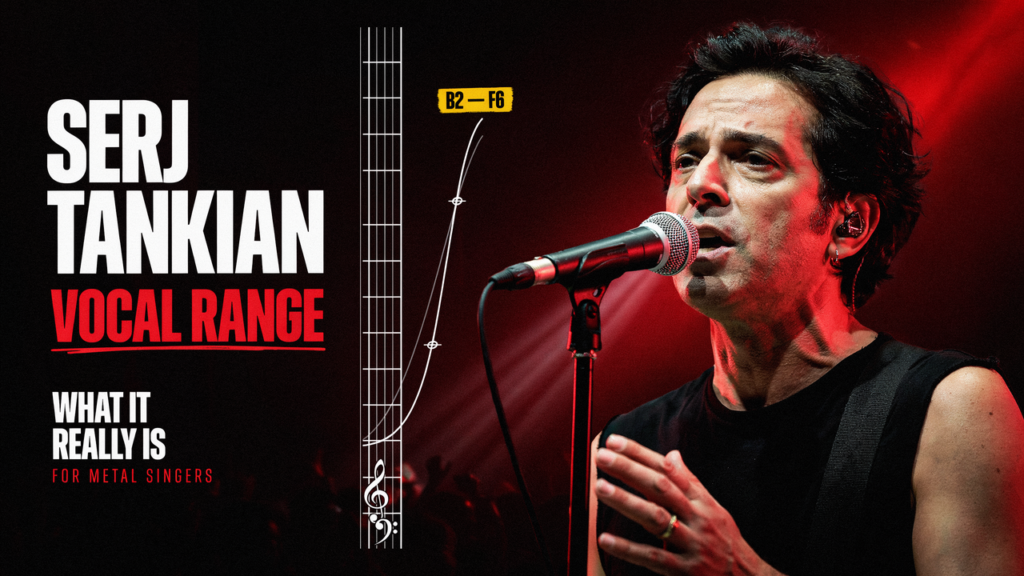
Serj Tankian’s vocal range refers to the span between his lowest and highest usable notes in clean singing, not including purely percussive screams. His range is commonly described as covering roughly three octaves, anchored in a baritone foundation with strong upper extension into high mixed and head-dominant notes.
Range numbers alone don’t explain his sound. What makes his voice unique is how he shifts tone, color, and intensity across registers—sometimes within a single phrase.
Let’s break it down clearly and practically.
Is Serj Tankian a Baritone or Tenor?
Most classifications place him as a baritone with unusual upper flexibility.
A baritone typically has:
- A grounded lower register
- A darker tonal color
- A tessitura that sits lower than a tenor
Serj’s mid-range feels baritone-centered. However, he can access upper notes that many baritones struggle with. That’s where confusion happens.
If you compare his core placement to a standard baritone vocal range, he fits that foundation more than a pure tenor classification.
Voice type is about comfort zone—not just the highest note someone can hit.
Clean Range vs Distorted Range
One of the biggest misunderstandings around metal singers is counting distorted screams as extra octaves.
Distortion is a texture layered onto pitch. It does not automatically expand true modal range.
Serj’s clean singing range is what should be measured first. Distorted notes sit on top of that coordination.
If you’re unsure how male voices are typically measured, reviewing a male vocal range overview gives helpful context.
Clean Singing
His clean tone shows strong chest voice in the lower register and controlled mixed/head coordination in the upper range.
Distortion and Grit
His distortion often rides on supported airflow and resonance placement—not pure throat squeezing. When done correctly, distortion uses controlled airflow and careful coordination rather than brute force.
But attempting this without technique can cause strain quickly.
The frequency sweep tool helps you spot playback gaps.
Lowest and Highest Notes Explained
His lowest notes sit comfortably in the lower baritone area. They’re not extreme bass notes, but they carry weight.
His highest clean notes extend into upper fourth and fifth octave territory, typically through a mix or head-dominant production.
That combination gives him an estimated three-octave span in clean singing.
If you want to visualize how that compares across voice types, a vocal range chart helps put those notes into perspective.
Tessitura: Where His Voice Lives
Range is the full stretch.
Tessitura is the most comfortable zone.
Serj’s tessitura sits in the mid-range of the male voice. That’s why much of his singing feels grounded even when he jumps high.
If you’re unclear on this concept, learning what is tessitura will prevent you from chasing extreme notes instead of building usable consistency.
Think of tessitura like your home base. Range is how far you can travel. You don’t live at the edge—you visit it.
Step-by-Step: Developing Upper Range Safely
If you’re inspired by his high notes, don’t start with screaming.
Build clean coordination first.
1. Establish a Stable Mid-Range
Sing five-note scales in a relaxed volume. This builds consistent pitch center.
2. Strengthen Chest Voice
Use simple “ah” vowels in your comfortable lower range without pushing.
3. Introduce Light Head Coordination
Slide upward gently on “oo” or “ee” and allow the tone to lighten.
4. Blend Slowly
Work on smoothing the transition between chest and head.
If that transition feels abrupt, studying chest voice vs head voice will clarify the mechanical differences.
5. Add Controlled Texture Last
Only after clean notes feel stable should you experiment with light distortion.
Never build distortion on instability.
How His Range Compares to Other Male Singers
Here’s a simplified comparison:
| Singer Type | Typical Range | Tessitura Focus |
|---|---|---|
| Untrained Male | 1.5–2 octaves | Mid-low |
| Trained Baritone | 2–3 octaves | Lower-mid |
| Flexible Rock Baritone | ~3 octaves | Mid with upper extension |
Serj fits most closely into the flexible rock baritone category.
If you want to measure your own span accurately, using a vocal range calculator prevents overestimating based on distortion alone.
Why His High Notes Sound Intense
Three technical reasons:
- Strong breath support
- Efficient resonance placement
- Emotional delivery layered onto pitch
High intensity does not equal shouting.
Imagine turning up the brightness on a light bulb rather than pushing more electricity through the wiring. The tone becomes brighter—not heavier.
Common Mistakes When Trying to Sing Like Serj Tankian
- Screaming without clean foundation
- Forcing chest voice too high
- Confusing distortion with power
- Ignoring warm-ups
- Practicing extreme notes daily without recovery
Your vocal folds are tissue. Overuse leads to swelling. Swelling leads to instability.
If your speaking voice feels hoarse after practice, you’ve gone too far.
Before expanding range, check your accuracy. A pitch accuracy test can reveal instability that distortion may hide.
Quick Self-Check: Are You a Baritone?
Ask yourself:
- Does your speaking voice sit lower than most peers?
- Do high tenor notes feel strained?
- Are lower notes easy and resonant?
- Is your strongest tone in the mid-lower range?
If most answers are yes, you may align with baritone territory.
If not, don’t force a label. Voice type reveals itself over time.
Realistic Expectations for Metal Range Development
Upper extension takes months or years of consistent coordination work.
Expect:
- Gradual semitone improvements
- Temporary plateaus
- Fatigue if recovery is ignored
Do not expect instant scream stability.
If you’re unsure where your notes begin and end cleanly, learning how to find your vocal range ensures you measure correctly before pushing further.
Progress comes from precision—not aggression.
The Takeaway
Serj Tankian’s vocal range is impressive because it combines baritone depth with controlled upper extension—not because it’s exaggerated.
Clean technique comes first. Texture comes second.
Build stability. Protect your voice. Expand gradually.
That’s how sustainable range is developed.
FAQs
1. What is Serj Tankian’s vocal range in notes?
His clean singing range is commonly described as spanning roughly three octaves, anchored in baritone territory with strong upper extension.
2. Is Serj Tankian a baritone or tenor?
He is generally classified as a baritone with unusual upper flexibility rather than a true tenor.
3. Do his screams count toward his range?
Distorted screams are texture layered onto pitch. They should not be counted as additional clean octaves.
4. Can beginners safely train to sing like him?
Yes, but start with clean coordination first. Distortion should only be explored once stable technique is developed.
5. Is his vocal style damaging?
When supported properly, controlled distortion can be sustainable. Poor technique, however, can cause strain quickly.
6. How long does it take to build a similar upper range?
Most singers need months or years of gradual development. Range growth is slow but steady when trained safely.
7. Should I practice high notes every day?
No. High-intensity singing requires recovery. Alternate between lighter and heavier practice days to protect your voice.

Cooke is a vocal training and singing education writer specializing in vocal range analysis, pitch recognition, voice development, and singing tools for vocalists, performers, musicians, and beginners. He creates practical content focused on vocal improvement, singing techniques, and voice analysis resources.