
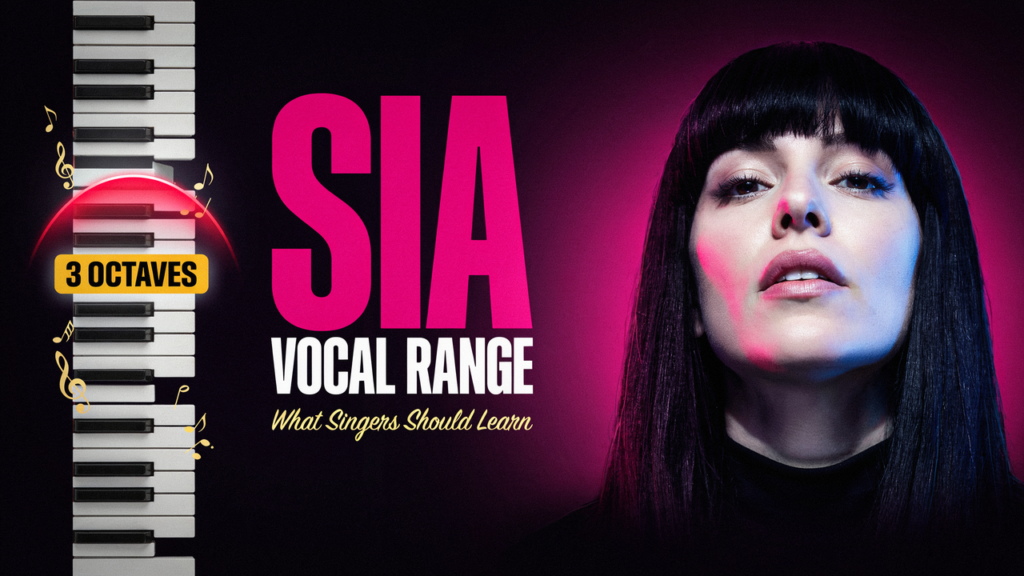
Sia’s vocal range refers to the span between her lowest and highest usable notes in clean singing, including powerful mixed belts and head voice extension. Her range is commonly described as covering around three octaves, centered in a mezzo-soprano foundation with exceptional upper-belt strength and dramatic tonal control.
Range alone doesn’t make her impressive. It’s how she controls intensity, resonance, and stamina at the top of her range that stands out.
Let’s break it down clearly.
Is Sia a Mezzo-Soprano or Soprano?
Sia is most commonly classified as a mezzo-soprano in pop terms.
A mezzo-soprano typically has:
- A strong mid-range
- Comfortable lower notes
- Powerful upper mix potential
- A tessitura that doesn’t live at the extreme top
If you compare her tonal center to a standard mezzo-soprano vocal range, she aligns more closely with that classification than with a light soprano.
However, her upper belt is strong enough that many people assume she’s a soprano. That’s the difference between range and tessitura.
Lowest and Highest Notes Explained
Her lower notes sit in a warm mid-lower female register. They are not contralto-deep, but they’re solid and grounded.
Her highest notes are typically powerful mixed belts rather than pure head voice. That distinction matters.
Belting is chest-dominant coordination carried upward. Head voice is lighter and more flute-like.
Understanding where those notes sit on a vocal range chart helps you see how she extends upward without abandoning structure.
Belt vs Head Voice: What Makes Her High Notes Work
Many singers confuse belting with shouting.
Belting is controlled intensity. Shouting is uncontrolled force.
Sia’s high notes work because:
- Breath pressure is managed
- Vowels are slightly modified
- The larynx remains relatively stable
- Resonance shifts forward
If you struggle to feel the difference between coordination types, reviewing chest voice vs head voice will clarify what physically changes.
Think of belting like turning up brightness—not like pushing harder on the gas pedal.
Tessitura: Where Her Voice Lives
Range is the full stretch.
Tessitura is where the voice feels at home.
Sia’s tessitura sits in the upper mid-range. She doesn’t live at the very bottom or the very top. She visits the top dramatically, but she doesn’t camp there.
If you’re unsure how to find your comfort zone, understanding what is tessitura helps prevent overtraining extremes.
Your tessitura is where your voice feels strong and repeatable—not where you barely survive.
How Her Range Compares to the Average Female Singer
Most untrained female singers have about 1.5–2 octaves of usable range.
Sia’s range is wider and more flexible than average, especially in upper mix strength.
Here’s a simple comparison:
| Singer Type | Typical Range | Tessitura Focus |
|---|---|---|
| Untrained Female | 1.5–2 octaves | Mid |
| Trained Mezzo | 2–3 octaves | Lower-mid |
| Power Pop Belter | ~3 octaves | Upper-mid |
She fits the power pop belter category within a mezzo foundation.
For context on how female voices differ structurally, reviewing a female vocal range overview gives useful perspective.
Step-by-Step: How to Build a Strong Upper Belt Safely
If you’re inspired by her high notes, you need structure—not force.
1. Build a Stable Mid-Range
Sing five-note scales at moderate volume. Stability first.
2. Strengthen Breath Control
Practice sustained “sss” or lip trills to regulate airflow.
3. Introduce Light Mix
Move upward on “ng” sounds before opening to vowels.
4. Modify Vowels
As pitch rises, slightly narrow wide vowels like “ah” toward “uh.”
5. Increase Intensity Gradually
Add volume only after coordination feels balanced.
If you’re unsure where your upper limit currently sits, use a vocal range calculator to measure before pushing higher.
Never build volume on instability.
Why Her Voice Sounds So Powerful
Power isn’t just loudness.
Her sound combines:
- Strong breath management
- Efficient cord closure
- Forward resonance placement
- Emotional intensity layered onto pitch
Imagine shining a flashlight. You don’t press harder on the button—you focus the beam.
Try the frequency range tool to explore audio limits.
Common Mistakes When Trying to Belt Like Sia
- Forcing chest voice too high
- Skipping warm-ups
- Practicing high belts daily without rest
- Ignoring subtle vowel changes
- Confusing volume with resonance
If your throat feels tight or your speaking voice sounds hoarse after practice, stop immediately.
Your vocal folds need recovery just like muscles do.
Before increasing intensity, make sure your pitch is stable. A pitch accuracy test can reveal instability that loud singing may hide.
Quick Self-Check: Are You a Mezzo with Belt Potential?
Ask yourself:
- Does your strongest tone sit in the middle of your range?
- Do extremely high soprano notes feel thin?
- Can you access louder upper notes without pain?
- Does your speaking voice feel moderately pitched?
If most answers are yes, you may align with mezzo-soprano territory.
If not, that’s completely fine. Every voice develops differently.
If you’re still identifying your natural boundaries, learning how to find your vocal range prevents unrealistic expectations.
Realistic Expectations for Upper Range Growth
Upper belt strength takes time.
Expect:
- Gradual semitone improvements
- Fatigue if overworked
- Greater control before greater volume
Do not expect instant dramatic expansion.
If you want to test upper extension carefully, a structured high note test allows exploration without pushing recklessly.
Progress comes from coordination—not aggression.
The Takeaway
Sia’s vocal range is impressive because it’s controlled, repeatable, and emotionally powerful—not because it’s exaggerated.
Her strength lies in balanced upper mix and intelligent resonance placement.
Train patiently. Protect your voice. Build coordination before intensity.
That’s how sustainable high notes are developed.
FAQs
1. What is Sia’s vocal range in notes?
Her range is commonly described as spanning around three octaves, centered in a mezzo-soprano foundation with strong upper belt extension.
2. Is Sia a soprano or mezzo-soprano?
She is generally classified as a mezzo-soprano based on her tonal center and tessitura.
3. What is her highest type of note?
Her highest notes are typically powerful mixed belts rather than pure head voice or whistle tones.
4. Does she use whistle register?
There is no consistent evidence of extended whistle register use in her mainstream performances.
5. Can beginners learn to belt like her?
With structured training and patience, upper mix strength can improve. However, forcing high belts too early can cause strain.
6. How long does it take to develop a strong upper range?
Most singers need months or years of gradual work. Coordination develops slowly but steadily with consistent practice.
7. Should I practice high belts every day?
No. High-intensity singing requires recovery time. Alternate heavier sessions with lighter technical work to protect your voice.

Cooke is a vocal training and singing education writer specializing in vocal range analysis, pitch recognition, voice development, and singing tools for vocalists, performers, musicians, and beginners. He creates practical content focused on vocal improvement, singing techniques, and voice analysis resources.