
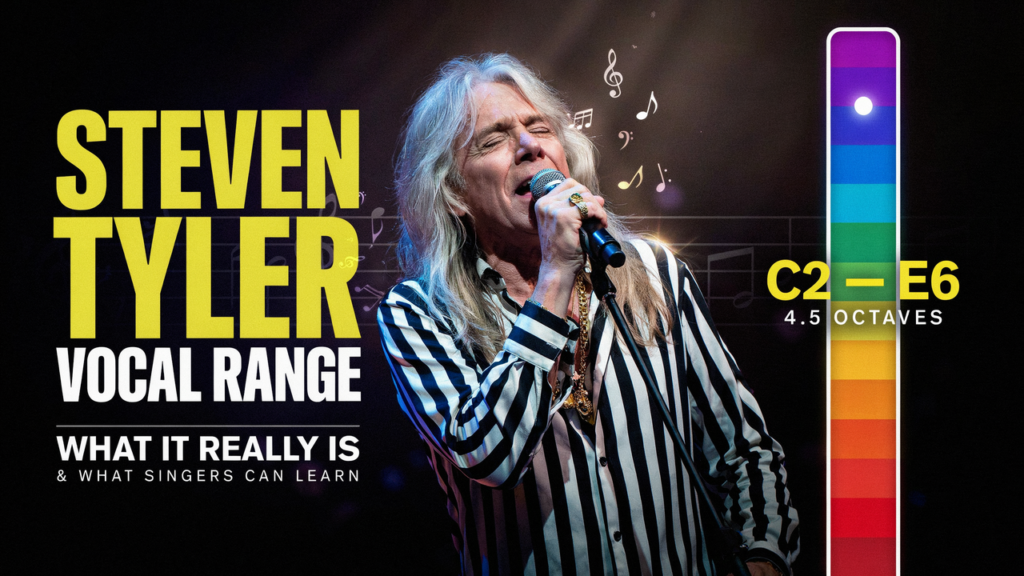
Steven Tyler’s vocal range refers to the span between his lowest and highest usable notes in clean singing, especially during his prime years. His range is commonly described as covering around three octaves, placing him in the tenor category, with additional high rock screams layered through controlled distortion.
The key word is usable. Not every scream equals a new octave. Let’s separate myth from technique.
Was Steven Tyler a Tenor?
Yes, he is widely classified as a tenor.
A tenor typically has:
- A brighter tonal quality
- Comfortable access to upper mid-range notes
- Easier transition into higher registers
If you compare his placement to a typical tenor vocal range, his tessitura aligns with that category, especially in his peak performing years.
Voice type is about comfort zone, not just extreme notes.
Lowest and Highest Notes Explained
His lowest clean notes sit in the lower male range but are not unusually deep. His strength lies in the upper mix and belt area.
His highest sustained clean notes were often delivered through a powerful mixed coordination—not pure chest shouting.
Understanding how this fits within a standard male vocal range helps you see why his upper extension stands out.
Clean Range vs Rock Screams
This is where confusion happens.
Distortion adds texture, not necessarily pitch.
A distorted scream still sits on a specific note. It doesn’t automatically expand the clean modal range.
If you want to understand the structure of voice types overall, reviewing voice types explained helps clarify how classification works beyond stylistic effects.
Clean Singing
His clean tone shows strong chest voice in the mid-range and controlled mix in the upper register.
Distorted High Notes
His screams are typically layered on top of supported airflow and balanced vocal fold closure—not uncontrolled yelling.
When done properly, distortion uses resonance and airflow management rather than throat tension.
Tessitura: Where His Voice Lived
Range is the outer boundary.
Tessitura is where the voice sits most comfortably.
Steven Tyler’s tessitura leaned into the upper mid-range. That’s why many songs feel high but still sustainable during his prime.
If you’re unsure how tessitura works, understanding what is tessitura will prevent you from chasing notes that aren’t built for your voice.
Think of tessitura as your “home key.” You visit higher notes—you don’t live there.
Prime Years vs Later Career
Every singer’s voice changes with time.
In his earlier decades, his high mix and belts were more consistent. Over time, like all vocalists, stamina and elasticity shifted.
Aging affects:
- Recovery speed
- Breath efficiency
- Fold flexibility
This is normal and should shape your own expectations.
Run the browser mic test when switching devices.
How His Range Compares to the Average Singer
Most untrained male singers have about 1.5–2 octaves of usable range.
Steven Tyler’s prime range was closer to three octaves in clean singing, with additional high distortion textures layered on top.
Here’s a simplified comparison:
| Singer Type | Typical Range | Tessitura Focus |
|---|---|---|
| Untrained Male | 1.5–2 octaves | Mid |
| Trained Tenor | 2.5–3 octaves | Upper-mid |
| Rock Tenor with Distortion | ~3 octaves clean | High mix |
If you want to measure your own span accurately, use a structured vocal range calculator rather than guessing based on one lucky note.
Step-by-Step: Building Upper Rock Range Safely
If you’re inspired by his high notes, build clean control first.
- Warm up with lip trills and gentle hums.
- Sing five-note scales in mid-range at moderate volume.
- Slide upward on “ng” to encourage head coordination.
- Blend chest and head gradually as pitch rises.
- Add intensity only when tone feels stable.
- Introduce light distortion only after clean notes are consistent.
If you want to test upper extension safely, a guided high note test can help you explore without forcing.
High notes should feel energized, not squeezed.
Why His High Notes Sound So Intense
Intensity comes from:
- Breath support
- Forward resonance placement
- Early transition into mix
- Emotional delivery layered onto pitch
Many singers push chest voice too high before adjusting coordination. That delay causes tension.
Imagine climbing stairs. You shift weight step by step. You don’t jump five steps at once.
Common Mistakes When Trying to Sing Like Steven Tyler
- Screaming without clean foundation
- Forcing chest voice upward
- Ignoring warm-ups
- Practicing high belts daily without recovery
- Counting distortion as extra octave
Your voice should feel normal after practice. If speaking feels hoarse or tired, you’ve overdone it.
Before increasing intensity, check whether your pitch is stable. A pitch accuracy test can reveal whether high notes are controlled or drifting sharp.
Quick Self-Check: Are You a Tenor?
Ask yourself:
- Does your comfortable singing range sit higher than most male peers?
- Are upper mid-range notes easier than deep lows?
- Does falsetto feel accessible without heavy strain?
- Is your speaking voice moderately high?
If most answers are yes, you may align with tenor classification.
If not, don’t force it. If you’re unsure of your limits, learning how to find your vocal range gives you clarity before training extremes.
Realistic Expectations for Rock Range Development
Upper rock range takes time.
Expect:
- Gradual semitone increases
- Temporary plateau phases
- More control before more volume
Do not expect instant dramatic expansion.
Range grows through coordination and patience—not force.
For perspective on where your notes sit structurally, reviewing a vocal range chart can help you visualize progression.
The Takeaway
Steven Tyler’s vocal range was impressive because it combined clean tenor extension with controlled rock distortion—not because it relied on reckless shouting.
A sustainable three-octave clean range with stable mix coordination is far more valuable than strained extreme notes.
Build clean technique first. Add intensity gradually. Protect your voice long term.
That’s how powerful high notes are developed safely.
FAQs
1. What is Steven Tyler’s vocal range in notes?
His prime clean range is commonly described as spanning around three octaves, anchored in tenor territory.
2. Was Steven Tyler a tenor or baritone?
He is generally classified as a tenor based on tessitura and upper range strength.
3. Do his screams count toward his range?
Distortion adds texture to pitch but does not automatically increase clean modal range.
4. Did his vocal range change over time?
Yes. Like all singers, vocal stamina and flexibility shifted with age.
5. Can beginners train to sing like him?
With structured technique and patience, upper mix coordination can improve. However, forcing high belts too early can cause strain.
6. How long does it take to build strong upper mix?
Most singers need months or years of consistent training. Progress is gradual.
7. Should I practice rock screams every day?
No. High-intensity singing requires recovery time. Alternate intense sessions with lighter technical work to protect your voice.

Cooke is a vocal training and singing education writer specializing in vocal range analysis, pitch recognition, voice development, and singing tools for vocalists, performers, musicians, and beginners. He creates practical content focused on vocal improvement, singing techniques, and voice analysis resources.