
John Legend’s vocal range is commonly documented from approximately C3 to C6, spanning about three octaves. He is generally classified as a lyric tenor, known for his smooth tone, controlled falsetto, and balanced mix rather than aggressive belting or extreme whistle notes.
The number matters—but how he uses that range matters more.
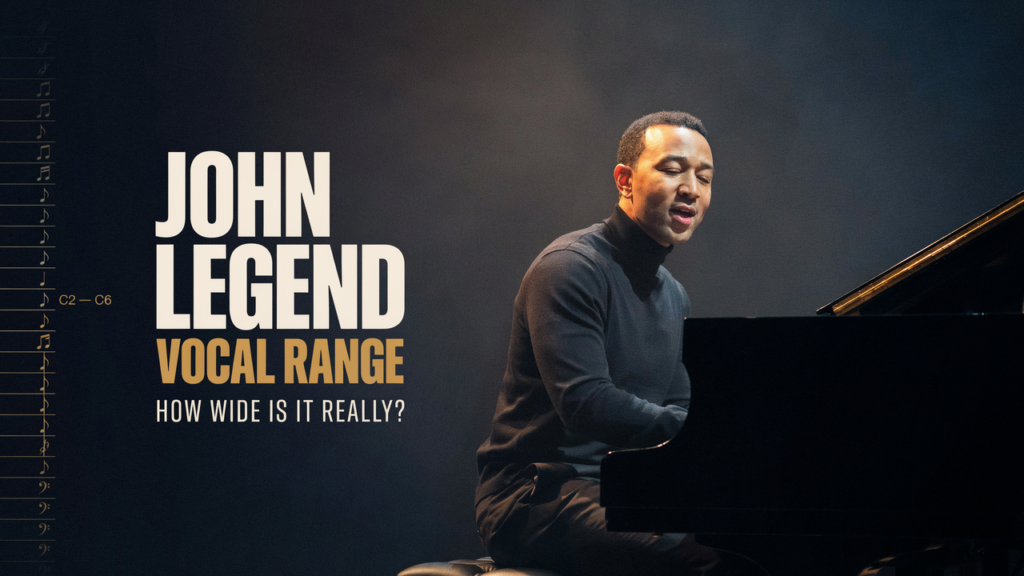
What Are John Legend’s Lowest and Highest Notes?
Lowest Recorded Note
Around C3, sitting comfortably in the lower tenor range.
These notes sound warm but not heavy or baritone-like.
Highest Recorded Note
Often cited around C6, typically produced in a light, controlled head voice or falsetto.
Total Octave Span
Roughly three octaves when counting full extension.
To understand where that sits overall, compare it to a general human vocal range. Three octaves with control and tone quality is strong, especially in contemporary R&B.
Here’s a simplified breakdown:
| Element | Detail |
|---|---|
| Lowest Note | C3 |
| Highest Note | C6 |
| Total Span | ~3 octaves |
| Voice Type | Lyric Tenor |
| Signature Strength | Smooth falsetto |
Is John Legend a Tenor or Baritone?
He is widely classified as a lyric tenor.
His speaking voice sits higher than most baritones.
His comfortable singing range centers above middle C.
His tone is bright and flexible rather than dark and thick.
If you compare his placement to a typical male vocal range, the tenor classification becomes clear.
Baritones generally feel more grounded in lower notes. John Legend’s power lives in the upper middle and head voice area.
Tessitura vs Full Range
This is where many singers get confused.
Full range includes your absolute lowest and highest notes.
Tessitura is where your voice feels strongest and sustainable.
John Legend’s tessitura sits comfortably in the mid-to-upper tenor range. That’s why songs like ballads feel effortless in his upper middle register.
If you’re unsure how your notes compare, mapping them on a vocal range chart gives helpful perspective.
Think of full range like stretching your arm as far as possible. Tessitura is where you naturally work all day without strain.
Falsetto vs Head Voice: What Does He Use?
John Legend is known for smooth upper notes.
Those high notes are typically produced in:
- Controlled falsetto
- Light head voice
- Balanced mix
Falsetto isn’t weakness. It’s a lighter coordination of the vocal folds.
His sound stays clean because airflow remains steady and relaxed. There’s no excessive throat pressure.
If you want to measure your own upper limits safely, try using a vocal range calculator before pushing higher.
How to Develop a Smooth Upper Register
If you want to build a similar smooth tone, focus on control—not volume.
1. Start in Comfortable Mid-Range
Hum lightly around speaking pitch.
Avoid jumping straight into high notes.
2. Transition Gently Into Head Voice
Slide upward on a soft “oo” sound.
Keep the volume moderate.
3. Reduce Air Pressure
If high notes feel breathy, don’t push more air.
Use less and stay relaxed.
4. Narrow Vowels Gradually
Wide vowels can strain at higher pitches.
Subtle shaping keeps tension down.
5. Increase Range Slowly
Move up by half-steps only.
If the throat tightens, stop and reset.
For structured daily practice, follow a consistent daily vocal warm up routine.
Are You a Lyric Tenor?
Ask yourself:
- Does my speaking voice sit higher than most male friends?
- Do high notes feel easier than very low notes?
- Does my tone stay bright even when singing softly?
- Can I access falsetto without strain?
If you’re unsure about classification, try a structured voice type test to narrow it down.
Common Mistakes When Trying to Sing Like John Legend
Forcing Chest Voice Upward
His style relies on mix and falsetto, not full chest shouting.
Oversinging Ballads
Smooth tone comes from control, not volume.
Ignoring Breath Management
Inconsistent airflow leads to cracking.
Skipping Vocal Preparation
High notes require coordination.
Always warm up before practicing upper register work.
If you want to expand your range safely over time, focus on exercises designed to extend your vocal range gradually.
Is He a 4-Octave Singer?
Online claims sometimes exaggerate. Most realistic assessments place him around three octaves.
Three controlled octaves are more musically useful than four unstable ones.
To put this in context, compare it with an average vocal range for trained male singers.
The goal isn’t the biggest number.
It’s consistency and tone quality.
What Makes His Voice Sound So Smooth?
Several technical elements work together:
- Relaxed jaw and tongue
- Even airflow
- Balanced mix
- Stable vibrato
- Gentle vowel shaping
Imagine pouring water smoothly from a glass. If you jerk the glass, the stream splashes. If you move steadily, it flows cleanly. That’s how airflow should feel.
Smooth tone is a coordination skill—not just natural talent.
If you’re curious how you measure up, try the range comparison tool.
Realistic Expectations for Your Own Range
Not every male singer will reach C6 comfortably.
Your anatomy plays a role:
- Vocal fold length
- Resonance space
- Natural speaking pitch
With healthy practice, many singers can gain several semitones over time. Large jumps rarely happen quickly.
If your throat feels tight, dry, or sore, reduce intensity immediately. Sustainable singing should feel engaged but not painful.
Progress in range comes from balance and patience.
Coaching Takeaway
John Legend’s vocal range spans about three octaves, but his real strength lies in smooth coordination and controlled falsetto. He blends chest and head voice efficiently, allowing high notes to sound effortless instead of forced.
If you focus on developing steady breath support, gentle transitions, and relaxed tone production, your upper register will become more reliable—and healthier over time.
FAQs
1. What is John Legend’s highest note?
He is commonly documented reaching around C6. These notes are typically produced in head voice or controlled falsetto.
2. How many octaves can John Legend sing?
Most assessments place him at roughly three octaves. His range is strong, especially in the upper middle register.
3. Is John Legend a tenor?
Yes, he is generally classified as a lyric tenor. His tessitura and tonal brightness support that label.
4. Does John Legend use falsetto often?
Yes, especially in softer ballads and high phrases. His falsetto is controlled and well-supported rather than breathy or weak.
5. Can John Legend hit C6 live?
He has demonstrated high notes in live settings, typically using light head voice coordination. Stamina and breath control are key factors.
6. Is a three-octave range impressive?
For trained singers, three controlled octaves are strong and versatile. Control matters more than raw octave count.
7. Can I train to sing like John Legend?
You can develop smoother tone and better upper register coordination with consistent, healthy practice. Focus on balance, not force, and progress gradually.

Cooke is a vocal training and singing education writer specializing in vocal range analysis, pitch recognition, voice development, and singing tools for vocalists, performers, musicians, and beginners. He creates practical content focused on vocal improvement, singing techniques, and voice analysis resources.