
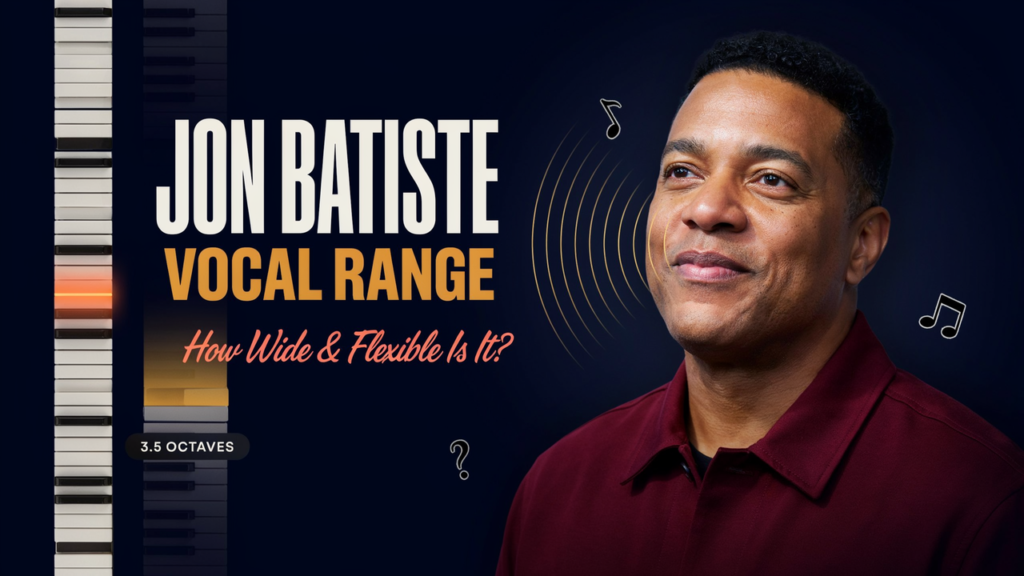
Jon Batiste’s vocal range is commonly documented from approximately B2 to B5, spanning close to three octaves. He is generally classified as a light tenor, known for his flexible mix, smooth falsetto, and stylistic versatility across soul, jazz, and contemporary pop.
His strength isn’t just range size. It’s agility and control across registers.
What Are Jon Batiste’s Lowest and Highest Notes?
Lowest Recorded Note
Around B2, sitting in the lower tenor range.
These notes are clear but not especially heavy or bass-like.
Highest Recorded Note
Often cited around B5, typically accessed in head voice or a light mix rather than full chest power.
Total Octave Span
Roughly three octaves when counting full extension.
To see how that compares structurally, review a general male vocal range framework. His span is strong, but what stands out more is how smoothly he transitions between registers.
Here’s a simplified breakdown:
| Element | Detail |
|---|---|
| Lowest Note | B2 |
| Highest Note | B5 |
| Total Span | ~3 octaves |
| Voice Type | Light Tenor |
| Signature Strength | Register flexibility |
Is Jon Batiste a Tenor or Baritone?
He is most accurately described as a light tenor.
His speaking voice sits above typical baritone placement.
His tessitura favors upper mid-range phrases.
His high notes feel fluid rather than forced.
If you compare him with a traditional tenor vocal range, the classification aligns well.
Tone color can sometimes sound mellow, but classification depends on tessitura and comfortable placement—not just brightness.
Tessitura vs Full Range
This is where many singers get confused.
Full range includes your extreme top and bottom notes.
Tessitura is where you can sing repeatedly without fatigue.
Jon Batiste’s tessitura sits in the middle-to-upper tenor range. That’s why his phrasing feels effortless in soul and jazz passages.
If you’re unsure where your own range sits, mapping it visually on a vocal range chart makes things clearer.
Think of full range as the edges of a map. Tessitura is the city you actually live in.
How He Uses Chest, Mix, and Falsetto
Jon Batiste doesn’t rely on brute force. He shifts registers smoothly.
- Chest voice: Warm and grounded in mid-range
- Mix: Balanced and flexible for emotional peaks
- Falsetto: Light, controlled, expressive
His transitions are subtle. There’s no audible gear shift.
That kind of coordination comes from consistent practice and balanced breath support.
If you want to measure your own current limits, use a vocal range calculator before trying to extend higher.
Building Smooth Register Transitions
If you want similar flexibility, focus on connection—not volume.
1. Start With Gentle Slides
Use “ng” or “oo” sounds and glide between notes slowly.
2. Reduce Volume in High Notes
High notes don’t need to be loud to be strong.
3. Narrow Vowels Slightly
Wide vowels often cause tension in upper range.
4. Practice Light Mix Coordination
Aim for balanced resonance rather than heavy chest pushing.
5. Increase Range Gradually
Move upward by half steps only.
Stop if your throat tightens.
To build consistency safely, follow a structured daily vocal warm up routine.
Are You a Light Tenor?
Ask yourself:
- Does my speaking voice sit mid-to-high?
- Do higher notes feel accessible with light support?
- Do very low notes feel weaker or unstable?
- Can I access falsetto easily?
If you’re unsure about your voice type, try a structured voice type test to clarify your classification.
Common Mistakes When Trying to Sing Like Jon Batiste
Pushing Chest Voice Too High
His flexibility comes from mix coordination, not chest dominance.
Ignoring Breath Stability
Upper notes collapse if airflow is inconsistent.
Overusing Falsetto
Falsetto is expressive—but it’s not a replacement for mix strength.
Skipping Foundation Work
Agility requires consistent technical practice.
Exercises designed to extend your vocal range should be gradual and balanced.
Is He a 4-Octave Singer?
There are occasional exaggerated claims online.
Most realistic assessments place him close to three octaves of functional range. Three controlled octaves are musically powerful.
For context, compare his span with an average vocal range for trained male singers.
Range size matters less than control and phrasing.
How to Develop More Vocal Agility
Agility is about coordination speed.
- Practice short melodic runs at moderate tempo.
- Keep volume moderate while learning.
- Focus on clear articulation.
- Avoid jaw tension.
- Rest between repetitions.
Imagine shifting gears smoothly in a car. If you slam the clutch, the ride jerks. Smooth transitions require precision.
Agility improves when tension decreases.
Use the voice comfort finder to avoid strain.
Realistic Expectations
Not every male singer will reach B5 comfortably.
Your:
- Vocal fold thickness
- Resonance space
- Natural speaking pitch
All influence your ceiling.
With steady training, many singers can gain several semitones over time. Sudden large jumps usually involve strain.
If you feel dryness, tightness, or fatigue, stop immediately. Vocal development should feel challenged—but not painful.
Coaching Takeaway
Jon Batiste’s vocal range spans close to three octaves, but his defining strength is flexibility. His light tenor placement allows smooth shifts between chest, mix, and falsetto.
If you focus on coordination, steady breath support, and gradual range expansion, your voice will become more agile and reliable over time.
Range is impressive.
Control is powerful.
FAQs
1. What is Jon Batiste’s highest note?
He is commonly documented reaching around B5. These notes are typically accessed through head voice or light mix rather than heavy chest belting.
2. How many octaves can Jon Batiste sing?
Most assessments place him at close to three octaves of functional range. His flexibility across that span is what stands out most.
3. Is Jon Batiste a tenor?
Yes, he is generally classified as a light tenor. His tessitura and upper register support that label.
4. Does Jon Batiste use falsetto often?
Yes, especially in expressive soul-style passages. His falsetto is controlled and blends smoothly with his mix.
5. Is his range considered wide?
Three octaves with control is strong for a contemporary male singer. The coordination matters more than the raw number.
6. Can I train to sing like Jon Batiste?
You can develop smoother transitions and stronger mix coordination with consistent, balanced practice. Focus on control before pushing higher.
7. What makes Jon Batiste’s voice unique?
His combination of flexibility, phrasing control, and smooth register shifts gives his voice versatility across multiple styles.

Cooke is a vocal training and singing education writer specializing in vocal range analysis, pitch recognition, voice development, and singing tools for vocalists, performers, musicians, and beginners. He creates practical content focused on vocal improvement, singing techniques, and voice analysis resources.