
Justin Timberlake’s vocal range is commonly documented from approximately B2 to C6, spanning about three to four octaves when including falsetto extension. He is generally classified as a light lyric tenor, known for agile upper-register singing, smooth pop/R&B mix, and a signature, controlled falsetto tone.
The headline number sounds impressive.
But the real story is how he uses that range.
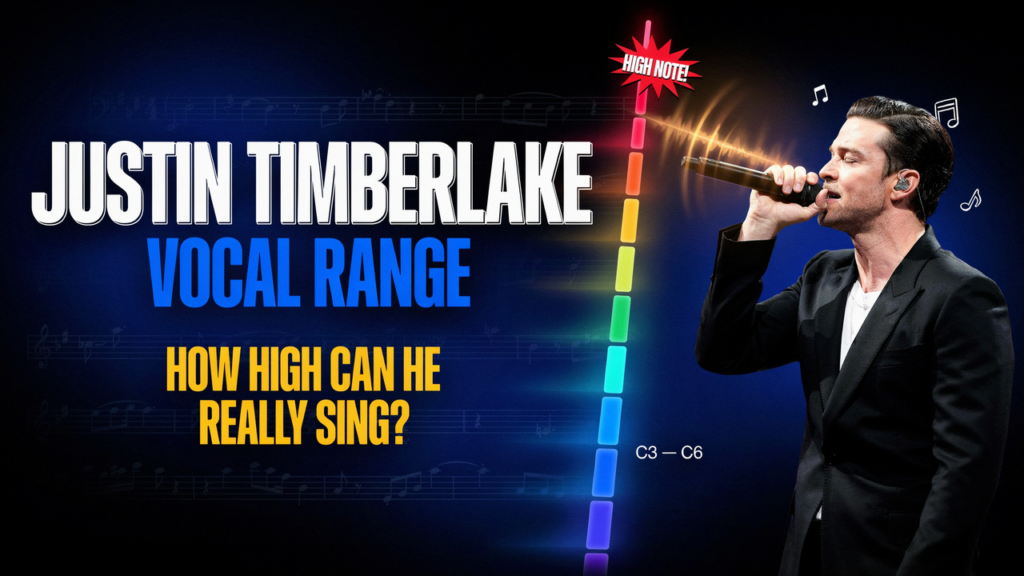
What Are Justin Timberlake’s Lowest and Highest Notes?
Lowest Recorded Note
Around B2, sitting in the lower male register.
These notes are present but not the defining strength of his voice.
Highest Recorded Note
Often cited around C6, typically produced in falsetto rather than full chest voice.
Total Octave Span
About three octaves in practical singing, extending closer to four when including falsetto.
If you compare this with a typical male vocal range, his upper extension is above average for contemporary pop singers.
Here’s a simplified breakdown:
| Element | Detail |
|---|---|
| Lowest Note | B2 |
| Highest Note | C6 |
| Practical Span | ~3 octaves |
| Full Extension | ~3–4 octaves |
| Voice Type | Light Lyric Tenor |
Is Justin Timberlake a Tenor?
Yes, he is widely considered a light lyric tenor.
His speaking voice sits mid-to-high.
His comfortable singing area favors upper mid-range phrases.
His tone is bright and flexible rather than heavy.
When compared with a standard tenor vocal range, his tessitura placement aligns well.
Voice type isn’t defined by the single highest note. It’s defined by where the voice sits comfortably most of the time.
Tessitura vs Full Range
This is one of the biggest misconceptions in range discussions.
Full range includes the lowest and highest notes you can possibly touch.
Tessitura is the area where you can sing repeatedly without fatigue.
Justin Timberlake’s tessitura sits in the upper mid-range for male singers. That’s why many of his songs center around notes above middle C.
If you’re unsure where your voice lives most comfortably, mapping your notes on a vocal range chart can make it clearer.
Think of full range as the edges of a basketball court. Tessitura is where the game actually happens.
Falsetto vs Mixed Voice
His falsetto is one of his signature sounds.
But not all high notes are falsetto.
He uses:
- Chest voice for grounded mid-range
- Mixed voice for strong upper notes
- Falsetto for extreme highs and stylistic color
Falsetto uses lighter vocal fold closure and more airflow.
Mix blends chest and head resonance for strength without strain.
If you want to identify your own voice type and register tendencies, try a structured voice type test.
Understanding your registers is like knowing your gears in a car. You shift depending on the terrain.
Live vs Studio Singing
Studio recordings allow:
- Multiple takes
- Vocal rest between lines
- Layered harmonies
Live singing demands stamina.
High pop singing requires breath pacing, hydration, and smart song sequencing.
If you compare his upper flexibility to the average vocal range, the extension stands out—but live consistency depends on conditioning.
High notes are athletic. You train for them.
How to Build a Strong Pop Tenor Upper Range
If you want to sing higher safely, follow this progression.
1. Stabilize Your Mid-Range
If your middle notes wobble, high notes will strain.
2. Practice Gentle Slides
Use “oo” or “ee” sounds to glide upward gradually.
3. Develop a Controlled Mix
Blend chest and head voice without pushing.
4. Reduce Volume at First
High notes don’t need to be loud to be strong.
5. Expand Slowly
Increase range in half-step increments.
Exercises designed to extend your vocal range should feel challenging but never painful.
Are You a Light Tenor?
Ask yourself:
- Does my speaking voice sit comfortably mid-to-high?
- Are upper notes easier than very low notes?
- Does my tone stay bright in higher phrases?
- Can I access falsetto easily?
If most answers are yes, you likely lean toward tenor classification.
You can measure your current limits objectively using a vocal range calculator to see where your lowest and highest notes fall.
Common Mistakes When Trying to Sing Like Justin Timberlake
Forcing Chest Voice Too High
Pushing chest past the passaggio leads to tension.
Overusing Airy Falsetto
Too much airflow weakens tone and reduces control.
Skipping Warm-Ups
Upper-register singing demands preparation. A consistent daily vocal warm up builds reliability.
Obsessing Over Octave Numbers
A “four-octave” claim means little without stamina and control.
How to Protect Your Upper Register
- Warm up gently before singing high material.
- Avoid yelling outside of practice.
- Hydrate consistently throughout the day.
- Rest after intense sessions.
- Stop immediately if sharp pain occurs.
High notes should feel energized—not tight or burning.
Imagine stretching a rubber band. If you pull too fast, it snaps back. If you stretch gradually, it remains flexible.
Beginners benefit from the voice category test to set expectations.
Realistic Expectations
Not every male singer can reach C6 comfortably.
Your upper limit depends on:
- Vocal fold length
- Natural speaking pitch
- Consistent technical training
- Age and recovery habits
Most singers can gain several semitones with structured practice. Dramatic jumps are rare.
Progress is steady, not explosive.
Use the endurance tool to build phrase support.
Coaching Takeaway
Justin Timberlake’s vocal range spans roughly three octaves in practical use, extending higher with falsetto. His true strength lies in mix coordination, agility, and controlled falsetto—not raw volume.
If you build a stable middle voice and train your mix gradually, your upper range will become more reliable and healthier.
High notes impress.
Consistency builds longevity.
FAQs
1. What is Justin Timberlake’s highest note?
He is commonly documented reaching around C6 in falsetto. His strongest mixed high notes sit lower than that.
2. How many octaves can Justin Timberlake sing?
His practical singing range spans about three octaves, with falsetto extension bringing it closer to four.
3. Is Justin Timberlake a tenor?
Yes, he is generally classified as a light lyric tenor based on tessitura and tonal brightness.
4. Does Justin Timberlake use falsetto often?
Yes. Falsetto is a major stylistic element in his pop and R&B sound.
5. What is Justin Timberlake’s tessitura?
His tessitura sits in the upper mid-range for male singers, allowing repeated high phrases without excessive strain.
6. Can I train to sing like Justin Timberlake?
You can develop stronger mix and falsetto with consistent practice. However, anatomy influences how high and bright your voice naturally sits.
7. Are high pop notes bad for your voice?
High notes are safe when supported with proper technique. Strain occurs when singers force chest voice beyond comfortable limits.

Cooke is a vocal training and singing education writer specializing in vocal range analysis, pitch recognition, voice development, and singing tools for vocalists, performers, musicians, and beginners. He creates practical content focused on vocal improvement, singing techniques, and voice analysis resources.