
Usher’s vocal range is generally estimated at around three to four octaves, stretching from a lower tenor register into high mixed and falsetto notes. He is widely classified as a tenor known for smooth register transitions, agile vocal runs, and controlled upper-range singing in R&B style.
What makes his voice impressive isn’t just the span.
It’s how efficiently he moves through it.
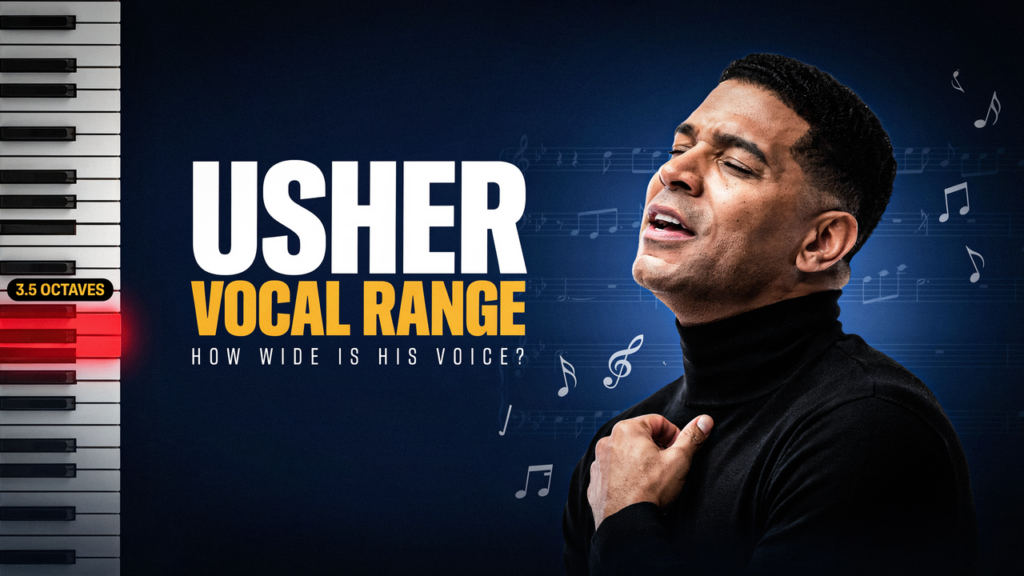
What Is Usher’s Vocal Range?
Most analyses place his lower notes in the tenor range, with his upper extension reaching into strong mixed voice and clear falsetto territory above the fifth octave.
He is not known for extreme low notes.
His strength is in upper flexibility and agility.
If you compare his span to a typical male vocal range, you’ll see that he operates comfortably in the higher half of that spectrum.
His tone remains bright and focused even as pitch rises.
Is Usher a Tenor?
Yes, Usher is best classified as a tenor.
More specifically, he fits the profile of a lyric tenor in contemporary R&B.
Tenors typically:
- Sit comfortably above middle C
- Transition smoothly into upper mix
- Use falsetto effectively
- Maintain brightness in higher registers
If you want to understand how that compares structurally, review the typical tenor vocal range.
The key indicator isn’t just the highest note he can hit.
It’s where his voice sounds most natural.
Highest and Lowest Notes in Context
Singers often ask, “What’s his highest note?”
But context matters more than extremes.
His lower notes sit solidly in tenor territory, but his upper register shows far more development.
To visualize how those notes sit musically, refer to a standard vocal range chart.
What stands out is his ability to move seamlessly from chest voice into mix and falsetto without obvious breaks.
That coordination is what gives his singing a smooth, effortless feel.
How Usher Uses Falsetto and Mixed Voice
One of his defining traits is how fluidly he blends registers.
Mixed Voice
Mixed voice is a coordination between chest and head voice.
It allows singers to sing high without shouting.
Think of it like gradually shifting gears instead of slamming into the highest one.
Usher frequently uses mix to maintain fullness in upper notes without straining.
Falsetto
Falsetto is lighter and airier.
He uses it stylistically in R&B phrasing, especially in softer passages and vocal runs.
The important detail: his falsetto stays controlled, not breathy or unstable.
If you want to build upper extension safely, structured work from a guide on how to extend vocal range helps prevent pushing too soon.
Vocal Agility: The R&B Factor
Usher’s style includes melisma — rapid movement between notes.
Agility requires:
- Clean vowel shaping
- Stable airflow
- Minimal jaw tension
- Clear pitch accuracy
If airflow is inconsistent, runs sound sloppy.
To check your accuracy before practicing fast runs, use a reliable pitch accuracy test.
Agility is about precision, not speed.
Developing a Smooth Upper Range Like Usher
Here’s a safe progression you can follow.
1. Strengthen Your Middle Register
Your mix depends on a balanced middle voice.
Practice medium-volume scales through your passaggio without pushing.
2. Blend Before You Belt
Avoid taking full chest voice too high.
Let the sound gradually lighten as pitch rises.
3. Develop Falsetto Control
Practice soft, sustained high notes.
Focus on clarity, not volume.
4. Add Agility Last
Once tone and control are stable, introduce short runs.
Use a metronome to build precision gradually.
If you’re unsure of your current ceiling, measure it objectively with a high note test.
Range vs Tessitura
Touching a high note once doesn’t define a singer.
Tessitura — your comfortable singing zone — matters more.
Here’s a simple comparison:
| Factor | Wide Range | Strong Upper Tessitura |
|---|---|---|
| Can hit high note briefly | Yes | Yes |
| Can sustain high notes musically | Not always | Yes |
| Tone stays consistent | Sometimes | Consistently |
| Live performance stability | Variable | Reliable |
Usher’s strength lies in repeatability.
If you’re curious how your range compares statistically, review an average vocal range baseline for perspective.
Is Your Upper Range Healthy?
Ask yourself:
- Can I sing the note softly first?
- Does my throat feel open?
- Can I repeat the note multiple times?
- Does my voice feel normal the next day?
If your voice feels tight or fatigued, you’re likely forcing chest voice too high.
Healthy upper singing feels lifted, not squeezed.
Common Mistakes When Trying to Sing Like Usher
Forcing Chest Voice Upward
This creates strain and eliminates mix coordination.
Confusing Falsetto With Weakness
Falsetto is a legitimate register, not a failure.
Practicing Runs Too Fast
Speed without control leads to sloppy pitch.
Ignoring Warm-Ups
High singing without preparation increases swelling risk.
Follow a structured daily vocal warm up before attempting upper runs.
Realistic Expectations for Singers
Most untrained male singers comfortably manage 1.5–2 octaves.
With consistent training, many can develop 2.5–3 usable octaves.
Upper fifth-octave notes require time, patience, and coordination.
Do not chase extreme highs at the expense of stability.
Range expansion should feel gradual and sustainable.
What Makes Usher’s Voice Unique
It’s not just his high notes.
It’s his control between registers.
He transitions without obvious breaks.
His phrasing feels conversational yet musical.
His tone remains clean even during fast runs.
That level of control is what singers should study — not just octave counts.
If you’re unsure where your natural placement sits, taking a structured voice type test can clarify whether you’re working within a tenor framework.
Final Coaching Takeaway
Usher’s vocal range is impressive, but his mastery lies in coordination.
He blends chest, mix, and falsetto smoothly.
He builds agility on top of stability.
If you want similar flexibility:
- Stabilize your middle voice.
- Develop mix before pushing high.
- Strengthen falsetto gently.
- Build agility gradually.
Focus on control first.
Range will follow.
FAQs
1. What is Usher’s vocal range?
His range is generally estimated at around three to four octaves, extending from lower tenor notes into high mixed and falsetto territory.
2. Is Usher a tenor?
Yes, he is best classified as a tenor, likely a lyric tenor in contemporary R&B style.
3. What is Usher’s highest note?
He has demonstrated strong upper fifth-octave notes in performance, often using mix or falsetto coordination.
4. Does Usher use falsetto?
Yes, falsetto is a key part of his style, especially in softer passages and vocal runs.
5. Can I train to sing like Usher?
You can develop smoother register transitions and better agility with structured training. Focus on coordination before chasing high notes.
6. Is a four-octave range common?
It is above average but not unheard of with training. Usable range matters more than extreme claims.
7. How do I improve my vocal runs?
Start slowly with controlled scales, maintain steady airflow, and build speed gradually only after accuracy is consistent.

Cooke is a vocal training and singing education writer specializing in vocal range analysis, pitch recognition, voice development, and singing tools for vocalists, performers, musicians, and beginners. He creates practical content focused on vocal improvement, singing techniques, and voice analysis resources.