
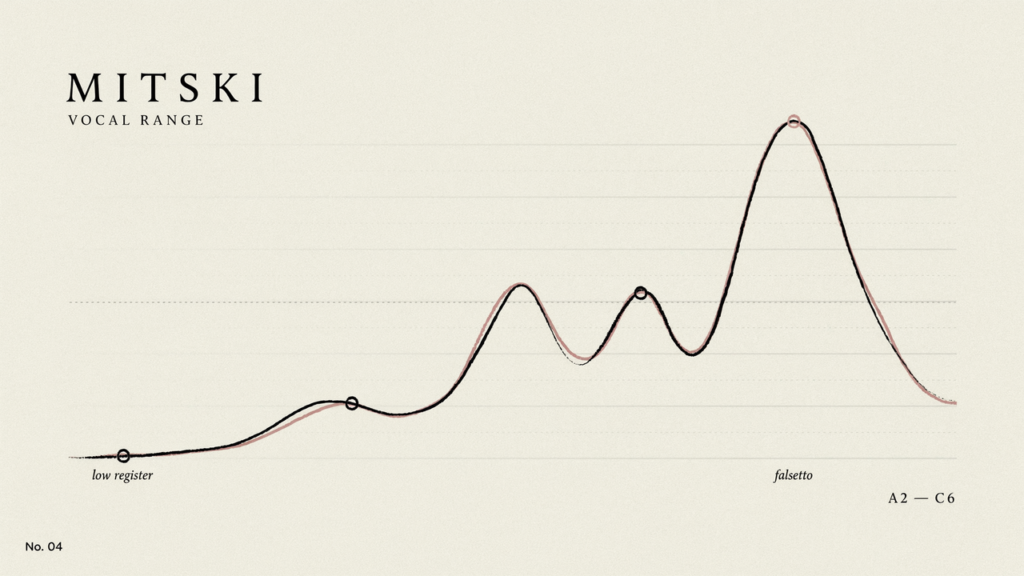
Mitski’s vocal range spans approximately from the lower third octave into the upper fifth octave, giving her a range of around two and a half to three octaves. She is generally described as a mezzo-soprano with a strong lower register and an expressive mid-range rather than a high, operatic top.
Understanding her range isn’t just about numbers. It’s about where her voice feels strongest, most emotional, and most natural.
What Is Mitski’s Lowest and Highest Note?
Most analyses place Mitski’s lowest notes around the F3 area, with upper notes reaching into the C6 range in studio recordings. That gives her roughly 2.5–3 octaves of total extension.
However, total range is different from usable range.
A singer may touch a note once in falsetto or a light mix, but that doesn’t mean it sits comfortably in performance. For context, compare her span to the average vocal range to see how it fits within typical female voice capability.
What Is Mitski’s Vocal Type?
Mitski is commonly categorized as a mezzo-soprano.
Why Mezzo-Soprano?
Her voice naturally centers in the mid-range. She carries warmth and emotional weight in lower notes, without the extremely bright top typical of a lyric soprano. If you’re unsure how voice types work, reviewing the broader voice types explained framework helps clarify the classification.
Tessitura vs Total Range
Her tessitura — the most comfortable singing zone — sits in the mid-register. That’s where her tone feels grounded and expressive.
To understand this difference clearly, it helps to study what is tessitura and how it shapes a singer’s identity more than their highest note ever recorded.
How Mitski Uses Her Registers
Range numbers alone don’t tell the story. Mitski’s artistry comes from how she navigates registers.
Chest Voice
Her lower register is rich and intimate. Many of her verses sit in this zone. The tone feels conversational, almost like controlled speech.
Head Voice
When she moves upward, the sound becomes lighter and more floating. She doesn’t rely heavily on power belting; instead, she uses dynamic shifts.
Mixed Coordination
In upper-mid passages, she blends chest and head coordination. This gives emotional intensity without shouting.
If you want to compare this to the typical female classification system, reviewing the female vocal range breakdown gives helpful context.
How Wide Is Her Range Compared to Other Singers?
A 2.5–3 octave span is strong but not extreme. It’s above beginner level, yet not in the rare 4–5 octave category.
Here’s a simple comparison:
| Category | Approximate Range |
|---|---|
| Average untrained singer | 1.5–2 octaves |
| Trained pop singer | 2–3 octaves |
| Highly advanced vocalist | 3+ octaves |
| Extreme outlier | 4+ octaves |
This places Mitski comfortably in the trained pop singer category.
If you want to measure your own span objectively, try a vocal range calculator to get accurate note data before comparing.
Can You Sing Mitski Songs?
That depends less on your highest note and more on your tessitura.
Here’s a practical way to check:
- Identify the song’s lowest and highest notes.
- Sing the melody lightly on a vowel like “ah.”
- Notice where your throat tightens or your tone thins.
- Check if most of the song sits in your comfortable mid-range.
- If strain appears, lower the key by 1–2 semitones.
If you haven’t mapped your voice yet, start by learning how to find your vocal range before attempting full songs.
Step-by-Step: Safely Expanding Toward Her Range
If certain Mitski notes feel just out of reach, don’t push. Build gradually.
Step 1: Strengthen the Mid-Range
Use smooth five-note scales at moderate volume. Focus on tone consistency.
Step 2: Blend Registers
Practice sliding from chest into head voice gently. Think of pouring warm water, not flipping a switch.
Step 3: Add Light Upper Extension
Use soft head voice first. Volume comes later. For structured routines, explore targeted vocal exercises to increase range.
Step 4: Prioritize Warm-Ups
Never attempt high notes cold. A consistent daily vocal warm up routine protects your cords.
Common Mistakes When Comparing Your Voice to Mitski
- Forcing high notes at full volume
- Ignoring key transposition
- Confusing falsetto with supported mix
- Believing octave count equals skill
- Skipping warm-ups
One more subtle mistake: assuming her emotional intensity comes from range alone. Much of it comes from phrasing, dynamics, and tone color.
Quick Self-Check: Do You Share a Similar Range?
Answer these honestly:
- Can you sing comfortably between A3 and A4?
- Do lower notes feel natural and warm?
- Does your voice feel strongest in mid-range songs?
- Can you reach C5 without shouting?
If most answers are yes, you likely sit in a similar mezzo territory.
For deeper insight, compare your span to the mezzo-soprano vocal range standards.
Realistic Expectations About Range
Range expands slowly. Most singers gain 3–5 semitones over months, not weeks.
If a note feels tight, breathy, or painful, stop. Range development should feel like stretching a muscle — not tearing it.
Mitski’s sound isn’t built on extreme high notes. It’s built on control, restraint, and emotional nuance.
Focus there first.
Why Her Range Works Artistically
Mitski’s vocal span supports her storytelling style.
She often stays in the mid-register where emotional clarity lives. When she rises, the contrast feels dramatic because she doesn’t overuse high notes.
Think of it like a movie soundtrack. Silence and restraint make the climax powerful.
That’s vocal strategy — not just vocal range.
FAQs
1. What is Mitski’s highest note?
Most analyses place her top recorded notes around C6 in studio recordings. However, those notes are not used constantly in performance. Her comfortable singing zone sits lower.
2. What is Mitski’s lowest note?
Her lowest notes are typically cited around F3. These notes contribute to her grounded, intimate tone.
3. How many octaves can Mitski sing?
She appears to have approximately 2.5 to 3 octaves of total range. That is strong for a contemporary pop/indie singer.
4. Is Mitski a soprano or mezzo-soprano?
She is generally described as a mezzo-soprano. Her tone centers in the mid-range rather than the bright upper register typical of sopranos.
5. Does Mitski belt high notes?
She uses intensity and mix coordination more than heavy belting. Her style favors emotional dynamics over extreme power.
6. Can beginners sing Mitski songs?
Yes, especially if you choose songs that sit in your comfortable range. Transposing keys is completely acceptable and often necessary.
7. Is having a 3-octave range considered good?
Yes. Three octaves is above average and more than enough for most contemporary music styles. Control and tone matter more than sheer span.

Cooke is a vocal training and singing education writer specializing in vocal range analysis, pitch recognition, voice development, and singing tools for vocalists, performers, musicians, and beginners. He creates practical content focused on vocal improvement, singing techniques, and voice analysis resources.