
Phil Anselmo’s vocal range spans roughly from G2 to C6 in his prime years, covering close to three octaves in clean modal voice. He is generally classified as a baritone, known for combining deep, heavy mid-range tones with aggressive metal screams and occasional high, piercing clean notes.
That headline number only tells part of the story.
With metal vocalists, we must separate clean singing from distorted techniques.
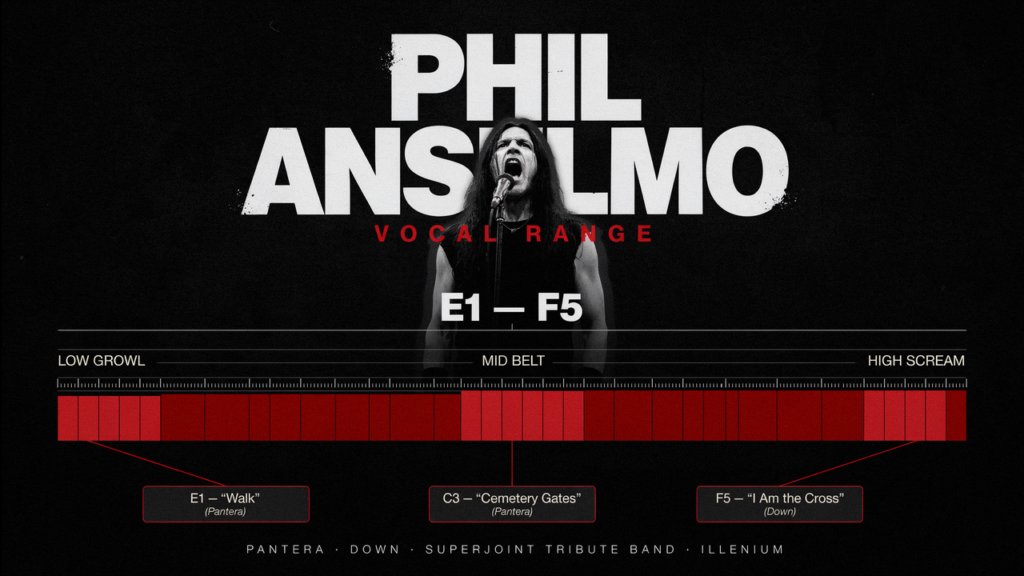
What Is Phil Anselmo’s Lowest and Highest Note?
In clean singing, his lower range extends into the G2 area, giving him a dark, grounded tone. His higher clean notes have reached up toward C6 in studio settings, particularly in earlier Pantera material.
However, those extreme highs were not always sustained or consistent in later years.
To see how that fits structurally, compare it with the typical male vocal range explained.
Is Phil Anselmo a Baritone or Tenor?
Most classifications place him as a baritone.
His speaking voice sits lower, and his mid-range carries weight and grit. That tonal density is a strong baritone trait.
Why Range Alone Doesn’t Decide Voice Type
Voice type depends on:
- Tessitura (where the voice is most comfortable)
- Tone color
- Passaggio location
- Sustainable range
If you want a deeper breakdown of classification, review the full voice type guide.
His Likely Tessitura
Anselmo’s strongest area sits in the lower-to-middle register. That aligns with baritone structure rather than high tenor placement.
Understanding this concept clearly requires knowing what tessitura explained really means.
Clean Singing vs Scream Range
This is where confusion happens.
Distorted screams and growls are not the same as clean, pitched singing. Some screams carry pitch. Others are noise-based distortions layered over airflow.
Counting a non-pitched scream as part of “octave range” is misleading.
Modal Voice (Clean Singing)
Modal voice refers to normal sung pitch. This is what determines actual octave span.
Distorted Techniques
Metal screams often use:
- Fry-based distortion
- Compressed airflow
- Reinforced false folds
These techniques create intensity but do not always extend usable melodic range.
Train your ear with the perfect pitch test and see how accurately you can name notes.
How Wide Is His Range Compared to Other Singers?
Here’s a grounded comparison:
| Category | Typical Range |
|---|---|
| Untrained male | 1.5–2 octaves |
| Trained contemporary singer | 2–3 octaves |
| Advanced rock/metal vocalist | 2.5–3+ octaves |
| Extreme outlier | 4+ octaves |
Anselmo fits comfortably into the advanced category during his peak.
If you’re unsure where you stand, compare yourself against the average vocal range.
Early Pantera Era vs Later Career
In the early 1990s, his upper clean notes were brighter and more accessible. Songs from that era show aggressive belts that reached into high tenor territory.
Over time, heavy touring and aggressive technique reduced upper consistency. That is common in extreme genres.
Voices adapt — and sometimes harden — under repeated high-intensity use.
Step-by-Step: Approaching Metal Vocals Safely
If you want to approach his style without harming your voice, follow this structured progression:
- Build a stable clean mid-range first.
- Strengthen breath control at moderate volume.
- Develop controlled mix before adding distortion.
- Introduce distortion lightly and briefly.
- Rest immediately if hoarseness appears.
Distortion should sit on top of supported airflow — not replace it.
If your clean range feels unstable, structured vocal exercises to increase range will strengthen your foundation first.
Common Mistakes When Trying to Sing Like Phil Anselmo
- Forcing chest voice upward without mix
- Treating screaming as brute force
- Ignoring hydration and recovery
- Skipping clean vocal development
- Measuring range based on noise instead of pitch
Many metal singers damage their voices by chasing aggression before mastering coordination.
Intensity comes from compression and control, not volume alone.
Quick Self-Check: Are You a Baritone?
Ask yourself:
- Does your speaking voice sit comfortably in a lower register?
- Do upper notes feel effortful past F4?
- Is your strongest singing area in the mid-range?
- Do high belts require significant push?
If yes, you likely lean baritone.
To confirm, compare yourself to the baritone vocal range and observe where your tessitura falls.
For precise measurement, use a vocal range calculator instead of guessing.
Realistic Expectations About Metal Range
Expanding range in aggressive genres takes time.
Most singers gain small increments — a semitone or two at a time — over months of consistent training.
Your vocal folds are delicate tissue. Repeated strain without recovery leads to swelling, reduced flexibility, and temporary range loss.
Train progressively. Rest consistently.
Why His Voice Sounds So Powerful
It’s not just depth.
It’s:
- Controlled compression
- Focused resonance
- Intentional phrasing
- Emotional conviction
Think of distortion like adding texture to paint. The base layer still matters.
If the clean tone is unstable, the distortion magnifies problems.
Can You Develop Similar Power?
Yes — but build from the inside out.
Start with clean support. Strengthen mix coordination. Only then layer grit.
You can compare your extension against general limits by reviewing the human vocal range limits.
Remember: sustainable power always beats temporary extremes.
Final Coaching Perspective
Phil Anselmo’s vocal range spans roughly three octaves in clean modal voice, anchored by a strong baritone foundation.
His screams add intensity, but his true range is defined by his clean notes.
If you want longevity in metal singing, prioritize coordination, breath support, and recovery.
That’s how you build aggression without sacrificing your voice.
FAQs
1. What is Phil Anselmo’s highest clean note?
In his prime, he reached high notes around C6 in studio recordings. However, his most consistent upper range sat slightly below that.
2. What is Phil Anselmo’s lowest note?
His lower extension reaches approximately G2 in clean singing. That gives his voice a grounded, baritone quality.
3. How many octaves can Phil Anselmo sing?
He covers close to three octaves in clean modal voice during his peak years. Distorted screams may extend beyond that, but they do not always represent melodic range.
4. Is Phil Anselmo a baritone?
Yes, he is generally classified as a baritone. His tessitura and tonal weight support that classification.
5. Does screaming count as vocal range?
Only if the scream carries clear pitch. Many harsh techniques are noise-based and should not be counted as melodic extension.
6. Did Phil Anselmo lose vocal range over time?
Like many extreme metal vocalists, his upper consistency reduced with years of heavy touring. This is common when aggressive technique is used frequently.
7. Can beginners safely practice metal screams?
Yes, but only after building strong clean technique first. Start gently and stop immediately if hoarseness or pain appears.

Cooke is a vocal training and singing education writer specializing in vocal range analysis, pitch recognition, voice development, and singing tools for vocalists, performers, musicians, and beginners. He creates practical content focused on vocal improvement, singing techniques, and voice analysis resources.