
The topic of Alicia Keys’ vocal range is frequently searched by fans, singers, and vocal students who want to understand what gives her voice such power, warmth, and emotional weight. As one of the most influential R&B and soul artists of the modern era, Alicia Keys is often praised not for extreme high notes, but for strength, control, and expressive consistency.
Alicia Keys’ vocal range is estimated at about 3 octaves, roughly from A2 to C6. She is commonly classified as a mezzo-soprano, known for her warm lower register, powerful belts, and expressive mid-to-high range. Her strength lies in tone, emotion, and vocal control rather than extreme range.
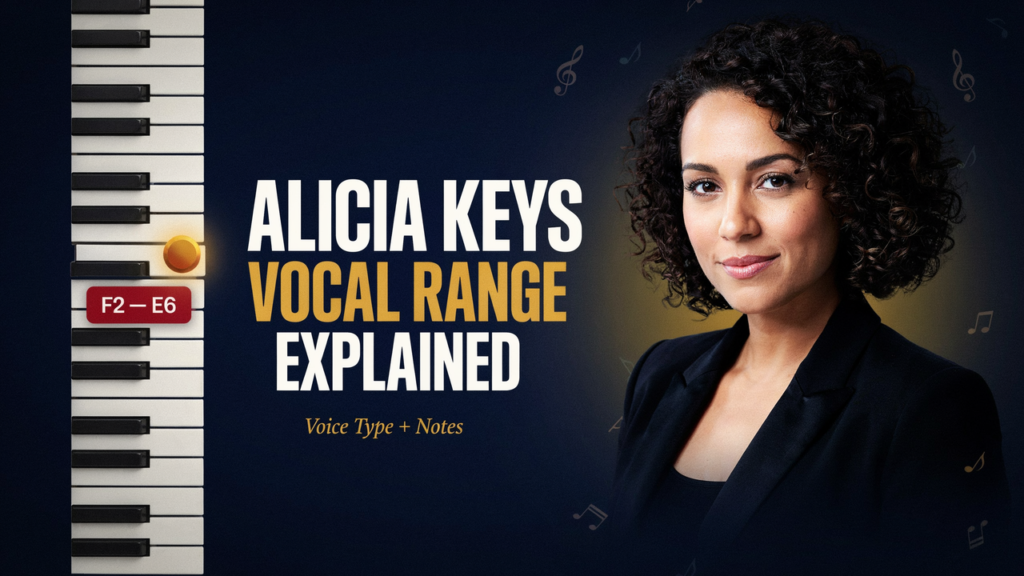
What Is Alicia Keys’ Vocal Range?
Based on studio recordings and documented live performances, Alicia Keys’ approximate recorded vocal range is commonly described as:
Approximately: G2 to C♯6 (just over three octaves)
Important context:
- This range includes multiple vocal registers
- Extreme high notes appear selectively, not constantly
- Her functional singing range is narrower and more relevant
Vocal range numbers alone don’t reflect how a singer actually performs over long tours and live shows.
Alicia Keys’ Functional (Comfortable) Singing Range
Alicia Keys most consistently sings within the following range:
Approximate functional range: A3 to E5
This is the range where she:
- Delivers strong, reliable pitch
- Sustains powerful phrases without strain
- Belts and mixes comfortably
- Performs the majority of her repertoire
Rather than pushing extremes, her music is written to sit in a range that supports endurance, tone, and emotional clarity.
Alicia Keys’ Voice Type
Alicia Keys is best classified as a:
Mezzo-soprano with strong lower-register emphasis
This classification fits because:
- Her voice has notable depth and warmth
- She is comfortable singing low for a female vocalist
- Her tessitura sits lower than many pop sopranos
- She can extend upward when needed without sounding shrill
She is sometimes labeled a soprano due to her upper range, but her tonal center and power align more closely with a mezzo-soprano voice type.
- Try the Online Singing Range Test to discover your voice type.
Belting, Chest Mix, and Head Voice
Alicia Keys’ vocal identity is strongly tied to healthy, grounded belting.
Chest-dominant mix (her signature)
- Strong vocal fold closure
- Rich harmonic content
- Resonant, gospel-influenced sound
- Used frequently in choruses and climaxes
Head voice and lighter mix
- Used sparingly for contrast
- Softer dynamics and emotional shading
- Less emphasized than in pop or R&B singers who rely on falsetto
Unlike many contemporary vocalists, Alicia Keys rarely depends on breathy or light production. Her sound is anchored and full, even at higher volumes.
If you’re covering a song, the key detection tool saves time.
Why Alicia Keys’ Voice Sounds So Powerful
Several factors contribute to the perceived power of Alicia Keys’ voice:
1. Lower tessitura choices
Many of her songs sit lower than typical female pop keys, allowing her to sing with more weight.
2. Gospel and soul influence
Her phrasing, dynamics, and sustain reflect gospel-rooted vocal traditions.
3. Strong breath support
She maintains consistent airflow, supporting long phrases and controlled belts.
4. Resonance over volume
Her voice carries because of resonance, not because she forces loudness.
These elements combine to create a vocal presence that feels commanding without excess strain.
Functional Range vs Extreme Notes
Online vocal-range charts often focus on “highest note ever sung,” but this can be misleading.
Extreme notes
- Appear briefly
- May be studio-assisted
- Do not represent everyday singing comfort
Functional range
- Determines vocal stamina
- Reflects real-world performance ability
- Is far more relevant for singers and students
Alicia Keys’ artistry is built almost entirely within her functional range, which explains her longevity and consistency.
Comparisons to Other R&B and Soul Singers (Context Only)
Compared to many modern R&B vocalists:
- Alicia Keys sings lower and fuller
- Uses less falsetto
- Relies more on chest mix and resonance
- Prioritizes emotional delivery over ornamentation
This sets her apart from lighter, more melisma-heavy pop-R&B styles.
Was Alicia Keys’ Range Natural or Trained?
Like most professional singers, her ability is a combination of natural anatomy and disciplined technique.
Indicators of strong training include:
- Consistent pitch under pressure
- Controlled belts without chronic strain
- Stable tone across decades of performing
- Ability to sing while playing piano
Range without technique is unreliable. Her career longevity strongly suggests solid foundational vocal habits.
What Singers Can Learn from Alicia Keys
For vocal students, Alicia Keys offers valuable lessons:
- Power comes from support and resonance, not pushing
- Staying in a comfortable tessitura improves consistency
- Belting should feel grounded, not forced
- Emotional connection matters more than range size
Trying to imitate her volume without proper breath support can lead to strain. Studying her approach is far more productive.
Common Questions About Alicia Keys’ Vocal Range
How many octaves can Alicia Keys sing?
A little over three, across multiple registers.
Does Alicia Keys belt high notes?
Yes, but within a controlled chest mix rather than extreme belting.
Is Alicia Keys a soprano or mezzo-soprano?
Most accurately described as a mezzo-soprano with upper extension.
Has her range changed over time?
Like most singers, it has matured, but her functional range remains consistent.
Summary: Alicia Keys’ Vocal Range in Perspective
- Approximate total range: G2–C♯6
- Functional singing range: A3–E5
- Voice type: Mezzo-soprano
- Defining strengths: Resonance, chest mix, emotional delivery
- Legacy: Proof that vocal power comes from control, not extremes
Related Articles:
- For a broader foundation on voice analysis, explore this helpful singing range guide.
- Her expressive control can be better understood by learning how to do vibrato in singing.
- Evaluating her span becomes easier when considering whether a 3 octave range is good.
- Her tonal color can be compared more accurately through alto vs mezzo-soprano.
- Vocal consistency and projection often improve with best posture for singing.
- If you’re aiming to refine similar skills, see whether vocal coaching works.
- For insight into extreme upper registers, review how to do whistle voice.

Cooke is a vocal training and singing education writer specializing in vocal range analysis, pitch recognition, voice development, and singing tools for vocalists, performers, musicians, and beginners. He creates practical content focused on vocal improvement, singing techniques, and voice analysis resources.