
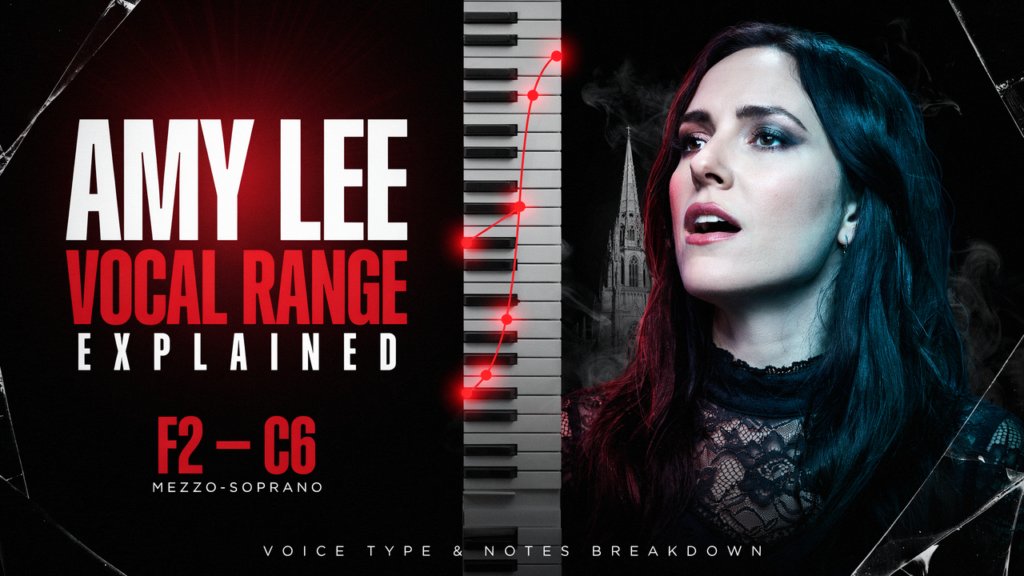
Amy Lee’s vocal range is commonly estimated at about E♭3 to E6, just over three octaves. Her voice type is often described as a mezzo-soprano: Wikipedia says she sings in a mezzo-soprano register, while a Boston Globe review called her sound “ethereal soprano”. Below are her lowest and highest listed notes, sheet-music ranges for six Evanescence songs, and the sources behind every number.
All figures here are estimates. No measured range has been published for Amy Lee; the numbers come from a 2011 vocal profile, a range database and Musicnotes sheet music, and they differ by several notes. Want to compare? Try your own range in our test and set your lowest and highest notes next to the tables below.
- Test Your Range
Sing your lowest and highest notes and see how many octaves you have.
- Which Voice Type Are You?
Mezzo-soprano, soprano or alto? Get a result from a few sung notes.
- How High Is Your Top Note?
Find your highest note and compare it with the D5 to G5 peaks in her songs.
Amy Lee Vocal Range at a Glance
| Detail | Value |
|---|---|
| Voice type | Often described as a mezzo-soprano; some reviewers call her a soprano |
| Commonly cited range | E♭3–E6 (37 semitones, about 3.1 octaves), from a 2011 vocal profile |
| Range database (Evanescence page) | A2–E6 (43 semitones, about 3.6 octaves; a band page, so not only her voice) |
| Lowest note listed | A2 in “Hello” (database); E♭3 in the profile; E3 written in “Going Under” (sheet music) |
| Highest note listed | E6 in “Farther Away” (database); G5 written in “Lithium” (sheet music) |
| Where her written melodies sit | Mostly A3 to D5 in six songs (table below) |
| Training | Studied classical piano for nine years; formal classical voice training not documented in the sources checked |
| Born | December 13, 1981, Riverside, California |
Why do the numbers differ? A database counts every note it can find, including backing vocals and ad-libs, while sheet music shows only the written melody. E♭3 to E6 is 37 semitones, or 3.1 octaves; A2 to E6 is 43 semitones, or 3.6 octaves. Neither reaches four octaves, so a “four-octave” claim is best treated as rounding up. To see what such a span involves, read about a three-octave voice and the four-octave claims people make.
What Are Amy Lee’s Lowest and Highest Notes?
These are notes listed for named songs, not guesses from live clips.
Lowest Recorded Note
The Singing Carrots database lists A2 in “Hello” (the song spans A2 to E5). A 2011 Diva Devotee vocal profile puts her low end at E♭3. In published sheet music the lowest written note is E3 in “Going Under” (E3 to D5). Diva Devotee also notes her lower register can lack resonance if reached with poor technique, which is one reason she rarely sits down there.
Highest Recorded Note
E6 in “Farther Away” (D5 to E6 in Singing Carrots) is the highest note listed, and the same profile says her head voice stays “warm, powerful and resonant” up to E6. Notes this high are very likely head voice rather than belted chest voice, although neither source labels the register of each note. The highest note in the sheet music checked is G5 in “Lithium”.
Total Octave Span
About 3.1 octaves by the commonly cited E♭3–E6, and about 3.6 by the database range A2–E6. Both are estimates. A typical untrained adult spans roughly two octaves (the typical adult span), so either figure is wide, but a wide span does not decide voice type.
Is Amy Lee a Soprano or a Mezzo-Soprano?
The best-supported answer is mezzo-soprano with a soprano-like top. Voice type depends on where a voice sits comfortably and how it sounds, not on the highest note. Four points matter:
- What sources say. Wikipedia states that she sings in a mezzo-soprano register, citing Rolling Stone (2017) and Billboard (2013). Diva Devotee’s profile calls her a lyric mezzo-soprano. The Boston Globe called her sound an “ethereal soprano”, which describes tone rather than a formal classification.
- Where her songs sit. The six sheet-music ranges below run from A3 to D5 in most cases, with one climb to G5. The usual mezzo-soprano range is commonly given as A3 to A5, so nearly all of it fits. The typical soprano range starts higher, around C4 to C6.
- The top notes. E6 is well above the usual mezzo limit, but a few head-voice notes do not make a soprano. This is why some listeners say soprano.
- Timbre. The profile describes a darker, weightier tone in her belted middle than in her head voice, which fits a mezzo.
Is Amy Lee a soprano?
Often called one because of her high notes and light head voice, but the better-supported label is mezzo-soprano. Nobody has published a formal classification, so treat both as descriptions.
Is Amy Lee an alto?
Not usually. Her lowest listed notes (A2 to E♭3) are in alto territory, but her written melodies sit above the alto centre. For the difference, see how alto and soprano differ and mezzo-soprano versus contralto.
Evanescence Songs: Ranges and Keys
Fans ask how demanding the songs are. The written melodies span between about 1.3 and 2.2 octaves, which is much narrower than her full range. All six ranges below come from the sheet music on Musicnotes, as quoted on each song’s Wikipedia page.
| Song | Vocal range | Key | Source |
|---|---|---|---|
| My Immortal | A3–C5 | A major (F♯ minor chorus) | Sheet music (Wikipedia) |
| Going Under | E3–D5 | B minor (D major chorus) | Sheet music (Wikipedia) |
| Everybody’s Fool | A3–D5 | D minor | Sheet music (Wikipedia) |
| Lithium | A3–G5 | B minor | Sheet music (Wikipedia) |
| Call Me When You’re Sober | G3–E♭5 | E minor | Sheet music (Wikipedia) |
| Lacrymosa | B3–E5 | E minor | Sheet music (Wikipedia) |
| Hello | A2–E5 | not checked | Singing Carrots (lowest note listed) |
| Farther Away | D5–E6 | not checked | Singing Carrots (highest note listed) |
Wikipedia notes that “Lithium” uses her lower register, yet it also holds her highest written note, G5. “Lacrymosa” adds a choir that sings B2 to E4 under her line. To try a song in a friendlier key, transpose a track to your range and sing it again.
Head Voice, Belting and Classical Influence
Amy Lee’s reputation rests on a resonant head voice and a dark, controlled middle. Diva Devotee describes belted notes as “resonant, rounded, and mixed well” and adds that pushing higher belts without blending in head voice strips character from the sound. That is one reviewer’s 2011 opinion, not a measurement. To hear what the registers are, read chest and head voice explained.
Is Amy Lee classically trained?
Partly, and the detail matters. Wikipedia describes her as a classically trained pianist who studied classical piano for nine years and was inspired by Mozart and Beethoven. She arranged the choir parts on “Lacrymosa”, which builds on Mozart’s Requiem. I found no source documenting formal classical voice training, so claims that she trained as an opera singer are unverified. The classical feel of her singing is better explained by her musical background and the band’s arrangements.
Amy Lee’s Singing Style and Sound
Evanescence is usually filed under gothic, symphonic or alternative metal, and Lee has said the band’s idea combines the dramatic, the rock, the classical and the film score. Against heavy guitars her voice does two things: it stays clear and sustained in the upper middle, and it moves from whispered lines to loud climaxes, as Wikipedia notes for “Going Under”. That contrast, together with ballads like “My Immortal” that sit in a narrow A3 to C5 band, explains why her voice sounds bigger than her written ranges suggest.
Functional Range vs Extreme Notes
Full range is your lowest to highest note. Your comfortable range is the stretch you can sing repeatedly without fatigue. For Amy Lee the full range is about three octaves, but her written melodies mostly sit between A3 and D5, a span of a little over an octave and a half. The extreme notes appear briefly or in head voice. This is the difference between how comfortable range differs from full range. Compare the mezzo zone with other female voices in voice types side by side.
How to Sing Like Amy Lee: Practical Steps
- Start in the middle. Her ballads sit in a comfortable band; practise “My Immortal” style lines before high notes.
- Build a gentle head voice. Slide from chest into head voice softly rather than pushing chest voice upward.
- Warm up every time. A short routine helps: warm up before high notes.
- Add range slowly. Follow steps to build your top range safely and stop if you feel pain or tightness.
- Copy the coordination, not the volume. Loud, tense singing is what strains voices.
To check progress, score your cover of her songs or check which notes you sang. For repertoire aimed at a similar voice, try songs for sopranos, and browse more famous singers’ ranges.
Amy Lee Vocal Range FAQs
How many octaves can Amy Lee sing?
About 3.1 octaves by the commonly cited E♭3–E6, and about 3.6 by the database range A2–E6. Both are estimates.
What is Amy Lee’s highest note?
The database lists E6 in “Farther Away”, and a 2011 profile also gives E6 as her head-voice limit. The highest note in the sheet music checked is G5 (“Lithium”).
Is Amy Lee a soprano or a mezzo-soprano?
Most often described as a mezzo-soprano, with a soprano-like head voice. There is no official classification.
Does Amy Lee belt?
Her middle voice is described as darkly resonant and her highest notes as head voice, so she belts less than the volume of the band suggests. That is an interpretation of one profile, not a measured fact.
Is Amy Lee classically trained?
She is a classically trained pianist. Documented formal classical voice training was not found.
Sources for These Figures
- Wikipedia, “Amy Lee” (mezzo-soprano register, citing Rolling Stone 2017 and Billboard 2013; Boston Globe “ethereal soprano”; nine years of classical piano; birth date and place).
- Wikipedia articles for “My Immortal”, “Going Under”, “Everybody’s Fool”, “Lithium”, “Call Me When You’re Sober” and “Lacrymosa” (key and vocal range from Musicnotes sheet music).
- Diva Devotee, “Amy Lee (Evanescence singer) – Vocal Profile” (May 2011: lyric mezzo-soprano, E♭3–E6, head voice to E6).
- Singing Carrots, Evanescence artist range page (A2–E6, 3.6 octaves; lowest song “Hello”, highest song “Farther Away”). The page lists the band, so it is used only for named songs.
Page last reviewed: .

Cooke is a vocal training and singing education writer specializing in vocal range analysis, pitch recognition, voice development, and singing tools for vocalists, performers, musicians, and beginners. He creates practical content focused on vocal improvement, singing techniques, and voice analysis resources.