
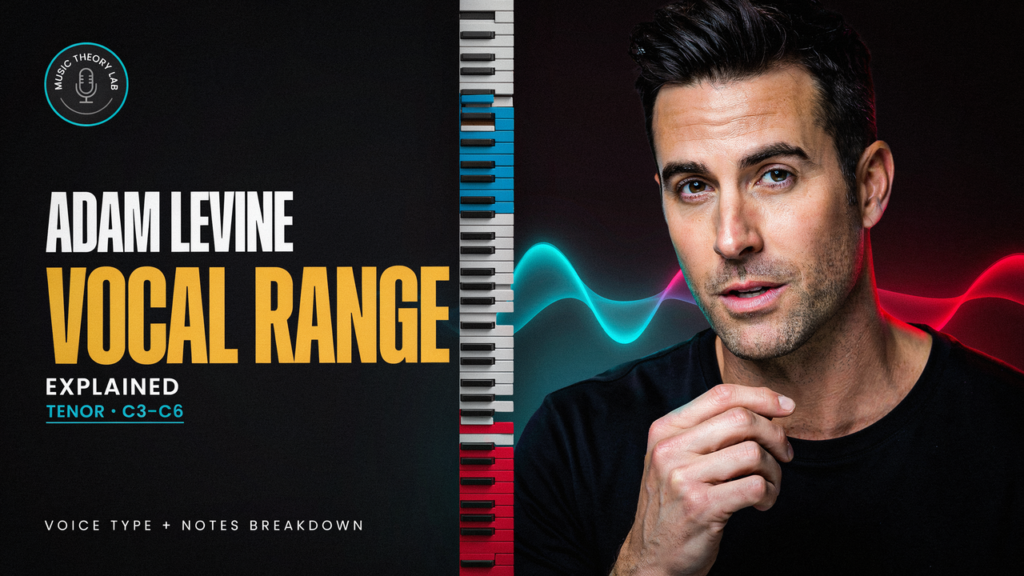
Adam Levine’s vocal range is commonly estimated at about C3 to C6, three octaves counting his falsetto. His voice type is usually described as tenor. Wikipedia calls him a “countertenor and tenor” and notes his falsettos, and none of the sources checked for this page classes him as a baritone. Levine, born 18 March 1979 in Los Angeles, is the lead singer of Maroon 5 and was a coach on The Voice.
All figures here are estimates. No measured range has been published; the numbers come from the sheet music of his songs and from range databases that analyse recordings, and they differ by several notes. The sources are listed at the end. Want to see how your own voice compares? Take our free singing range test and line your notes up against the tables below.
- Measure Your Range
Sing your lowest and highest notes and see how many octaves you have.
- Tenor or Baritone? Test Yourself
Get a voice type suggestion from a few sung notes.
- See How High You Can Sing
Find your top note and compare it with the peaks in Maroon 5 songs.
Adam Levine Vocal Range at a Glance
| Detail | Value |
|---|---|
| Voice type | Tenor, often described as a light or lyric tenor; Wikipedia: “countertenor and tenor” |
| Estimated full range | C3–C6, commonly cited estimate (3 octaves, 36 semitones), including falsetto |
| Other published estimates | C3–E5, 2.3 octaves (Singing Carrots); E2–B♭5, 3.5 octaves (one analysis video). This page previously gave three different figures: B2–C6, C3–D6 and E2–C6 |
| Lowest listed notes | C3 in “Lost Stars” (Singing Carrots); D♭3 in “Sugar” (sheet music) |
| Highest listed note | C6 in “Don’t Wanna Know” (sheet music span D4–C6, as reported on Wikipedia); E5 in “Lost Stars” and “Sugar” |
| Where his hit melodies sit | About D♭3 to E5 across the singles below (about 2¼ octaves) |
| Known for | Falsetto, lead vocals for Maroon 5, coaching on The Voice |
| Born | 18 March 1979, Los Angeles, California |
Why do the numbers differ? Sheet music shows the notes written for one song. Databases and videos count everything they can find, including ad-libs, live lows and falsetto peaks, and they seldom say which register was used. The sheet music also does not say whether the C6 in “Don’t Wanna Know” is falsetto or full voice, though the melody sits far above the usual tenor chest range. The overall picture still agrees: three octaves at most, and most melodies in the middle of the tenor range.
What Is Adam Levine’s Vocal Range?
A fair reading of the evidence is a full range of about C3 to C6, with the top third of it reached mainly in falsetto. The three-octave vocal range guide explains what that span means, and it is roughly one octave wider than the average untrained range.
Adam Levine’s Functional (Comfortable) Singing Range
No source measures his comfortable range. The sheet-music spans below give a guide to where his hit melodies are written: F3–C5 (“One More Night”), G♯3–B4 (“Payphone”) and D♭3–E5 (“Sugar”). Together that suggests most of his singing sits between roughly D♭3 and E5, about 2¼ octaves, with the notes above E5 as occasional peaks. That is an inference from three songs, not a published figure. An earlier version of this page gave G3–B4, which was unsourced.
Adam Levine’s Voice Type: Tenor or Baritone?
Usually tenor. That is how this site and most analysis pages describe him, and Wikipedia lists him as a “countertenor and tenor”. No source checked calls him a baritone.
Is Adam Levine a tenor?
- Where his melodies sit. His written notes regularly reach C5 (“One More Night”) and E5 (“Sugar”). The range usually given for tenors is C3 to C5.
- Above the usual baritone top. Baritones are commonly given A2 to A4. Even “Payphone” peaks at B4, one step above that.
- Prominent falsetto. Wikipedia says he “has been noted for his falsettos”, and it names falsetto in the reception of several Maroon 5 songs.
Voice type is judged by where a voice sits comfortably and how it sounds, not by one low or high note. The vocal fach system explained covers the method.
Is Adam Levine a baritone?
The evidence points the other way. His lowest listed notes, C3 and D♭3, are ordinary lows for a tenor, and his melodies spend their time above the usual baritone top. If you want to compare the two voice types, read how tenors and baritones differ and the baritone range.
Is Adam Levine a countertenor?
Wikipedia uses that word, but a countertenor sings mainly in falsetto as a professional voice type. Levine uses falsetto as a signature colour on top of a tenor voice, and most analysis sites call him a tenor, so tenor with a strong falsetto is the safer description.
Full Voice vs Falsetto: A Key to Adam Levine’s Sound
Falsetto is a lighter register above the full voice. The difference between chest voice and head voice explains the neighbouring registers. Wikipedia notes his falsetto in coverage of several songs: Loftus (AllMusic) heard “wry falsetto” in “This Love”, AOL Radio called “Misery” a “falsetto-pleading, yet upbeat” track, and reviews of “Lost Stars” and “Wait” both single out his falsetto. The Atlantic ran a 2012 piece on Maroon 5’s falsetto singing.
Why Adam Levine’s Voice Sounds So High
Two documented reasons. First, the sheet music shows melodies that reach C5 and E5 regularly, which is high for a male chest voice. Second, the falsetto: it lets him go well above that, up to the C6 in “Don’t Wanna Know”, without the strain of belting. The result is a voice that many listeners hear as “high” even when a song sits in a middle range like “Payphone”.
Songs and Their Sheet-Music Ranges
These spans show the written vocal line of one song, not his limits. Four come from the Wikipedia article of each song (citing Musicnotes sheet music) and one from Singing Carrots.
| Song | Vocal span | Span size | Source |
|---|---|---|---|
| One More Night | F3–C5 | 19 semitones, about 1.6 octaves | Wikipedia (Musicnotes) |
| Payphone | G♯3–B4 | 15 semitones, about 1.25 octaves | Wikipedia (Musicnotes) |
| Sugar | D♭3–E5 | 27 semitones, about 2¼ octaves | Wikipedia (Musicnotes); the article writes the top as F♭5 |
| Don’t Wanna Know | D4–C6 | 22 semitones, about 1.8 octaves | Wikipedia (Musicnotes) |
| Lost Stars | C3–E5 | 28 semitones, about 2.3 octaves | Singing Carrots |
For songs that fit a similar voice, browse songs written for tenor voices.
How Adam Levine Compares With Other Singers
Among pop and R&B tenors, Bruno Mars’s vocal range is a close comparison: also a tenor with a prominent falsetto, and the SRT page gives B♭2–D6. For another male pop-rock voice, see Adam Lambert’s range. More frontmen are collected on lead vocalists of famous bands, and the full list is at vocal ranges of dozens of other singers.
Compare Your Voice With Adam Levine
- Run the our homepage range test and note your lowest and highest comfortable notes.
- Compare them with the table above: can you reach the C5 or E5 written in “One More Night” and “Sugar”?
- Not sure which note you are on? Use the tool that names the note you sing.
- If a song sits too high, shift it with the pitch changer for your recordings.
- Then get a score for your take to check how steady and in tune it is, and see typical male voice types for where you fit.
Frequently Asked Questions
What is Adam Levine’s exact vocal range? There is no exact, measured figure. The commonly cited estimate is about C3 to C6, three octaves including falsetto; Singing Carrots lists C3 to E5.
What voice type is Adam Levine? A tenor, often described as light or lyric, with a prominent falsetto. Wikipedia lists him as a “countertenor and tenor”.
Is Adam Levine a tenor or a baritone? A tenor. His written notes regularly sit at C5 to E5, above the usual baritone top of about A4, and none of the sources checked calls him a baritone.
Is Adam Levine a countertenor? Wikipedia uses the term, but most analyses call him a tenor who uses falsetto as a signature colour.
How many octaves can Adam Levine sing? About three, counting falsetto, from an estimated C3 to C6. The full-voice portion is smaller.
What is Adam Levine’s highest note? C6 in “Don’t Wanna Know”, according to the sheet-music span reported on Wikipedia. The register is not stated.
What is Adam Levine’s lowest note? C3 in “Lost Stars” according to Singing Carrots; D♭3 in “Sugar” according to its sheet music.
Does Adam Levine sing in falsetto? Yes. Wikipedia says he has been noted for his falsettos, and reviews cite it in songs such as “This Love”, “Misery”, “Lost Stars” and “Wait”.
Why does Adam Levine sound so high? His melodies reach C5 and E5 regularly, and he moves into falsetto for higher notes.
Is Adam Levine a good singer? That is a matter of opinion. Facts: he has been Maroon 5’s lead singer since the band’s debut, the band has won three Grammy Awards, and he coached winners on The Voice.
Sources for These Figures
Figures on this page were checked on 30 September 2026 against:
- Wikipedia, “Adam Levine”: “countertenor and tenor”, falsettos, birth date, The Voice, Grammy Awards.
- Wikipedia articles for “One More Night”, “Payphone”, “Sugar” and “Don’t Wanna Know”: vocal spans from Musicnotes sheet music; and for “This Love”, “Misery”, “Lost Stars” and “Wait”: falsetto in critical reception.
- Singing Carrots, Adam Levine artist range: C3–E5, lowest and highest song.
- A widely shared analysis video on YouTube listing E2–B♭5 (unverified, shown only as part of the spread).
Range databases and analysis blogs give different numbers. Where they disagree, this page shows the spread instead of a single exact figure.
Page last reviewed: .

Cooke is a vocal training and singing education writer specializing in vocal range analysis, pitch recognition, voice development, and singing tools for vocalists, performers, musicians, and beginners. He creates practical content focused on vocal improvement, singing techniques, and voice analysis resources.