
Gerard Way’s vocal range refers to the span between his lowest and highest sung notes across chest voice, mix, and falsetto. At his peak, his total usable range measured around three octaves, with a tenor tessitura and strong upper mix that defined the My Chemical Romance sound.
He is not a classical tenor.
He is a rock tenor with dramatic intensity and stylistic edge.
That distinction matters when analyzing his voice.
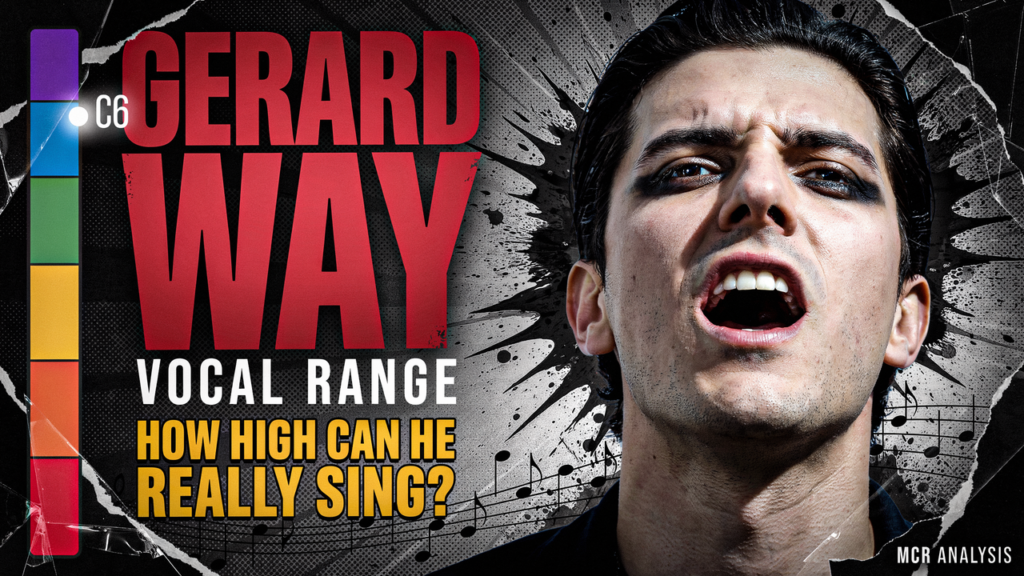
What Is Gerard Way’s Vocal Range?
Across studio recordings and live performances, Gerard Way’s voice extends from the low second octave up into the fifth octave using mix and falsetto coordination.
Here’s a simplified breakdown:
| Category | Approximate Notes | Register | Practical Meaning |
|---|---|---|---|
| Lowest Notes | Around E2–F2 | Chest voice | Lean, speech-based tone |
| Core Tessitura | G3–D4 | Modal register | Most consistent strength |
| Upper Modal | E4–G4 | Mixed voice | Powerful rock belt zone |
| Highest Notes | A5 area | Mix/falsetto | Intense, stylistic highs |
Compared to the average male vocal range, his upper register sits noticeably higher than most untrained male singers.
However, range alone does not explain his sound.
Control and coordination do.
Is Gerard Way a Tenor or Baritone?
Functionally, he operates as a tenor.
His comfortable singing zone sits higher than typical baritone territory. If you compare standard classifications like the tenor vocal range and the baritone vocal range, his tessitura aligns more closely with tenor placement.
Tessitura is key here. It describes where your voice feels most natural and powerful, not just your highest note. If that concept is new to you, review this explanation of what is tessitura.
Gerard Way’s voice lives in that upper-middle zone comfortably—especially in early recordings.
Clean Notes vs Distorted Notes
This is where many singers get confused.
Rock distortion does not automatically mean a higher pitch. Distortion is a stylistic texture layered over a pitch.
When analyzing vocal range, we count the actual pitch being sung—not the grit.
Think of distortion like adding gravel to a road. The road is still there underneath. The pitch is the road.
Understanding that difference prevents inflated octave claims.
How His Voice Changed Over Time
Early in his career, Gerard Way used aggressive upper mix frequently. Songs from the mid-2000s showcase repeated high belts in the fourth octave.
Over time, his voice matured. High notes became more selective. The tessitura slightly lowered. That is normal.
Vocal folds change with age, touring fatigue, and stylistic choices.
Sustainable singers adapt rather than forcing their younger range forever.
The hearing frequency check shows low and high tone thresholds.
Step-by-Step: How to Test If You Share a Similar Range
If you’re curious whether your voice overlaps with his, test safely.
- Warm up gently for at least 8 minutes using humming and lip trills.
- Slide downward from mid-range until your tone loses clarity.
- Mark the lowest clean, supported note.
- Glide upward through your middle range without pushing chest voice.
- Shift into mix before strain appears.
- Stop immediately if your throat tightens or jaw locks.
For a structured approach, follow a guide to find your vocal range. Once warmed up, you can carefully explore your upper extension using a controlled high note test.
Never chase a note that feels squeezed.
Self-Check: Are You a Rock Tenor?
Ask yourself:
- Do high notes around E4–G4 feel accessible?
- Is your speaking voice moderate rather than deep?
- Do you naturally project forward rather than downward?
- Can you transition into head voice without cracking?
If you answered yes to most, you may lean toward a tenor profile.
If you’re unsure, use a structured voice type test to clarify your classification.
Remember, voice type is about comfort and sustainability—not ego.
Common Mistakes When Imitating Gerard Way
Many singers try to copy his intensity without copying his coordination.
Here are the biggest mistakes:
- Pushing chest voice too high
- Confusing distortion with pitch
- Locking the jaw on high belts
- Neglecting breath support
- Singing loudly without warming up
High rock singing should feel energized, not crushed.
If you feel hoarse after singing, that is a sign of misuse—not effort paying off.
How His Range Compares to Other Male Singers
Gerard Way’s range is strong but realistic. Many trained male singers can access three octaves when including mix and falsetto.
His advantage lies in how often he used his upper-middle register.
When you compare your own notes visually using a structured vocal range chart, you may notice that most singers avoid living in that upper space.
He embraced it.
That’s a stamina skill as much as a pitch skill.
Realistic Expectations for Expanding Your High Range
Range expansion takes time.
Some singers gain a few semitones over months of structured training. Others primarily improve consistency and tone quality rather than adding new extreme notes.
Think of upper range like sprinting. You train coordination and efficiency. You don’t simply “try harder.”
If you want to build safer high notes:
- Strengthen breath support
- Develop mix rather than pushing chest
- Practice controlled volume
- Rest when fatigued
Rock singing does not require pain.
It requires balance.
Practical Lesson: Build a Usable Upper Register
Gerard Way didn’t just hit high notes once in the studio. He performed them live.
That means those notes were functional.
When evaluating your range, count a note only if you can:
- Sustain it
- Repeat it
- Keep tone stable
You can also explore your lower extension with a guided low note test to balance your range development.
Balanced singers last longer.
Final Coaching Perspective
Gerard Way’s vocal range sits within a high tenor framework, with strong upper mix and stylistic intensity.
His impact comes from emotional delivery combined with controlled upper register use.
The lesson isn’t to scream higher.
The lesson is to coordinate better.
If you build breath support, mix stability, and forward resonance, your own upper range will feel more reliable—without sacrificing vocal health.
Your goal is not to copy his extremes.
Your goal is to build sustainable power in your own voice.
FAQs
1. What is Gerard Way’s vocal range in octaves?
His total usable range measures around three octaves when including mix and falsetto. His tessitura sits in the tenor range.
2. What is Gerard Way’s highest note?
He reaches into the fifth octave using mix and falsetto coordination. These notes are most prominent in earlier recordings.
3. Is Gerard Way a tenor?
Yes, functionally he aligns with a tenor classification based on tessitura and upper register strength.
4. Did his voice change over time?
Yes. Like most singers, his comfortable range lowered slightly with age and touring, which is normal and healthy adaptation.
5. Does distortion count toward vocal range?
No. Distortion is a stylistic layer. Vocal range is measured by pitch, not texture.
6. Can I train to sing that high?
You can improve mix coordination and upper extension, but your anatomy sets natural limits. Focus on safe development rather than copying exact pitches.
7. Is high rock singing damaging?
It becomes risky when singers push chest voice or ignore fatigue. With proper technique and rest, high singing can be done safely.

Cooke is a vocal training and singing education writer specializing in vocal range analysis, pitch recognition, voice development, and singing tools for vocalists, performers, musicians, and beginners. He creates practical content focused on vocal improvement, singing techniques, and voice analysis resources.