
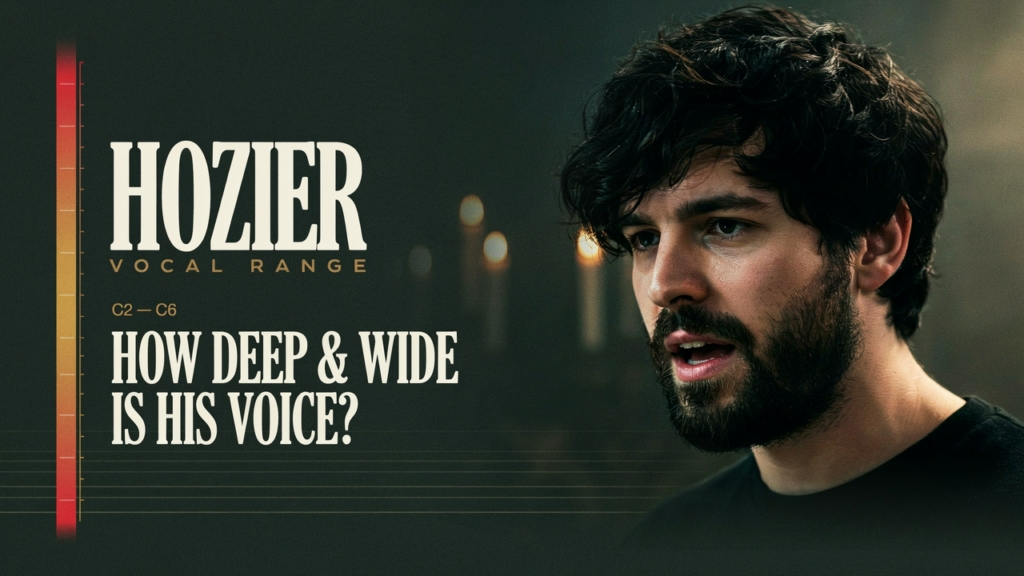
Hozier’s vocal range refers to the span between his lowest and highest sung notes across chest voice, mix, and falsetto. Most careful estimates place his total usable range at around three octaves, with a strong lower register and a baritone tessitura that gives his voice its dark, soulful character.
He is not a high belting tenor.
He is a resonant, expressive baritone with controlled upper extension.
That distinction explains his sound.
What Is Hozier’s Vocal Range?
Across studio recordings and live performances, Hozier’s voice extends from the low second octave up into the fifth octave when including falsetto.
Here’s a simplified breakdown:
| Category | Approximate Notes | Register | Practical Meaning |
|---|---|---|---|
| Lowest Notes | Around E2–F2 | Chest voice | Deep, resonant tone |
| Core Tessitura | G2–D4 | Modal register | Most powerful and consistent |
| Upper Modal | E4–G4 | Mix | Bright but controlled |
| Upper Extension | A4–C5 area | Falsetto | Light, stylistic highs |
Compared to the average male vocal range, his lower register sits comfortably within baritone territory.
What makes him stand out is not extreme high notes, but depth and texture.
Is Hozier a Baritone or Tenor?
Functionally, he fits the baritone category.
His speaking voice sits low. His strongest singing lives in the lower and middle registers. When compared to classifications like the baritone vocal range and the tenor vocal range, his tessitura clearly aligns lower.
Tessitura matters more than a single high note. If you’re unfamiliar with that concept, review this explanation of what is tessitura.
Hozier’s comfort zone is low and grounded.
Why His Low Notes Sound So Powerful
Many singers can reach low notes.
Few can sustain them with clarity.
Hozier maintains resonance in his chest voice instead of letting the tone collapse. Think of his low notes like a well-tuned cello: full, supported, vibrating evenly.
He achieves this through:
- Stable breath support
- Relaxed jaw and tongue
- Open throat space
- Consistent airflow
Low singing requires just as much support as high singing.
If you “drop” into low notes without energy, the sound becomes breathy.
How He Uses Falsetto
Although known for depth, Hozier also uses falsetto effectively.
His upper notes often sound airy and emotional rather than forceful. This creates contrast.
Falsetto does not mean weak.
It means lighter coordination. When used intentionally, it adds color.
When measuring vocal range, falsetto counts toward total span—but it should be clearly separated from modal (full voice) notes.
Try the mic readiness test before any online lesson.
Step-by-Step: How to Test If You Share a Similar Range
If you want to compare your voice safely, follow this method:
- Warm up gently with humming and descending slides.
- Start in mid-range and move downward slowly.
- Stop when tone becomes breathy or unstable.
- Mark the lowest note that feels supported.
- Glide upward through your natural speaking range.
- Shift into mix or falsetto without pushing chest.
- Stop immediately if tension appears.
For structured guidance, use this step-by-step method to find your vocal range. You can also explore your lower extension carefully with a guided low note test.
Never force your voice downward to “sound deeper.”
Self-Check: Do You Have a Baritone Profile?
Ask yourself:
- Does your speaking voice sit low and relaxed?
- Do low notes feel stronger than high belts?
- Do high notes require noticeable effort?
- Does your voice feel richest in the lower third and fourth octaves?
If most answers are yes, you may lean toward baritone territory.
You can confirm using a structured voice type test to understand your natural placement.
Voice type is about comfort, not ego.
Common Mistakes When Trying to Sing Like Hozier
Many singers misunderstand low singing.
Here are the most common errors:
- Forcing the larynx downward to sound darker
- Dropping breath support on low notes
- Oversinging with too much air
- Ignoring upper register development
- Confusing “deep” with “pressed”
Healthy low notes feel grounded and energized—not pushed.
If your throat tightens or you feel neck tension, you’re likely forcing.
How His Range Compares to Other Male Voices
Hozier’s range is solid and practical.
It is not built around extreme high notes. Instead, it centers around a rich middle and lower register.
When you compare your own notes against a structured vocal range chart, you may notice that many singers avoid living in the lower register because it feels harder to control.
He embraced it.
That’s coordination and breath control—not just anatomy.
Realistic Expectations for Expanding Lower Range
You cannot drastically change your natural vocal weight.
If you are naturally a tenor, you can strengthen lower notes—but you won’t become a true baritone overnight.
Lower range development works like flexibility training.
You build access gradually.
If you want to improve your lower register safely:
- Maintain steady airflow
- Avoid pushing downward
- Practice slow descending slides
- Rest when fatigued
Deep singing should feel supported, not heavy.
Practical Lesson: Focus on Usable Notes
A note only counts if you can:
- Sustain it
- Repeat it
- Keep it resonant
Hozier’s low notes are repeatable live. That means they are coordinated.
Balanced singers also develop upper flexibility. You can check your full span visually using a structured human vocal range guide to see where you sit overall.
Balance protects longevity.
Final Coaching Perspective
Hozier’s vocal range sits within a baritone framework, with strong lower resonance and controlled falsetto extension.
His strength isn’t about extreme octaves.
It’s about depth, control, and emotional phrasing.
If you want similar authority, focus on breath stability, relaxed low-note production, and balanced register transitions.
Don’t chase deeper.
Chase healthier.
Your voice becomes powerful when it feels effortless.
FAQs
1. What is Hozier’s vocal range in octaves?
His total usable range measures around three octaves when including falsetto. His core strength sits in the lower and middle registers.
2. Is Hozier a baritone?
Yes, functionally he aligns with the baritone category based on tessitura and lower register comfort.
3. What is Hozier’s lowest note?
He reaches into the low second octave in chest voice with supported resonance.
4. Does Hozier use falsetto?
Yes. He uses falsetto selectively for emotional contrast and upper extension.
5. Can I train to sing as low as Hozier?
You can strengthen your lower register, but anatomy sets natural limits. Focus on support and coordination rather than forcing depth.
6. Does singing low damage the voice?
Low singing becomes risky when singers push downward or drop support. With proper technique, it can be done safely.
7. How do I know if I’m a baritone?
If your strongest, most comfortable notes sit lower and high belts feel strained, you may lean baritone. A voice type evaluation can clarify your placement.

Cooke is a vocal training and singing education writer specializing in vocal range analysis, pitch recognition, voice development, and singing tools for vocalists, performers, musicians, and beginners. He creates practical content focused on vocal improvement, singing techniques, and voice analysis resources.