
Jeremy Jordan’s vocal range is commonly documented from approximately A2 to Bb5, spanning a little over three octaves. He is generally classified as a lyric tenor, known for his bright tone, strong chest-dominant mix, and powerful Broadway-style belt rather than extended falsetto singing.
That range is impressive. But what really sets him apart is how efficiently he uses it on stage.
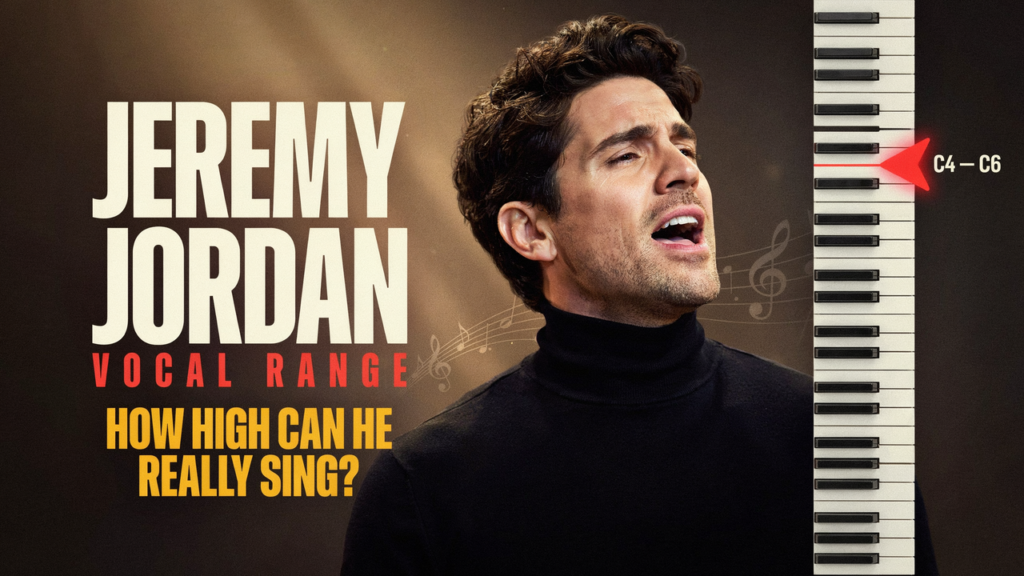
What Are Jeremy Jordan’s Lowest and Highest Notes?
Lowest Recorded Note
Around A2, which sits comfortably in the lower tenor range.
It’s solid but not unusually low for male singers.
Highest Recorded Note
Commonly cited around Bb5, typically delivered in a chest-dominant mix rather than pure falsetto.
Total Octave Span
A little over three octaves when counting full extension.
To understand where that sits overall, compare it to a standard male vocal range framework. His strength is not extreme lows or whistle notes. It’s upper-middle power and clarity.
Here’s a simplified breakdown:
| Element | Detail |
|---|---|
| Lowest Note | A2 |
| Highest Note | Bb5 |
| Total Span | 3+ octaves |
| Voice Type | Lyric Tenor |
| Signature Strength | Broadway belt |
Is Jeremy Jordan a Tenor or Baritone?
He is widely considered a lyric tenor.
Why not baritone?
His speaking voice sits higher.
His comfortable singing range lives above middle C.
His timbre is bright and forward rather than dark and heavy.
If you compare his range with a typical tenor vocal range, the classification fits naturally.
Some confusion comes from how strong his lower middle register sounds. But weight alone doesn’t determine voice type—tessitura does.
Tessitura vs Full Range
This is where most singers misunderstand range.
Full range includes extreme notes.
Tessitura is where the voice feels strongest and sustainable.
Jeremy Jordan’s tessitura sits high for a male voice. His core power zone is in the upper mix area.
That’s why roles like Jack Kelly demand stamina in the upper register.
If you’re unsure how your own notes compare visually, use a structured vocal range chart to map it out.
What Makes His Broadway Belt So Effective?
Broadway belting isn’t yelling. It’s controlled intensity.
Jeremy Jordan uses:
- Strong breath support
- Chest-dominant mix
- Narrowed vowels at high pitches
- Efficient cord closure
Imagine shifting gears in a car. He doesn’t slam into high notes. He transitions smoothly.
The result: high notes that sound powerful without obvious strain.
If you want to measure your own upper limits safely before training, try a vocal range calculator.
How to Build a Broadway-Style Tenor Belt
If you’re inspired by his sound, focus on coordination—not imitation.
1. Strengthen Your Mid-Range First
Your mix builds from stability.
Practice comfortable notes slightly above speaking pitch.
2. Develop Chest-Dominant Mix
Use medium-volume “yeah” or “hey” exercises in a speech-like tone.
Avoid pushing air.
3. Adjust Vowels on Higher Notes
As pitch rises, modify wide vowels slightly.
This reduces throat tension.
4. Maintain Steady Breath Pressure
Power comes from consistency, not force.
5. Increase Gradually
Move up by semitone steps only.
Never jump a fourth or fifth higher suddenly.
For long-term growth, follow a structured guide like this plan to extend your vocal range.
Are You a High Tenor?
Ask yourself:
- Does my voice naturally sit higher when speaking?
- Do high notes feel easier than low notes?
- Does my tone stay bright even on stronger notes?
- Do low notes feel less resonant than mid-high notes?
If you’re unsure, take a structured voice type test for clarity.
Common Mistakes When Trying to Sing Like Jeremy Jordan
Forcing Chest Voice Too High
Pushing full chest upward leads to tension and fatigue.
Confusing Volume with Belt
Belting is about coordination, not shouting.
Ignoring Breath Management
Inconsistent airflow causes cracking and strain.
Skipping Warm-Ups
High musical theatre roles demand preparation.
A focused daily vocal warm up is essential.
Is He a 4-Octave Singer?
Claims of four octaves appear online, but most realistic assessments place him just over three octaves.
Three well-controlled octaves with stamina are more impressive than four inconsistent ones.
To understand perspective, compare his span with an average vocal range for trained singers.
The key isn’t maximum height—it’s usable strength.
How He Handles High Notes on Stage
Stage singing demands endurance.
Jeremy Jordan maintains:
- Consistent breath support
- Controlled jaw and tongue position
- Minimal throat tension
- Strong vowel shaping
That’s why his high belts stay clear instead of strained.
If your throat feels tight, dry, or squeezed during practice, stop. Healthy singing never feels like choking.
This singer analytics tool gives you context for your results.
Realistic Expectations for Your Own Training
Not every male singer is built to sing Bb5 in a chest-dominant mix.
Your vocal folds, resonance space, and natural placement matter.
With safe training:
- You may gain several semitones over months.
- You can improve clarity and stamina.
- You can strengthen mix coordination.
Large jumps rarely happen quickly. Progress is gradual.
The goal isn’t copying someone else’s range.
It’s maximizing your own healthy potential.
Coaching Takeaway
Jeremy Jordan’s vocal range is impressive, but his real strength lies in how he manages mix and belt. He combines bright resonance, steady breath support, and efficient transitions to create powerful high notes without sacrificing clarity.
If you focus on building coordination step by step, your upper register will grow stronger and more reliable—without strain.
FAQs
1. What is Jeremy Jordan’s highest note?
His highest commonly cited note is around Bb5. It’s typically delivered in a strong chest-dominant mix rather than pure falsetto.
2. How many octaves can Jeremy Jordan sing?
He spans a little over three octaves based on documented notes. His strength lies in his upper-middle and high mix range.
3. Is Jeremy Jordan a tenor?
Yes, he is generally classified as a lyric tenor. His tessitura and tonal brightness support that classification.
4. Does Jeremy Jordan use falsetto?
He can use falsetto when stylistically needed, but his signature high notes rely on mix and belt coordination.
5. Can Jeremy Jordan hit Bb5 live?
Yes, he has demonstrated strong upper notes in live performance. Stamina and breath control are key to maintaining those notes on stage.
6. Is a three-octave range impressive?
For a trained singer, three well-controlled octaves are strong and versatile. Control matters more than raw octave count.
7. Can I train to sing as high as Jeremy Jordan?
You can improve your upper range with proper technique and patience. Focus on coordination, not force, and build gradually to avoid strain.

Cooke is a vocal training and singing education writer specializing in vocal range analysis, pitch recognition, voice development, and singing tools for vocalists, performers, musicians, and beginners. He creates practical content focused on vocal improvement, singing techniques, and voice analysis resources.