
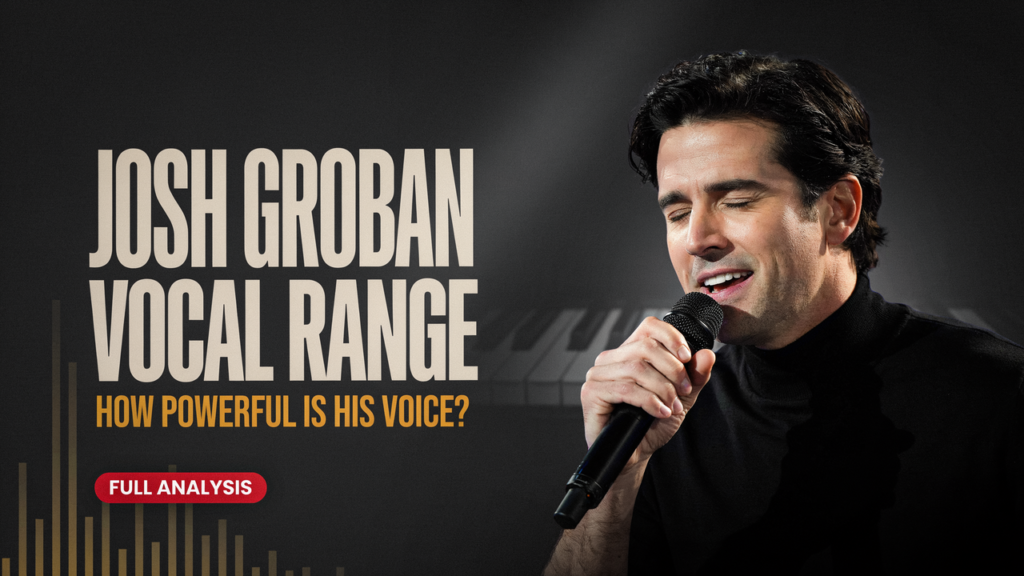
Josh Groban’s vocal range is commonly documented from approximately C2 to A4, spanning about two and a half octaves. He is generally classified as a baritone, known for his rich lower register, strong upper extension, and sustained high notes in classical-crossover repertoire.
His voice isn’t about extreme highs. It’s about controlled, resonant power.
What Are Josh Groban’s Lowest and Highest Notes?
Lowest Recorded Note
Around C2, sitting firmly in baritone territory.
These notes are full and supported, not breathy or weak.
Highest Recorded Note
Often cited around A4, typically sung with a chest-dominant mix rather than light falsetto.
Total Octave Span
Approximately 2.5 octaves of functional range.
To understand how that fits overall, compare it with a general male vocal range. His span is solid for a baritone, especially given the sustained intensity of his upper notes.
Here’s a simplified breakdown:
| Element | Detail |
|---|---|
| Lowest Note | C2 |
| Highest Note | A4 |
| Total Span | ~2.5 octaves |
| Voice Type | Baritone |
| Strength | Sustained upper baritone notes |
Is Josh Groban a Baritone or Tenor?
He is most accurately classified as a baritone.
His speaking voice sits low.
His tessitura centers in the mid-to-lower male range.
His tone has depth and warmth rather than light brightness.
If you compare him to a typical baritone vocal range, the classification makes sense.
Some listeners assume tenor because he sings high notes confidently. But range extension doesn’t automatically change voice type.
Tessitura vs Full Range
This distinction matters.
Full range includes your absolute lowest and highest notes.
Tessitura is where your voice feels comfortable for long phrases.
Josh Groban’s tessitura sits in the upper baritone area. That’s why he can sustain strong G4–A4 notes without sounding strained.
If you’re unsure where your voice naturally sits, mapping it visually on a vocal range chart helps clarify.
Think of full range as the ceiling and floor. Tessitura is the main living space.
How He Sings High Notes as a Baritone
Groban doesn’t scream high notes. He builds into them.
Technically, he uses:
- Strong breath support
- Controlled chest-dominant mix
- Open vowel shaping
- Stable resonance placement
He allows resonance to rise without forcing the throat upward.
It’s like lifting a weight with proper form. The strength comes from coordination, not brute force.
If you want to evaluate your own limits safely, start with a voice type test to confirm your classification first.
How to Strengthen Upper Baritone Notes
If you’re a baritone wanting stronger highs, follow this approach.
1. Stabilize Your Mid-Range
Practice comfortable notes around E3–G3 first.
2. Use Light Slides Upward
Glide from mid-range into upper notes slowly.
3. Narrow Vowels Slightly
Wide “ah” vowels often create tension above F4.
4. Keep Breath Pressure Steady
High notes collapse if airflow is inconsistent.
5. Build Gradually
Move upward in half steps over weeks, not days.
For structured progress, use exercises designed to extend your vocal range safely.
Are You a Baritone?
Ask yourself:
- Does my speaking voice sit comfortably low?
- Do high notes above G4 require effort?
- Do low notes feel stable and resonant?
- Does my tone sound warm rather than bright?
If you relate to these traits, you likely fall into baritone territory.
For context, compare yourself to the broader average vocal range for male singers.
Common Mistakes When Trying to Sing Like Josh Groban
Forcing Chest Voice Too High
Chest dominance without mix coordination leads to strain.
Overdarkening the Tone
Artificially lowering the larynx muffles clarity.
Skipping Breath Support Work
Sustained high notes require steady airflow.
Ignoring Warm-Ups
High-intensity singing demands preparation.
A consistent daily vocal warm up builds reliability.
The Baritone Challenge
The passaggio is the transition area between chest and mix/head coordination.
For many baritones, it occurs around E4–F#4.
Groban navigates this smoothly by allowing resonance to shift rather than pushing chest upward.
If you push straight through the passaggio, the voice tightens.
Instead, think of blending gears rather than slamming into the next one.
Use the vocal profile test to guide training focus.
Can Josh Groban Sing Opera?
He sings in a classical-crossover style, not traditional full operatic repertoire.
True operatic baritones train extensively in projection without microphones. Groban’s technique blends classical influence with contemporary amplification.
That distinction matters.
Crossover singers often use a mix-based approach rather than fully operatic resonance strategies.
Realistic Expectations for Your Own Range
Not every baritone will reach A4 comfortably.
Your range depends on:
- Vocal fold thickness
- Natural speaking pitch
- Breath coordination
- Training consistency
You may gain several semitones over time, but extreme expansion is rare.
If your throat feels tight, dry, or sore, reduce intensity immediately. Healthy singing should feel engaged but not painful.
Coaching Takeaway
Josh Groban’s vocal range spans roughly 2.5 octaves, with strong upper-baritone extension. His power comes from breath stability, resonance alignment, and gradual coordination—not from forcing high notes.
If you focus on balanced support and smooth passaggio transitions, you can strengthen your upper register safely.
Big sound doesn’t come from tension.
It comes from control.
FAQs
1. What is Josh Groban’s highest note?
He is commonly documented reaching around A4. These notes are typically produced with a strong chest-dominant mix rather than falsetto.
2. Is Josh Groban a baritone or tenor?
He is generally classified as a baritone. His tessitura and vocal weight support that label.
3. How many octaves can Josh Groban sing?
Most assessments place him at about 2.5 octaves of functional range. His strength lies in sustained upper-baritone notes.
4. Does Josh Groban use falsetto?
He primarily relies on mix and strong head resonance rather than airy falsetto for high notes.
5. What is Josh Groban’s tessitura?
His tessitura sits in the mid-to-upper baritone range, allowing him to sustain powerful notes around G4–A4.
6. Can a baritone sing as high as Josh Groban?
With consistent training, some baritones can develop similar upper extension. However, anatomy and coordination both influence limits.
7. Is classical crossover different from opera?
Yes. Classical crossover blends classical tone with contemporary technique and amplification, while opera relies on full acoustic projection without microphones.

Cooke is a vocal training and singing education writer specializing in vocal range analysis, pitch recognition, voice development, and singing tools for vocalists, performers, musicians, and beginners. He creates practical content focused on vocal improvement, singing techniques, and voice analysis resources.