
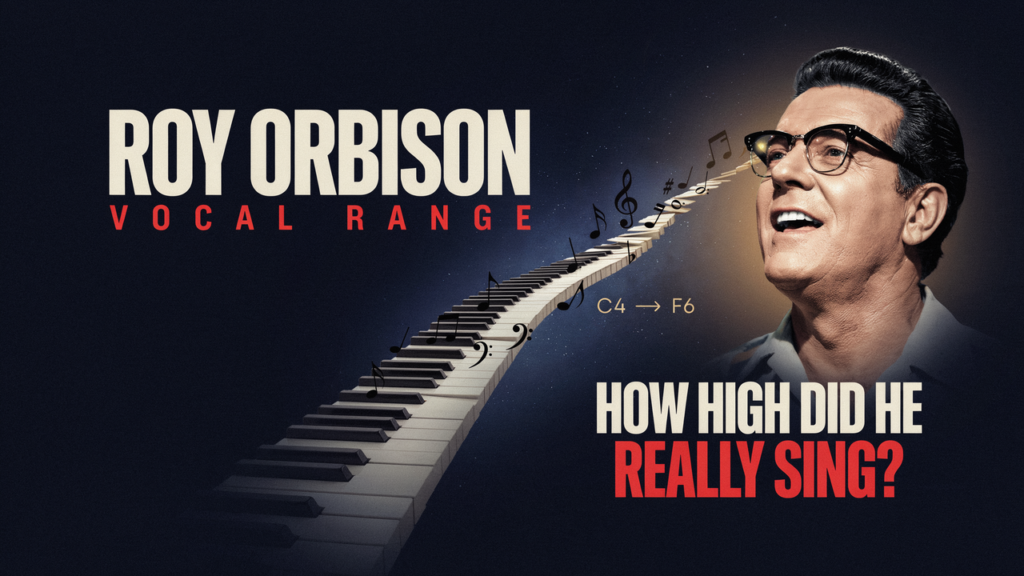
Roy Orbison’s vocal range is generally estimated at around three octaves, stretching from the lower baritone area up into a powerful high tenor range. What made it remarkable wasn’t just the span of notes, but the ease, control, and operatic tone he brought to his upper register.
He wasn’t famous because he could hit high notes. He was famous because those notes sounded full, emotional, and effortless.
Let’s break down what his range likely was, how he achieved it, and what singers can realistically learn from his voice.
What Was Roy Orbison’s Vocal Range?
Most documented analyses place Roy Orbison’s range roughly from the low F or G below middle C up to high tenor notes around E5–F5 in performance. That gives him about a three-octave usable span.
But here’s the important coaching point:
Range alone doesn’t define a singer. Tessitura — where the voice sits most comfortably — matters more.
Orbison’s tessitura sat higher than many male rock singers of his era. He spent a lot of time in the upper middle and high tenor range, and that’s what gave his songs their dramatic lift.
If you’re still unsure how vocal spans are measured, review a full human vocal range explanation to understand note naming and octaves clearly.
Was Roy Orbison a Tenor or Baritone?
Roy Orbison is most accurately described as a tenor.
Why He’s Classified as a Tenor
- His comfortable singing range leaned high.
- He sustained upper notes with resonance, not just falsetto.
- His tone remained strong above C5.
- His vocal color stayed bright and ringing in upper passages.
Many listeners confuse him for a baritone because of his darker tone in lower verses. But tone color and voice type are not the same thing.
If you want a deeper breakdown of classification differences, compare his placement to a typical tenor vocal range.
How Did Roy Orbison Sing So High?
This is where things get interesting.
He didn’t simply “belt” high notes. He used a head-dominant mix with strong resonance shaping.
Think of it like shifting gears in a car. Instead of forcing the engine to stay in first gear (chest voice), he smoothly transitioned into higher coordination.
Key Technical Elements
- Early head voice engagement
He didn’t wait until the top note to switch. The mix began earlier. - Narrowed vowel shaping
Open vowels close slightly as pitch rises. That reduces strain. - Forward resonance
His sound felt lifted and focused rather than pushed. - Controlled vibrato
His vibrato stabilized pitch and reduced tension.
If you’re working on upper notes yourself, start with foundational exercises from a structured daily vocal warm up routine before attempting anything high.
Highest and Lowest Notes in Context
Instead of obsessing over exact note numbers, understand this:
High notes only matter if they are usable in music.
Orbison frequently sustained notes in the upper fifth octave during climactic moments in songs like “Crying.” These weren’t brief squeaks — they were emotionally driven, controlled tones.
That’s a sign of developed coordination, not random range extension.
To see how this compares to broader expectations for male singers, review the typical male vocal range.
Range vs Tessitura: Why This Matters
A singer might technically touch a high note once. That doesn’t mean they can build a career around it.
Roy Orbison’s power came from:
- Living comfortably in a high tessitura
- Transitioning smoothly through his passaggio
- Maintaining tonal consistency across registers
If you’re unfamiliar with tessitura, study a clear explanation of what is tessitura to understand why comfort zone matters more than extremes.
Developing a High, Orbison-Style Upper Range
This is not about copying his voice. It’s about building healthy upper extension.
Step 1: Stabilize Your Middle Voice
Your upper range depends on a balanced middle register.
Practice light “gee” or “nay” patterns through your passaggio without pushing.
Step 2: Blend Before You Belt
Do not jump straight into high chest voice.
Allow your voice to mix gradually. The sensation should feel lifted, not jammed upward.
Step 3: Narrow Vowels on High Notes
“Ah” becomes closer to “uh.”
“Eh” becomes slightly narrower.
This reduces tension automatically.
Step 4: Control Airflow
More air does not equal higher pitch.
High notes need steady, efficient airflow — not force.
If you’re trying to safely expand upward, follow progressive work from a guide on how to extend vocal range instead of pushing randomly.
Is Your Upper Range Healthy?
Ask yourself:
- Can I sing high notes softly?
- Does my throat stay relaxed?
- Can I repeat the note multiple times?
- Does my voice feel normal the next day?
If the answer is no, you’re likely forcing.
You can also measure your comfortable high limit using a structured high note test rather than guessing.
Common Mistakes Singers Make
1. Forcing Chest Voice Too High
This leads to tension and fatigue. High notes require coordination, not brute strength.
2. Confusing Falsetto With Mix
Falsetto is breathier and lighter. Orbison’s high notes carried weight and resonance.
3. Ignoring Warm-Ups
Jumping into upper extremes cold increases strain risk.
4. Overestimating Octave Count
Internet myths often exaggerate ranges. Real usable range is what matters.
The range tracker tool helps you measure range increases.
Comparison Table: Range vs Usability
| Factor | Wide Range | High Tessitura Control |
|---|---|---|
| Can touch high note once | Yes | Yes |
| Can sustain high notes musically | Not always | Yes |
| Tone stays full | Not guaranteed | Consistent |
| Career built around upper range | Rare | Likely |
Roy Orbison succeeded because he combined range with sustained usability.
Realistic Expectations for Singers
Most untrained male singers sit comfortably within 1.5–2 octaves.
With consistent training, many can develop 2.5–3 usable octaves.
Reaching upper fifth-octave notes like Orbison requires:
- Time
- Technical coaching
- Gradual conditioning
- Proper recovery
Never chase high notes at the expense of vocal health.
Temporary swelling can feel like “power,” but it shortens longevity.
What Made His Voice Unique Beyond Range
It wasn’t just pitch height.
It was:
- Emotional phrasing
- Dynamic contrast
- Controlled vibrato
- Operatic shaping in a rock context
Range is measurable. Expression is what listeners remember.
If you focus only on high notes, you’ll miss what truly made his voice powerful.
Final Coaching Takeaway
Roy Orbison’s vocal range was impressive, but his true strength was control in the upper register. He didn’t force high notes — he coordinated them.
Build coordination first. Expand range gradually.
And always prioritize repeatability over extremes.
That’s how you build a voice that lasts.
FAQs
1. What was Roy Orbison’s highest note?
He was known to sing sustained notes in the upper fifth octave, around E5–F5 in performance. The key factor wasn’t just the pitch, but how full and controlled those notes sounded.
2. How many octaves could Roy Orbison sing?
Most analyses estimate around three usable octaves. What made it special was his ability to use the upper part of that range musically.
3. Did Roy Orbison use falsetto?
He occasionally used lighter coordination, but many of his high notes were produced with a head-dominant mix rather than pure falsetto.
4. Was Roy Orbison classically trained?
He incorporated operatic qualities into his singing, but his technique developed within popular music performance rather than formal opera training.
5. Can I train to sing as high as Roy Orbison?
Possibly, but it depends on your natural voice type and consistent technical training. Focus on coordination and gradual extension instead of forcing high notes.
6. What voice type was Roy Orbison?
He is most accurately classified as a tenor, based on his tessitura and upper register strength.
7. Is having a three-octave range rare?
It’s above average but achievable with structured training. What truly matters is how comfortably and consistently you can use those notes in real songs.

Cooke is a vocal training and singing education writer specializing in vocal range analysis, pitch recognition, voice development, and singing tools for vocalists, performers, musicians, and beginners. He creates practical content focused on vocal improvement, singing techniques, and voice analysis resources.