
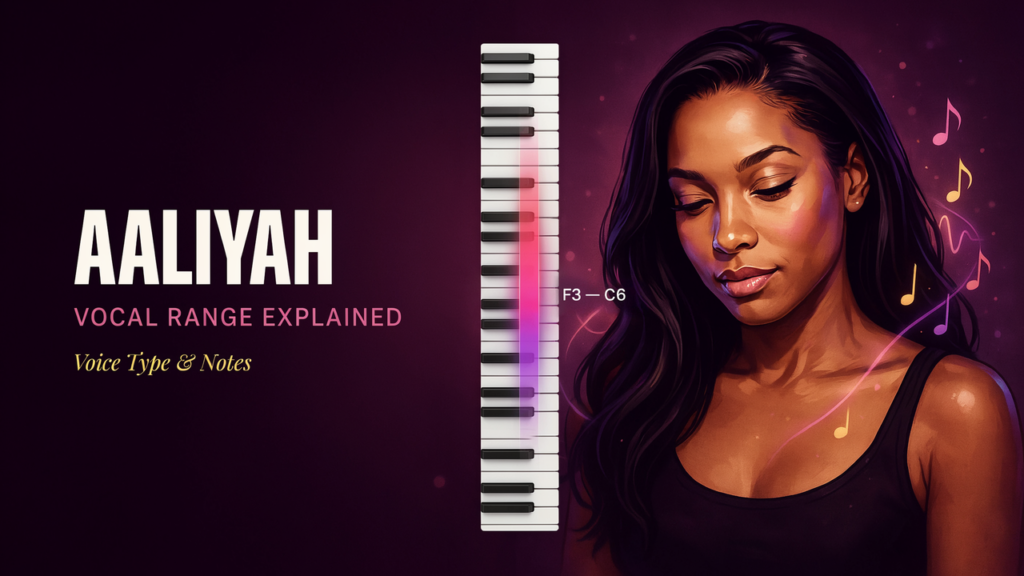
Aaliyah’s vocal range is estimated at F3 to E♭5 in her lead vocals, just under two octaves. That is the span Singing Carrots reports across her songs (F3 to D♯5, about 1.8 octaves). Wider figures, up to G2–E6, appear on fan-analysis sites but are not tied to a named song. Her voice type is often described as soprano (Wikipedia lists a soprano range), while her low-set, breathy style is why many listeners hear a mezzo-soprano or alto instead.
Every figure here is an estimate from analysis of her recordings and sheet music, not a measured or official range; Aaliyah died in 2001, and no clinical measurement was ever published. The sources are listed at the end. Want to see where your own voice sits? Test your own vocal range in the browser, then compare your notes with the table below.
- Test Your Range
Sing your lowest and highest notes and see how many octaves you have.
- Find Your Voice Type
Soprano, mezzo-soprano or alto? Get a result from a few sung notes.
- Check Your Tone
Record a few seconds and see descriptive readouts of your own tone.
What Was Aaliyah’s Vocal Range?
Published estimates disagree, so here they are side by side:
| Detail | Value |
|---|---|
| Voice type | Often described as soprano (Wikipedia); many listeners hear a low-set mezzo-soprano or alto |
| Estimated range in lead vocals | About F3–E♭5 (just under 2 octaves) |
| Singing Carrots database | F3–D♯5, about 1.8 octaves |
| Wider fan-analysis estimate | G2–E6 (about 3¾ octaves), described by its own source as an “extended” figure, not a clean singing range |
| Lowest note listed for a song | F3 in Miss You, Are You That Somebody?, Rock the Boat and I Care 4 U |
| Highest note listed for a song | E♭5 in Journey to the Past (D5 or lower in the other songs listed) |
| Known for | Breathy, airy tone, soft delivery, falsetto, close-mic production |
| Born / died | Aaliyah Dana Haughton, 16 January 1979, Brooklyn, New York; died 25 August 2001 |
| Albums | Age Ain’t Nothing but a Number (1994), One in a Million (1996), Aaliyah (2001) |
Why do the numbers differ? Range databases estimate from the melodies of her songs, while wider figures usually add ad-libs, backing vocals and notes heard once. A single low hum or a light head-voice peak can move a total by several notes. The lead-vocal figures agree closely (F3 to about D5 or E♭5), so this page uses them as the main estimate and treats G2–E6 as unverified.
Aaliyah’s Functional (Comfortable) Singing Range
Most of the songs in the table further down keep to roughly F3–D5, and several top out at B♭4 or C5. That is her functional range: where a singer spends most of a song. It matters more than a single extreme note because it shows what the voice does easily and repeatedly. Her songs sit in a warm low-middle voice, with a few lifts higher rather than sustained high belting.
Aaliyah’s Voice Type: Alto, Mezzo-Soprano or Soprano?
There is no official classification, and sources differ. Wikipedia describes her as having a soprano vocal range; the site Vocal Range Calculator calls her a light contemporary soprano, with light mezzo-soprano as the alternative. Other listeners hear an alto because her voice sits low.
Range alone does not settle it. Compared with commonly cited conventions (soprano voices about C4–C6, mezzo-sopranos about A3–A5, altos about F3–F5), her lead-vocal span of F3–E♭5 fits inside the alto range and is lower than the usual soprano range. Voice type also depends on timbre and where the voice is comfortable, and pop singers rarely fit classical labels neatly. See how altos and mezzo-sopranos differ if the two terms are new to you.
Was Aaliyah a soprano?
She is often listed as one, including on Wikipedia. But the songs with published ranges rarely go above D5, which is low for a soprano. “Light soprano in a low-set pop style” is the fairest short summary.
Was Aaliyah an alto or a mezzo-soprano?
Her range and warm lower voice fit both. Neither label is confirmed by a source that measured her voice, so treat “alto” and “mezzo-soprano” as listener descriptions, not facts.
Why Aaliyah’s Voice Sounded Different
Aaliyah described her signature style as “breathy, tone-y, airy”, singing softly and using her falsetto, according to Wikipedia. Critics picked up on the same restraint: Rolling Stone wrote that the most remarkable thing about her voice was its “almost preternatural poise”, and Mixmag noted that she did not try to “toss the caber with vocal athleticism. There’s no shouting, screeching, wailing.” Both quotes are as printed on her Wikipedia page.
Production played a part too. Her later albums were made with Timbaland and Missy Elliott, whose sparse, rhythmic tracks left room for a close, intimate vocal. To hear the difference between a full-strength note and a light one, read the difference between chest voice and head voice; a soft, airy sound like hers relies on the lighter side of that divide.
Functional Range vs Extreme Notes
Many range charts online focus on the “highest note sung”, which can be misleading. An extreme note may appear once, in an ad-lib or a layered part, and says little about daily comfort. Aaliyah’s recordings are a good example: her artistry lived inside a modest, controlled range rather than at its edges.
Songs That Show Aaliyah’s Range
Ranges below are Singing Carrots’ estimates for each song’s lead vocal (C4 is middle C). The database says they are estimated from what is known about the songs, and editions can differ by a note.
| Song | Estimated range | What it shows |
|---|---|---|
| Miss You | F3–B♭4 | The lowest-pitched song in the database, with a steady, low-middle melody |
| Are You That Somebody? (1998) | F3–B♭4 | A rhythmic lead that stays low and close to speech |
| Rock the Boat | F3–C5 | Low verses with a light lift to C5 |
| I Care 4 U | F3–C5 | A smooth mid-tempo melody that rarely leaves her comfortable zone |
| More Than a Woman | G3–D5 | The most sustained work near D5 in this list |
| The One I Gave My Heart To | G3–D5 | A ballad with a gentle climb |
| Try Again (2000) | G♯3–G♯4 | A narrow range of about one octave, all in the middle voice |
| Journey to the Past (1997) | B♭3–E♭5 | The highest peak in the database |
Notice that the melodies span from F3 to E♭5 but rarely climb past D5. If you want repertoire in a similar zone, browse songs that suit low female voices.
Was Aaliyah a “Small-Range” Singer?
Not in a way that matters. A range of about 1.8 octaves is close to what an untrained adult covers (roughly two octaves, see the an untrained singer’s range), yet her impact came from tone, phrasing and rhythm rather than range. Even if the wider G2–E6 estimate were accepted, that would be about 3¾ octaves, and it would still not explain why her records sound the way they do.
For other R&B voices on this site, compare Alicia Keys’s range, Brandy’s and Rihanna’s, or check a wider list of famous singers. Typical range by voice type is set out in typical female voice ranges.
How to Compare Your Voice With Aaliyah’s
- Find your lowest and highest notes with the range test on our homepage.
- Check whether F3 to D5 feels comfortable. If it does, most of her songs in the table should fit in the original key.
- Not sure which note you are singing? Hum the phrase into the find the notes you sing and compare it with the ranges above.
- Sing a phrase softly, the way she did, and see how steady and in tune it is by getting a score for your take.
- To find out whether your natural voice leans soprano, mezzo-soprano or alto, try the voice type test.
Frequently Asked Questions
What is Aaliyah’s vocal range? There is no measured figure. The lead-vocal estimate is about F3 to E♭5, just under two octaves; wider claims up to G2–E6 are unverified.
What voice type was Aaliyah? Often described as a soprano, though many listeners hear a low mezzo-soprano or alto because her voice sat low and warm. No source measured her voice.
Was Aaliyah a soprano? Wikipedia lists a soprano range, but her published song ranges mostly stay below D5. “Light soprano, low-set style” is the most cautious description.
Was Aaliyah an alto? Her lead-vocal range fits the commonly cited alto span (F3–F5). It is a fair description of where she sang, but it is a listener label, not a confirmed classification.
How many octaves could Aaliyah sing? About 1.8 octaves in her documented lead vocals. A fan-analysis figure of G2–E6 would be about 3¾ octaves but is not tied to a song.
What was Aaliyah’s highest note? E♭5 in Journey to the Past, per Singing Carrots. Some sites cite E6, which they describe as an extended, unverified endpoint.
What was Aaliyah’s lowest note? F3 in several songs, including Miss You and I Care 4 U. Some sites cite G2 as a widely reported but less defensible low.
Did Aaliyah use falsetto? Yes. She said her style was singing softly and using her falsetto, according to Wikipedia.
Sources for These Figures
Figures on this page were checked on 30 September 2026 against:
- Wikipedia, “Aaliyah”: birth and death dates, albums, producers, soprano range, her “breathy, tone-y, airy” description and the Rolling Stone and Mixmag quotes.
- Singing Carrots, Aaliyah artist range: F3–D♯5 overall and the estimated range of eight songs.
- Vocal Range Calculator, Aaliyah: the wider G2–E6 estimate and its caveat, and the light soprano / light mezzo-soprano description.
Range databases and analysis blogs give slightly different numbers. Where they disagree, this page shows the spread of estimates instead of a single exact figure.

Cooke is a vocal training and singing education writer specializing in vocal range analysis, pitch recognition, voice development, and singing tools for vocalists, performers, musicians, and beginners. He creates practical content focused on vocal improvement, singing techniques, and voice analysis resources.