
A choir is usually split into four sections, from highest to lowest: soprano, alto, tenor and bass, known together as SATB. Each section sings its own line of the harmony, and singers are placed by where their voice sits most comfortably. The commonly cited ranges are soprano C4–C6, alto F3–F5, tenor C3–C5 and bass E2–E4, although most choir music stays well inside them.
Choir and choral mean the same thing here: choral vocal ranges, choir voice parts, choir sections and choir “voice levels” all describe these four parts. Larger choirs split each section again (soprano 1 and 2, and so on), and some use baritones or countertenors.
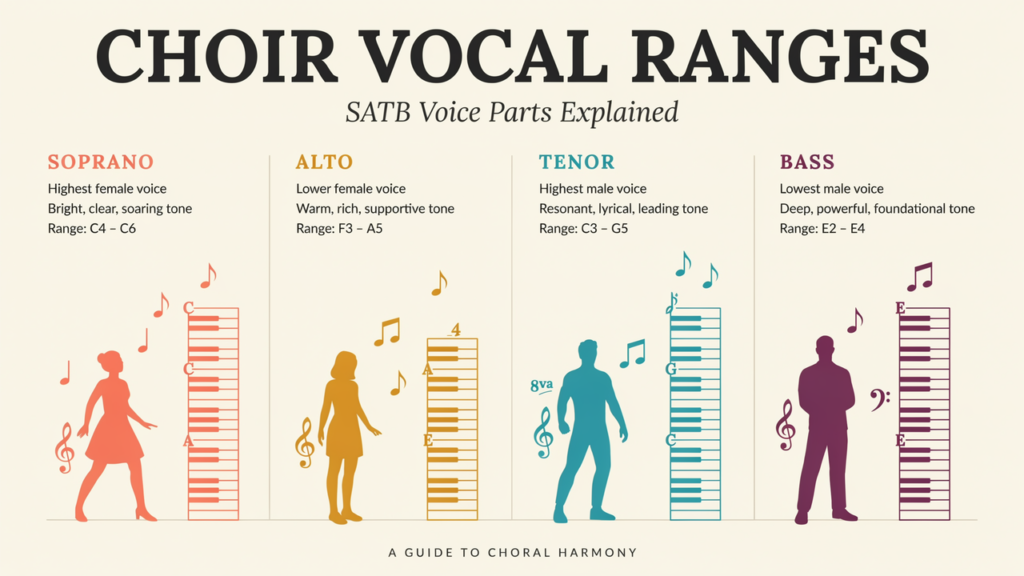
The SATB Choir Voice Parts — Complete Chart
| Voice part | Full range (commonly cited) | Where most choir parts sit | Full range in Hz | Role in the choir |
|---|---|---|---|---|
| Soprano | C4 – C6 | C4 – G5 (A5 in harder music) | 262 – 1,047 Hz | Top line, usually the melody |
| Alto | F3 – F5 | G3 – C5 (D5 in harder music) | 175 – 698 Hz | Upper inner harmony |
| Tenor | C3 – C5 | C3 – G4 (A4 in harder music) | 131 – 523 Hz | Lower inner harmony, highest men’s line |
| Bass | E2 – E4 | F2 – C4 (E2 in harder music) | 82 – 330 Hz | Lowest line, the harmonic foundation |
How to read the chart: C4 is middle C, and the number after each letter shows the octave (see how note names like C4 work). The full range is what a trained singer of that voice type is expected to reach. The middle column is where arrangers keep most of the notes, because a section sounds best in its tessitura, the part of the range it can sing for a whole rehearsal without tiring. The Hz column is the pitch of the lowest and highest note at standard tuning (A4 = 440 Hz); you can measure your own voice in Hz to compare.
These ranges vary by choir and arranger. There is no single agreed standard for SATB ranges: harmony textbooks, arrangers and voice-type references publish slightly different numbers, and a school choir and a professional chamber choir write to different limits. The full ranges above match this site’s voice-type guides.
Choir Voice Parts Highest to Lowest
From highest to lowest pitch, the four choir voices are soprano, alto, tenor and bass.
- Soprano is the highest voice in the choir.
- Alto is the choir voice directly below soprano, and the second-highest part in a four-part chorus.
- Tenor is the second-lowest part and the highest part normally sung by men.
- Bass is the lowest voice in the choir.
Neighbouring parts overlap a lot. Alto and tenor, for example, share the notes from F3 to C5 in the chart above, which is why a low alto and a high tenor can sometimes cover each other’s lines. From the bottom of the bass range (E2) to the top of the soprano range (C6) is almost four octaves, so a full SATB choir covers most of the range of the human singing voice.
Which Choir Part Am I?
Your choir part depends on where your voice sits comfortably for a whole rehearsal, not on the single highest or lowest note you can reach. Use these as starting points:
- Soprano: you sing easily from about middle C (C4) up to G5 or A5, and high notes feel clear rather than forced. Most sopranos are women, or children whose voices have not changed.
- Alto: your comfortable zone sits roughly between G3 and C5 or D5, your lower notes feel full, and long passages above E5 tire you.
- Tenor: you are usually a man whose comfortable top is around G4 to A4, with a bright upper range that can stretch toward C5.
- Bass: your voice feels at home low, roughly F2 to C4, and notes above D4 or E4 feel strained.
A quick way to check:
- Find your lowest and highest comfortable notes, then find your SATB part with a range test.
- Compare them with the “where most choir parts sit” column above rather than the full range.
- If you are between two parts, the voice type test answers “soprano or alto?” for choir and estimates your comfortable zone.
- Ask your director to hear you sing. Placement also depends on the music and the balance of the choir.
Soprano in Choir
Sopranos sing the highest line and carry the melody in most hymns, classical choruses and traditional arrangements, so this section sets the character of the piece. Soprano is the most common female voice type, and in many community choirs it is one of the larger sections.
Classical choral soprano parts can reach B5 or C6, but most community and school arrangements stay at or below G5 or A5. When the part splits, Soprano 1 takes the top notes and Soprano 2 sings a lower line that often suits mezzo-sopranos. For solo ranges and famous examples, see the soprano vocal range guide.
Alto in Choir
The alto section sings directly below the sopranos and fills in the inner harmony. Often called the “glue” of the choir, altos tend to hold repeated notes and move in small steps while the melody moves above them, so a steady ear and good sight-reading matter more than a big range.
Several voice types sing alto. Many choir altos are really mezzo-sopranos (see the mezzo-soprano range), true contraltos are rarer and usually sing Alto 2, and in some church and early-music choirs men called countertenors sing the alto line too. Read the alto vocal range guide, or see how alto differs from contralto.
Tenor in Choir
Tenors sing the higher of the two men’s lines, often weaving around the alto part. Many choirs find tenors the hardest section to fill, because baritone is the most common adult male voice and most baritones feel more at home in the bass section.
Tenor parts are usually written in treble clef with a small 8 below it, which means the notes sound an octave lower than written. In hymnals and older scores the tenors may share the bass staff instead. Most choral tenor parts sit between about C3 and G4 or A4. Tenor 1 takes the top notes, and in men’s choirs tenors sometimes use falsetto for the highest ones. More on the solo voice in the tenor vocal range guide.
Bass in Choir
The bass section provides the harmonic foundation. A strong, resonant bass line gives a choir power, depth and grounding in the lower frequencies, and the other parts tune to it.
Classical works can take basses down to E2, while many community arrangements rarely go below F2 or G2. When the section splits, Bass 1 is the higher line and is usually sung by baritones, and Bass 2 is the lower line for true basses. Some Russian church music goes further and uses very low basses, called oktavists, who double the bass line an octave below. See the bass vocal range guide for the solo voice type.
Choir Sections Explained — The Full Structure
A choir section is the group of singers who share one part. A mixed SATB choir has four sections, but other kinds of choir are organised differently:
| Choir format | Parts, high to low | Where you usually see it |
|---|---|---|
| SATB | Soprano, alto, tenor, bass | Mixed adult choirs, church and community choirs |
| SAB | Soprano, alto, baritone | Mixed choirs with few men, many school choirs |
| SSA / SSAA | Soprano 1, soprano 2, alto (or alto 1 and 2) | Women’s, girls’ and children’s choirs |
| TTBB | Tenor 1, tenor 2, bass 1, bass 2 | Men’s choirs |
| SSAATTBB | Every SATB section split in two | Larger choirs and eight-part music |
| SATB/SATB | Two separate four-part choirs | Double-choir works |
Sections usually stand together so singers can hear their own part. A common layout puts sopranos and altos in front or on one side and tenors and basses behind or on the other, but every conductor chooses a layout for the room and the music, and some mix singers in quartets.
Extended Choir Voice Parts
When a score marks a part divisi (div.), that section splits into two lines for a passage. Music written in eight parts from the start is labelled SSAATTBB. The table shows how the sub-parts usually line up with voice types, using the ranges on this site’s voice-type guides. Exact notes depend on the arrangement.
| Sub-part | Who usually sings it | Voice-type range it draws on |
|---|---|---|
| Soprano 1 | Higher, lighter sopranos | Upper half of soprano, C4 – C6 |
| Soprano 2 | Lower sopranos, mezzo-sopranos | Mezzo-soprano, A3 – A5 |
| Alto 1 | Mezzo-sopranos, higher altos | Upper half of alto, F3 – F5 |
| Alto 2 | Lower altos, contraltos, some countertenors | Lower half of alto, F3 – F5 |
| Tenor 1 | Higher tenors | Upper half of tenor, C3 – C5 |
| Tenor 2 | Lower tenors, high baritones | Lower half of tenor, C3 – C5 |
| Bass 1 | Baritones | Baritone, A2 – A4 |
| Bass 2 | True basses | Bass, E2 – E4 |
Countertenor: a man who sings in the alto range, mostly in head voice or falsetto. The range usually given is about E3 to D5 or E5. Countertenors are most common in cathedral choirs and early-music groups, where they sing the alto line.
Baritone and mezzo-soprano: choirs rarely give these in-between voices their own section. Baritones sing Bass 1, or Tenor 2 if their top notes are strong (SAB music is the exception, with “baritone” as the single men’s line). Mezzos sing Soprano 2 or Alto 1. Compare the solo baritone range of A2 to A4 with tenor and bass.
Explore Each Choir Voice Type in Detail
- Vocal range chart for all six voice types: soprano to bass on one chart
- Female voice types chart: soprano, mezzo-soprano and contralto side by side
- Male voice types chart: tenor, baritone and bass side by side
Learning and Holding Your Choir Part
- Know your notes: use the note finder to work out the notes of a line you are learning.
- Check what you sing: a live note detector shows which note you are actually singing, handy when your part sits under the melody.
- Stay in tune: practise singing in tune for your choir part, since inner parts drift more easily than the melody.
- Warm up first: a short warm-up routine before rehearsal makes the edges of your range easier.
Frequently Asked Questions
What does SATB stand for in choir? SATB stands for soprano, alto, tenor, bass, the four standard voice parts in mixed-voice choral music.
What are the choir voice parts from highest to lowest? Soprano, alto, tenor, bass. In a choir that splits every section: Soprano 1, Soprano 2, Alto 1, Alto 2, Tenor 1, Tenor 2, Bass 1 (baritone), Bass 2.
What is the choir voice below soprano? Alto. In an SATB choir the altos sing directly below the sopranos. If the sopranos split, Soprano 2 sits between Soprano 1 and the altos.
What is the lowest voice in a choir? Bass, reaching down to about E2 in classical music. When the basses split, Bass 2 sings the lowest line.
How do I know which choir part I am? Find your comfortable range and compare it with the “where most choir parts sit” column of the chart above.
Can a baritone sing in a choir? Yes. Most choirs place baritones in the bass section as Bass 1, or in Tenor 2 if their top notes are strong. SAB arrangements have a dedicated baritone line.
Can men sing alto in a choir? Yes. Countertenors sing the alto part using head voice or falsetto, especially in cathedral choirs and early music.
What is the difference between alto and soprano in choir? Soprano sings the highest female line (C4–C6), usually the melody. Alto sings the lower female harmony (F3–F5) that supports it. See: Alto vs. Soprano.

Cooke is a vocal training and singing education writer specializing in vocal range analysis, pitch recognition, voice development, and singing tools for vocalists, performers, musicians, and beginners. He creates practical content focused on vocal improvement, singing techniques, and voice analysis resources.