
Billie Eilish’s vocal range spans approximately F2 to G5 — about three octaves. Her voice type is a mezzo-soprano, but what defines her sound isn’t range width — it’s her distinctive breathy, intimate delivery and remarkable control at very low volumes. Eilish has built one of the most recognisable vocal styles in modern pop around restraint rather than power.
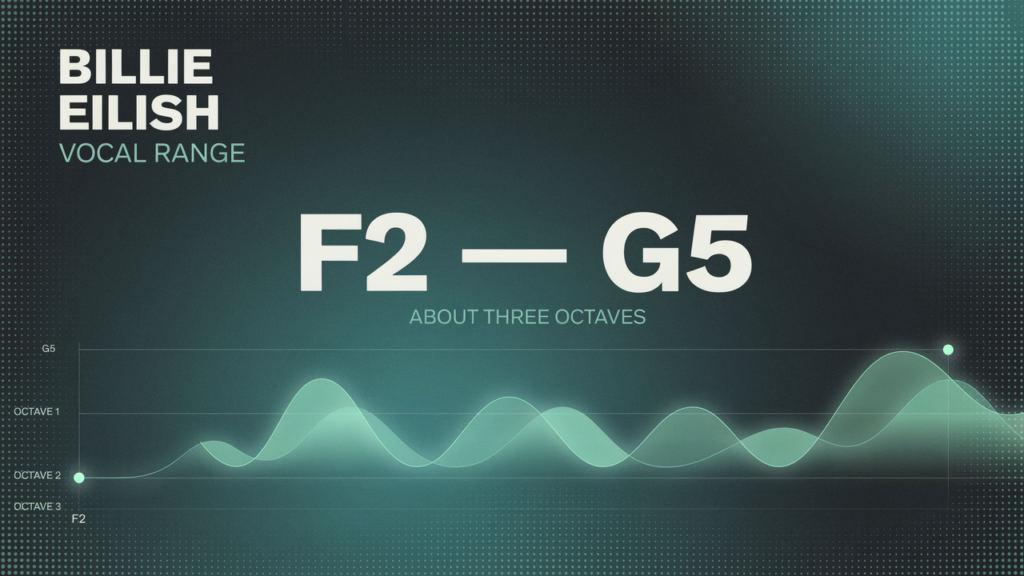
Billie Eilish Vocal Range at a Glance
| Detail | Value |
|---|---|
| Full Range | F2–G5 |
| Span | ~3 octaves |
| Voice Type | Mezzo-Soprano |
| Lowest Note | F2 |
| Highest Note | G5 |
| Tessitura | A3–D5 |
| Known For | Breathy intimacy, dynamic control, ASMR-like delivery |
What Voice Type Is Billie Eilish?
Billie Eilish is a mezzo-soprano — the middle female voice type. While her range covers about three octaves, she rarely uses its extremes. Instead, her artistry centres on the middle of her range, where she delivers vocals with an intimate, breathy quality that has become her signature.
Her surprisingly low chest voice — she can descend to notes more common in male voices — gives her music an atmospheric depth. For more on how female voices are classified, see the female vocal range chart and mezzo-soprano vocal range guide.
What Makes Billie Eilish’s Voice Distinctive
Breathy intimacy. Eilish’s defining quality is her soft, close-mic’d delivery that creates an intimate, almost whispered atmosphere. This restraint is a deliberate artistic choice, not a limitation.
Dynamic control at low volume. Where many singers showcase power, Eilish demonstrates control at the quiet end of the dynamic range — maintaining pitch and tone precision while singing barely above a whisper.
Atmospheric low register. Her ability to descend into a deep, resonant low register adds a moody, atmospheric quality that suits her production style.
Songs That Showcase Billie Eilish’s Range
“when the party’s over” (2019) — A showcase of her intimate, controlled delivery building to a more open upper register.
“ocean eyes” (2016) — Her breakthrough, highlighting the breathy clarity of her voice.
“bad guy” (2019) — Demonstrates her rhythmic delivery and the atmospheric low register in her verses.
“Happier Than Ever” (2021) — Builds from a soft, intimate opening to a powerful, rock-influenced climax, showing her dynamic range.
“everything i wanted” (2019) — Highlights her control and emotional restraint across a wide dynamic span.
How Billie Eilish’s Range Compares to the Average Singer
The average singer has a range of about 1.5–2 octaves. Eilish’s three-octave range is above average, but her artistry deliberately focuses on the expressive middle of her range rather than its extremes. Her example shows that vocal artistry is about control and choice, not just range width.
Compare her range to other modern vocalists with the singer comparison tool, or explore the full list of famous singer vocal ranges.
Frequently Asked Questions
What is Billie Eilish’s exact vocal range? Her range spans approximately F2 to G5 — about three octaves. Her tessitura sits between A3 and D5, where most of her songs are written.
What voice type is Billie Eilish? Billie Eilish is a mezzo-soprano. Her distinctive sound comes from her breathy, intimate delivery rather than her range width.
How many octaves can Billie Eilish sing? Eilish has a usable range of approximately three octaves, above the average singer, though she focuses on the expressive middle of her range.
Why does Billie Eilish sound so different? Her signature sound comes from her deliberately soft, breathy delivery and close-mic’d recording style, creating an intimate, ASMR-like atmosphere distinct from power-driven pop vocals.
Can Billie Eilish sing low notes? Yes — Eilish has a surprisingly deep low register, able to descend to notes more common in male voices, which adds atmospheric depth to her music.

Cooke is a vocal training and singing education writer specializing in vocal range analysis, pitch recognition, voice development, and singing tools for vocalists, performers, musicians, and beginners. He creates practical content focused on vocal improvement, singing techniques, and voice analysis resources.