
Andrea Bocelli’s vocal range spans approximately F2 to C5 — about two and a half octaves. His voice type is a lyric tenor, with a warm, resonant tone that bridges classical opera and popular crossover music. One of the best-selling classical artists of all time, Bocelli combines operatic technique with broad emotional accessibility.
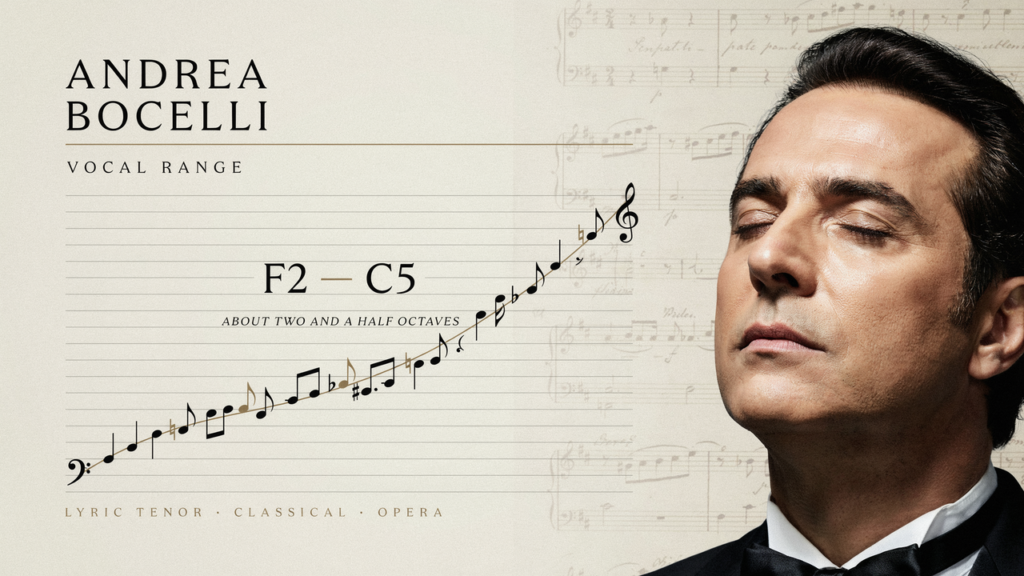
Andrea Bocelli Vocal Range at a Glance
| Detail | Value |
|---|---|
| Full Range | F2–C5 |
| Span | ~2.5 octaves |
| Voice Type | Lyric Tenor |
| Lowest Note | F2 |
| Highest Note | C5 |
| Tessitura | C3–G4 |
| Known For | Warm resonant tone, operatic technique, emotional warmth |
What Voice Type Is Andrea Bocelli?
Andrea Bocelli is a lyric tenor — a high male voice with a warm, lyrical quality suited to melodic, expressive material. His tone has a rich resonance and a smooth, controlled production that reflects his classical training.
Bocelli works across both operatic repertoire and popular crossover material, bringing operatic technique to accessible, emotionally direct songs. For more on the tenor classification, see the tenor vocal range guide and the vocal fach system explained.
What Makes Andrea Bocelli’s Voice Distinctive
Warm, resonant tone. Bocelli’s voice has a rich, warm resonance that carries both power and intimacy, equally suited to grand arias and tender ballads.
Operatic technique. His classical training gives his voice controlled production, smooth phrasing, and the breath support needed for sustained, demanding passages.
Emotional accessibility. Bocelli bridges classical and popular music, delivering operatic technique with an emotional directness that reaches broad audiences.
Songs That Showcase Andrea Bocelli’s Range
“Con te partirò / Time to Say Goodbye” (1995) — His signature, showcasing his warm tone, control, and emotional power.
“Nessun dorma” (Puccini) — His interpretation of the famous aria, demonstrating his operatic technique and upper-register power.
“The Prayer” (with Celine Dion, 1998) — A crossover duet highlighting his control and emotional warmth.
“Vivo per lei” — Demonstrates his lyrical phrasing and rich middle register.
“Caruso” — A showcase of his emotional delivery and dynamic control.
How Andrea Bocelli’s Range Compares to the Average Singer
The average male singer has a range of about 1.5–2 octaves. Bocelli’s two-and-a-half-octave range is above average and typical of a trained operatic tenor. His distinction comes from the quality, control, and emotional resonance of his tone rather than extreme range.
Compare his range to other tenors with the singer comparison tool, or explore the full list of famous singer vocal ranges.
Test Your Own Vocal Range
Curious how your range compares to Andrea Bocelli’s? Take the free singing range test to find your lowest and highest notes. To discover whether you share his tenor classification, use the voice type test. And to develop the breath control that operatic singing requires, see our guide on how to strengthen vocal cords.
Frequently Asked Questions
What is Andrea Bocelli’s exact vocal range? His range spans approximately F2 to C5 — about two and a half octaves. His tessitura sits between C3 and G4.
What voice type is Andrea Bocelli? Andrea Bocelli is a lyric tenor with a warm, resonant tone and classical operatic technique.
How many octaves can Andrea Bocelli sing? Bocelli has a usable range of approximately two and a half octaves, typical of a trained operatic tenor.
What makes Andrea Bocelli’s voice special? His warm, resonant tone, operatic technique, and emotional accessibility allow him to bridge classical opera and popular crossover music.
Is Andrea Bocelli an opera singer? Yes — Bocelli is a classically trained operatic tenor who also performs popular crossover material, making him one of the best-selling classical artists of all time.

Cooke is a vocal training and singing education writer specializing in vocal range analysis, pitch recognition, voice development, and singing tools for vocalists, performers, musicians, and beginners. He creates practical content focused on vocal improvement, singing techniques, and voice analysis resources.