
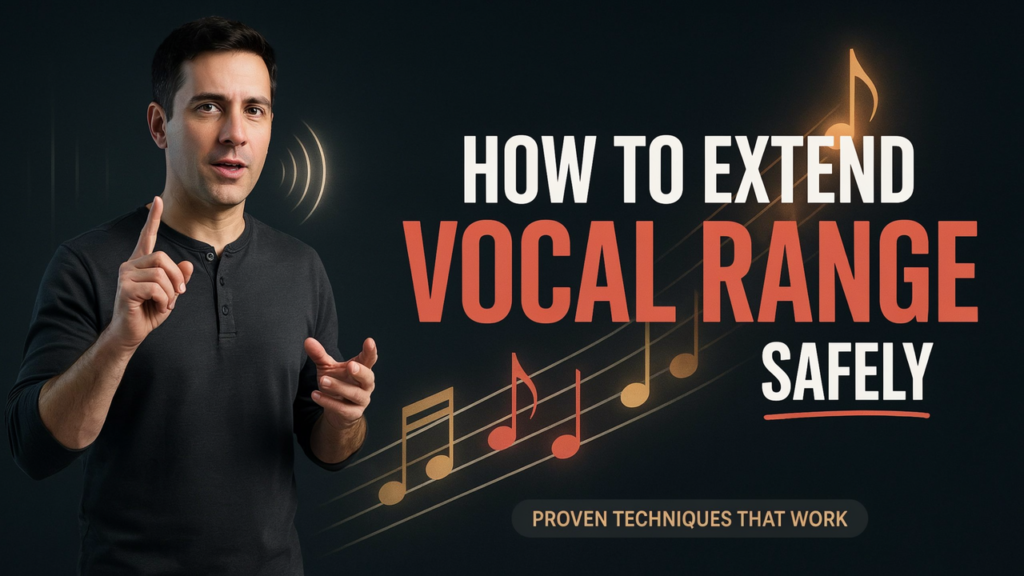
You can extend your vocal range, but only by improving coordination, flexibility, and register balance—not by forcing higher or lower notes. Sustainable range growth happens when you expand your usable tessitura (the notes you can sing comfortably and reliably), reduce excess tension, and train smooth transitions between vocal registers.
To extend your vocal range safely, warm up daily, support your breath, relax your throat, and practice gentle sirens, lip trills, and scale exercises. Gradually stretch higher and lower notes without forcing. Consistent, strain-free practice improves range, control, and vocal strength over time.
Many singers think extending range means hitting one impressive high note. That’s not the goal—and chasing it often causes strain.
Extending vocal range actually means:
- Making unstable notes reliable
- Singing higher or lower with ease
- Reducing strain near your current limits
- Expanding where your voice feels comfortable over time
If your voice feels tighter as you “gain” notes, you’re not extending your range—you’re compensating.
Discover your full range with our advanced voice analysis tool.
Why singers hit range limits
Most range ceilings are not physical. They’re coordination problems.
Common causes include:
- Excess tension in the neck, jaw, or tongue
- Forcing chest voice too high
- Avoiding head voice or falsetto
- Poor airflow balance (too much or too little)
- Abrupt register breaks (passaggio issues)
Fixing these issues unlocks notes that were already possible—but inaccessible.
How vocal range extension actually works
Your vocal folds can already vibrate at many pitches. Range extension happens when you:
- Improve efficiency (less effort per note)
- Balance airflow and resistance
- Smooth register transitions
- Reduce unnecessary muscular tension
This is why yelling, pushing, or “singing louder” almost never works long-term.
Key principle: Range is a coordination skill, not a strength test.
The most effective methods to extend vocal range
1. Semi-Occluded Vocal Tract (SOVT) exercises
These are among the most reliable tools for safe range extension.
Examples:
- Lip trills (brrr)
- Tongue trills
- Straw phonation (singing through a straw)
Why they work:
SOVT exercises balance air pressure above and below the vocal folds, allowing them to stretch and thin safely for higher notes—or relax for lower ones.
How to use them:
- Start in your mid-range
- Slide gently up and down
- Keep volume light
- Stop before strain appears
2. Sirens and slides (range bridges)
Sirens teach your voice to move across registers without “breaking.”
Examples:
- Lip-trill sirens
- “ng” (as in “sing”) slides
- “oo” or “ee” vowel slides
Benefits:
- Smooth chest–head coordination
- Reduced fear of high notes
- Expanded usable range without forcing
Sirens should feel continuous and easy, not dramatic.
3. Head voice development (non-negotiable for high range)
Many singers plateau because they avoid head voice or falsetto.
To extend your high range safely, you must develop:
- Head-dominant coordination
- Light onset
- Even airflow
Effective exercises:
- Soft “hoo” or “woo” patterns
- Five-note scales starting quietly
- Falsetto slides that blend back down
Head voice is not weakness—it’s the foundation of sustainable high notes.
4. Vowel modification strategies
As pitch rises, vowels must adjust slightly. If they don’t, strain appears.
Common adjustments:
- “Ah” subtly narrows toward “uh”
- “Eh” shades toward “ih”
- Avoid wide, spread vowels at the top
These changes reduce resistance and allow higher pitches with less effort.
5. Gentle techniques for extending low range
Low range grows through release, not pressure.
What helps:
- Descending slides on “oo” or “uh”
- Relaxed onset (no pushing volume downward)
- Focus on resonance and ease
Low notes often improve modestly—but reliably—with patience.
A simple daily routine to extend vocal range
You don’t need long sessions. Consistency matters more than duration.
10–15 minute structure:
- SOVT warm-up (3–5 min)
Lip trills or straw slides across mid-range - Sirens (3–4 min)
Gentle up-and-down slides - Head voice patterns (3–4 min)
Light exercises above your comfort zone - Application (2–3 min)
Short scales or song phrases using the same ease
Stop immediately if pain, burning, or hoarseness appears.
Exploring upper-register potential becomes clearer with a guide to how to do whistle tones
How long does it take to extend vocal range?
Set realistic expectations.
Typical progress:
- 1–2 weeks: Improved ease and coordination
- 3–6 weeks: More reliable notes near current limits
- 2–3 months: Noticeable expansion of usable range
Progress is non-linear. Plateaus are normal—and often precede breakthroughs.
Common mistakes that block range growth
Mistake 1: Forcing volume
Loud singing at the top locks the voice instead of freeing it.
Mistake 2: Forcing chest voice upward
This creates strain and stalls progress.
Mistake 3: Practicing extremes too long
Train near your edge—not at it.
Mistake 4: Ignoring fatigue
Range development requires recovery.
Mistake 5: Expecting instant results
Coordination changes take time.
The vibrato depth analyzer helps you understand pitch fluctuation.
Is it safe to extend vocal range?
Yes—when done correctly.
Stop and reassess if you notice:
- Pain or sharp discomfort
- Persistent hoarseness
- Tight throat sensation
- Loss of control or breathiness
Healthy range extension feels easier over time, not harder.
Can beginners extend vocal range?
Absolutely. Beginners often progress quickly because inefficient habits aren’t deeply ingrained yet.
Beginner priorities:
- Keep volume moderate
- Use SOVT exercises daily
- Focus on coordination, not power
- Avoid comparing yourself to advanced singers
At-home practice vs working with a coach
At-home practice is effective for:
- Building consistency
- Improving awareness
- Maintaining gains
A qualified coach helps by:
- Identifying hidden tension
- Customizing exercises
- Preventing bad habits
- Accelerating progress safely
Both approaches work best together.
What extending vocal range cannot do
Even excellent technique cannot:
- Change your fundamental voice type
- Add multiple octaves unnaturally
- Eliminate the need for rest and recovery
It can help you reach the full, healthy potential of your voice.
Final verdict
- You can extend vocal range safely
- Coordination matters more than strength
- SOVT, sirens, and head voice work are essential
- Progress is gradual but reliable
- Vocal health determines long-term success
If you want to sing higher or lower with confidence, stop trying to push your voice past its limits—and start training it to work more efficiently.
Related Articles:
- Building a healthy foundation starts with understanding how the vocal cords work.
- Strengthening flexibility becomes easier with proven best singing exercises.
- Avoiding vocal damage is simpler when you know whether whispering strains your voice.
- Improving breath support and tone benefits from proper singing posture.
- Expanding expressive control is easier when learning how to do vibrato in singing.
- Exploring upper-register potential becomes clearer with a guide to how to do whistle tones.

Cooke is a vocal training and singing education writer specializing in vocal range analysis, pitch recognition, voice development, and singing tools for vocalists, performers, musicians, and beginners. He creates practical content focused on vocal improvement, singing techniques, and voice analysis resources.