
Frank Sinatra’s vocal range spanned approximately G2 to G4 — about two octaves. His voice type was a baritone, and his legend rests not on range width but on phrasing, breath control, and emotional interpretation that set the standard for popular singing. The Chairman of the Board remains one of the most influential vocalists in recorded history.
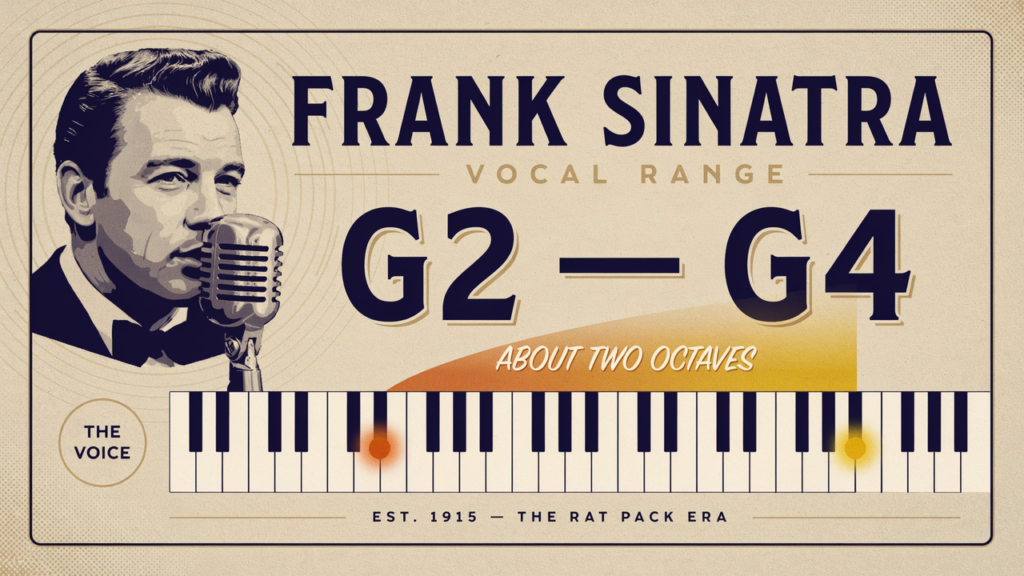
Frank Sinatra Vocal Range at a Glance
| Detail | Value |
|---|---|
| Full Range | G2–G4 |
| Span | ~2 octaves |
| Voice Type | Baritone |
| Lowest Note | G2 |
| Highest Note | G4 |
| Tessitura | B2–D4 |
| Known For | Phrasing, breath control, emotional interpretation, timing |
What Voice Type Was Frank Sinatra?
Frank Sinatra was a baritone — the most common male voice type, sitting between tenor and bass. His comfortable range was relatively modest by the standards of range-focused singers, but his mastery lay elsewhere: in his interpretation, phrasing, and the conversational intimacy of his delivery.
Sinatra’s voice darkened and gained richness as he aged, moving from the lighter crooner of his early career to the warmer, more authoritative baritone of his later recordings. For more on the baritone classification, see the baritone vocal range guide, and compare it with the tenor range in our tenor vs baritone breakdown.
What Makes Frank Sinatra’s Voice Distinctive
Phrasing. Sinatra’s phrasing is his most studied quality — his ability to shape a melodic line, place emphasis, and breathe in unexpected places gave his interpretations a conversational, deeply personal quality.
Breath control. His long, smooth phrases — sustained without audible breaths — were the product of remarkable breath control, allowing him to deliver lyrics with seamless flow.
Emotional interpretation. Sinatra treated each song as a story, calibrating his delivery to the lyrics’ meaning with subtlety and precision rather than vocal display.
Songs That Showcase Frank Sinatra’s Range
“My Way” (1969) — His signature, demonstrating his emotional interpretation and authoritative late-career baritone.
“Fly Me to the Moon” (1964) — Highlights his swinging phrasing and rhythmic confidence.
“I’ve Got You Under My Skin” (1956) — A showcase of his phrasing and dynamic build across a classic arrangement.
“The Way You Look Tonight” (1964) — Demonstrates his warm tone and intimate delivery.
“New York, New York” (1980) — A powerful, anthemic showcase of his late-career voice.
How Frank Sinatra’s Range Compares to the Average Singer
The average male singer has a range of about 1.5–2 octaves. Sinatra’s range was around two octaves — solidly average in width. His example is the definitive proof that vocal greatness is about interpretation, phrasing, and emotional connection far more than range.
Frequently Asked Questions
What was Frank Sinatra’s exact vocal range? His range spanned approximately G2 to G4 — about two octaves. His tessitura sat between B2 and D4.
What voice type was Frank Sinatra? Frank Sinatra was a baritone — the most common male voice type. His voice darkened and gained richness as he aged.
How many octaves could Frank Sinatra sing? Sinatra had a usable range of about two octaves, average in width but exceptional in interpretation and control.
What made Frank Sinatra a great singer? His phrasing, breath control, and emotional interpretation — not range width — made him one of the most influential and admired vocalists in recorded history.
Was Frank Sinatra a tenor or baritone? Frank Sinatra was a baritone. His warm, authoritative tone sat firmly in the baritone range.

Cooke is a vocal training and singing education writer specializing in vocal range analysis, pitch recognition, voice development, and singing tools for vocalists, performers, musicians, and beginners. He creates practical content focused on vocal improvement, singing techniques, and voice analysis resources.