
Celine Dion’s vocal range spans approximately B2 to C6 — over three octaves. Her voice type is a lyric soprano with exceptional power, control, and projection. One of the best-selling vocalists of all time, Dion is known for her ability to deliver massive, sustained belted notes with technical precision and emotional intensity.
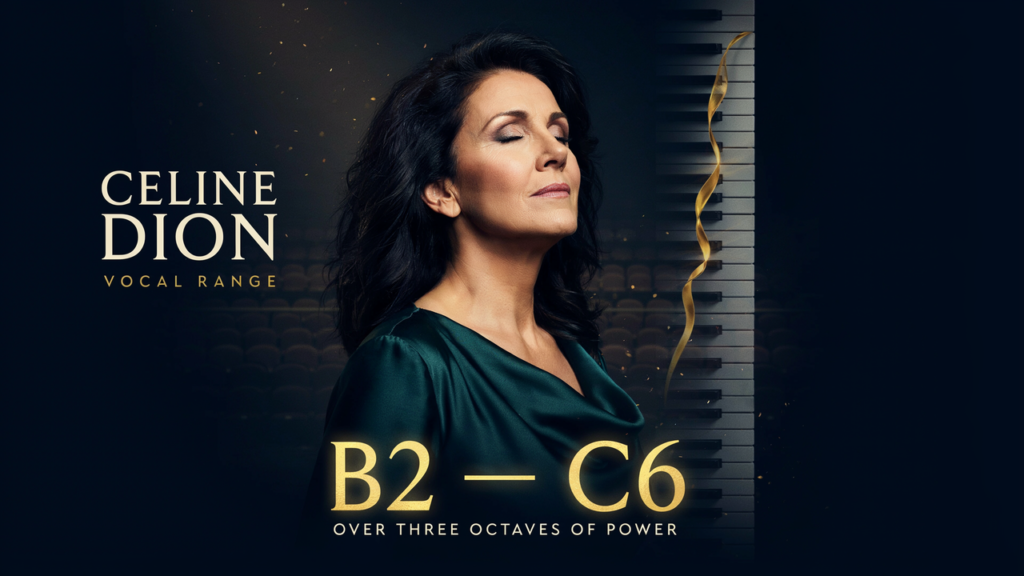
Celine Dion Vocal Range at a Glance
| Detail | Value |
|---|---|
| Full Range | B2–C6 |
| Span | ~3.2 octaves |
| Voice Type | Lyric Soprano |
| Lowest Note | B2 |
| Highest Note | C6 |
| Tessitura | G3–G5 |
| Known For | Powerful belting, breath control, sustained high notes |
What Voice Type Is Celine Dion?
Celine Dion is a lyric soprano — a high female voice known for a bright, powerful tone. What distinguishes her is her belting ability: she can carry chest-dominant power high into her range, producing the massive, sustained notes that define her biggest hits.
Her technical control is exceptional — her breath support allows her to sustain powerful notes far longer than most singers, and her pitch accuracy remains precise even at full intensity. For more on the soprano classification, see the soprano vocal range guide and the female vocal range chart.
What Makes Celine Dion’s Voice Distinctive
Powerful sustained belting. Dion’s signature is her ability to belt massive notes and sustain them with full power — the climactic moments in “My Heart Will Go On” and “All by Myself” are defining examples.
Exceptional breath control. Her breath support allows her to hold notes longer and build dynamics more gradually than most singers, a product of rigorous technical training.
Emotional intensity. Dion delivers her vocals with a dramatic, emotionally committed style that matches the scale of her power, making her ballads feel epic.
Songs That Showcase Celine Dion’s Range
“My Heart Will Go On” (1997) — Her signature song, building from a gentle verse to a soaring, belted climax.
“All by Myself” (1996) — Famous for its sustained, powerful high note that showcases her belt and breath control.
“The Power of Love” (1993) — Demonstrates her dynamic range and emotional delivery across a building arrangement.
“It’s All Coming Back to Me Now” (1996) — A dramatic showcase of her range, power, and stamina across an extended piece.
“Because You Loved Me” (1996) — Highlights her control and emotional warmth in the middle of her range.
How Celine Dion’s Range Compares to the Average Singer
The average singer has a range of about 1.5–2 octaves. Dion’s three-plus-octave range places her well into elite professional territory. But her true distinction is her belting power and the technical control that lets her sustain massive notes with precision.
Compare her range to other power vocalists with the singer comparison tool, or explore the full list of famous singer vocal ranges.
Test Your Own Vocal Range
Curious how your range compares to Celine Dion’s? Take the free vocal range test to find your lowest and highest notes. To discover whether you share her soprano classification, use the voice type test. And to build the breath support that powers her belting, see our guide on how to strengthen vocal cords.
Frequently Asked Questions
What is Celine Dion’s exact vocal range? Her range spans approximately B2 to C6 — over three octaves. Her tessitura sits between G3 and G5.
What voice type is Celine Dion? Celine Dion is a lyric soprano with exceptional belting power and breath control.
How many octaves can Celine Dion sing? Dion has a usable range of approximately 3.2 octaves, placing her in elite professional territory.
What is Celine Dion’s most famous high note? The sustained, powerful notes in “All by Myself” and “My Heart Will Go On” are among her most famous, showcasing her belt and breath control.
Who has a voice similar to Celine Dion? Whitney Houston and Mariah Carey are often compared to Dion for their power and range, though each has a distinct tone and technique.

Cooke is a vocal training and singing education writer specializing in vocal range analysis, pitch recognition, voice development, and singing tools for vocalists, performers, musicians, and beginners. He creates practical content focused on vocal improvement, singing techniques, and voice analysis resources.